Native Biome: High-altitude freshwater canal networks and remnant lake basins.
Axolotl
Ambystoma mexicanum
From Nahuatl āxōlōtl, linked to the god Xolotl; often glossed as “water monster.”
Linnaean Taxonomic Tree
~60–110 g adults
Female: Similar; females plump when gravidShort swimming bursts with tail
Burst Acceleration10–15 years possible
Captivity: 10–20 years with careCompare Look-Alikes
vs Red-Eyed Tree Frog
🐣Growth & Lifespan
Birth to old age slider
🔍 Distinctive Diagnostic Markings & Anatomy
Critical morphological field marks naturalists use to verify species identification in the wild.
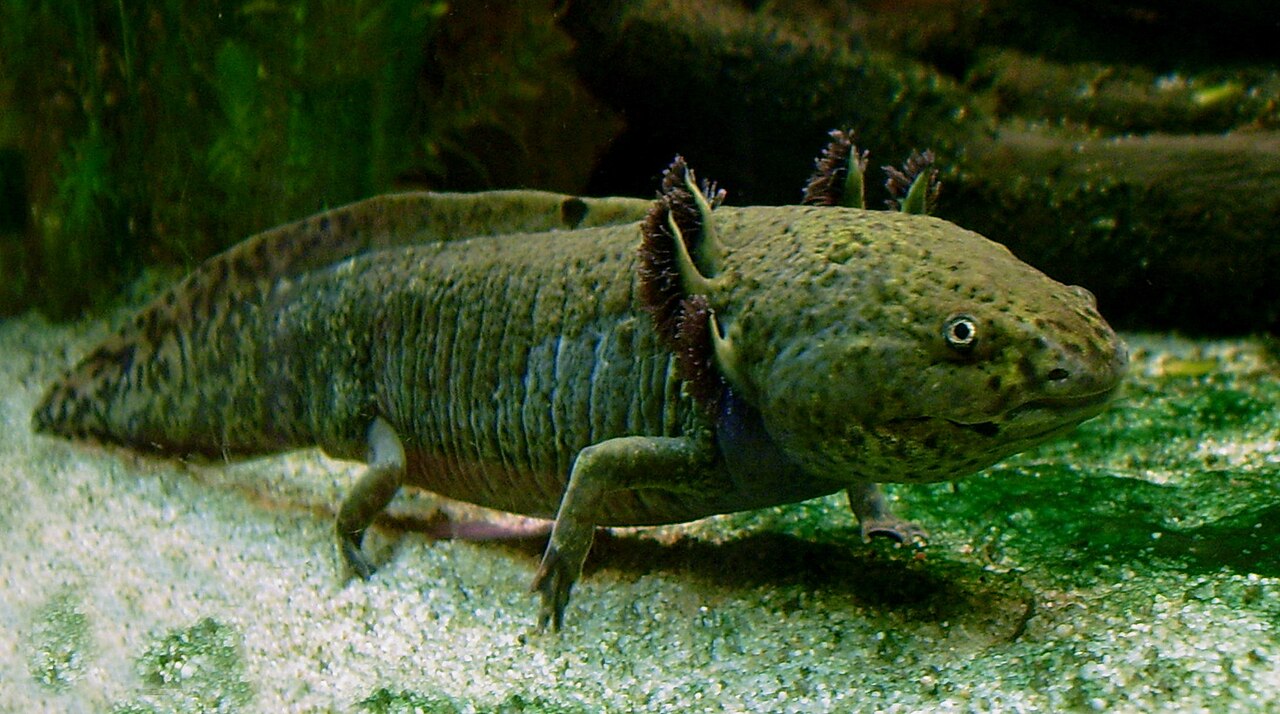
Neotenic — retains larval external gills; wild-type dark mottled; captive morphs include leucistic pink with red gills.
Broad head with lidless eyes; teeth small for suction feeding.
Lidless; poor lids mean sensitive to bright light.
Four limbs with digits; feathery external gills behind head.
Laterally compressed finned tail for swimming.
Males have longer, more swollen cloaca at breeding time.
🍖 Trophic Role & Hunting Strategy
MesopredatorAquatic suction feeder of worms, insects, small crustaceans and fish.
🏕️ Social Behavior & Activity Rhythms
CathemeralMostly solitary
No parental care after egg laying
Life Cycle, Growth & Lifespan Journey
| Age | Stage | Length/Height | Weight |
|---|---|---|---|
| Birth / Hatch / Day 0 | Young | 10–15 mm | 0.2–0.4 g |
| Early growth | Young | 10.6–16.2 mm | 7.4–14.8 g |
| Mid juvenile | Juvenile | 11.8–18.5 mm | 21.1–42.3 g |
| Late juvenile | Juvenile | 13–21 mm | 36.1–72.2 g |
| Near maturity | Adult | 14.3–23.5 mm | 51–102 g |
How Big Will a Axolotl Get?
Calculate estimated adult weight, shoulder height, remaining growth timeline, and weekly development rate based on current age and biometrics.
Conservation Status & Population Dynamics
Wild population extremely small/fragmented; common in captivity
Subject to ongoing wildlife telemetry monitoring
- •Habitat degradation
- •Water pollution
- •Invasive fish
- •Urbanization
- Xochimilco restoration
- Captive breeding
- Chinampa conservation
Field Intelligence & Diagnostic Hub for Axolotl
Laterally compressed finned tail for swimming.
Audio frequency analysis, territorial roar/call synthesis, and harmonic resonance measurements.
Ecosystem food web, trophic interactions, and cohabiting species in North America.
⚖️ Look-Alike Species Differentiation Matrix
Instant one-click comparison tools to prevent common field misidentifications
Axolotl vs. Red-Eyed Tree Frog
Key DifferentiationTree frogs are terrestrial/arboreal adults without external gills; axolotls are permanently aquatic neotenic salamanders.
How to Identify Axolotl from a Photograph
Standard operating procedures for photographers and field naturalists submitting sightings for verification.
- 📷Clear side profile
- 📷Head/face close-up
- 📷Full body in natural light
- 🔍External gills
- 🔍Neotenic aquatic body
- 🔍Wide head
- 🔍Finned tail
- ⚠️Confusing with larval tiger salamanders
- ⚠️Assuming wild pink leucistic morphs are common (captive trait)
Frequently Asked Questions About Axolotl
Verified answers compiled by zoologists, wildlife biologists, and field guides.
Related Identification Tools
Identify similar animals with focused photo tools for dogs, cats, birds, reptiles, fish, bugs, and more.