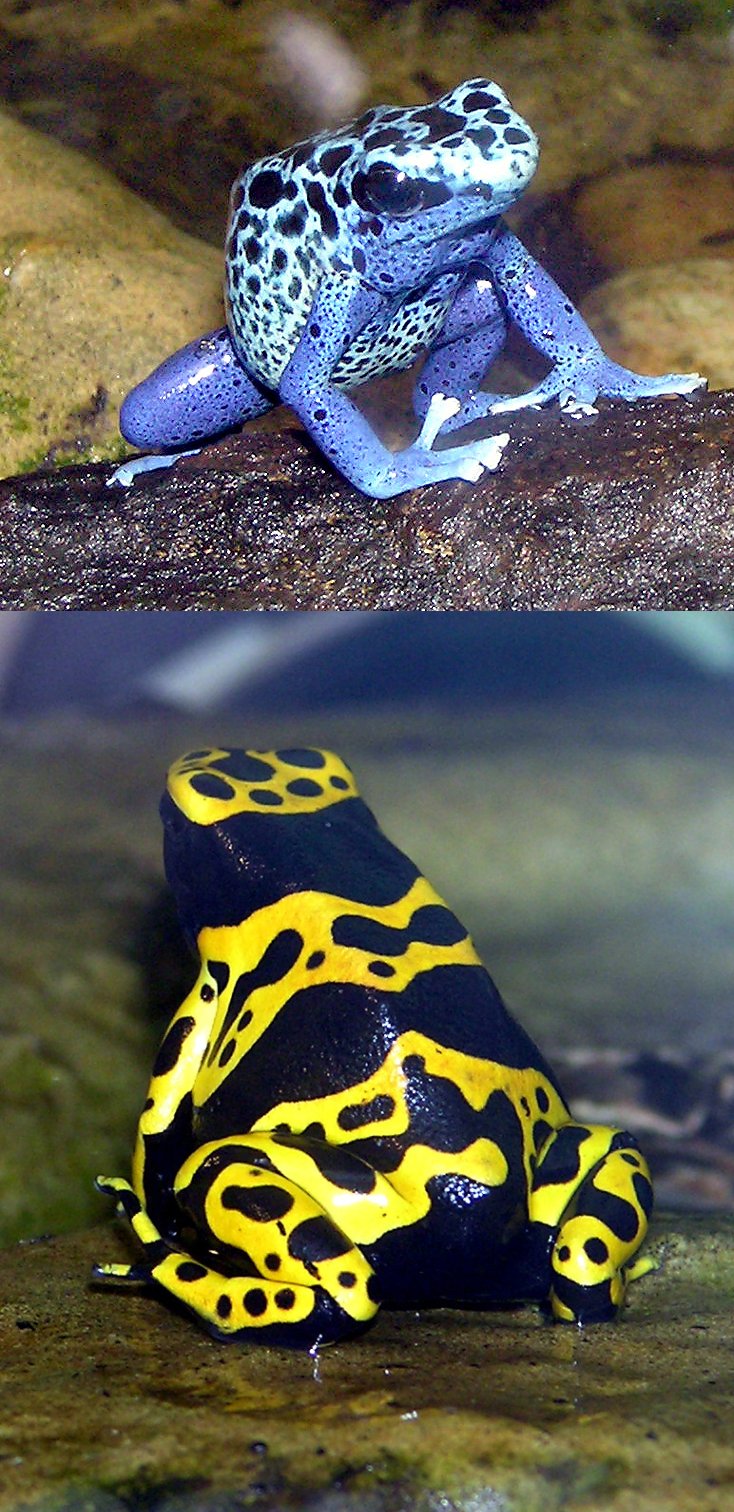
Native Biome: Lowland tropical rainforest floor with high humidity and leaf litter.
Golden Poison Frog
Phyllobates terribilis
Phyllobates means “leaf climber”; terribilis means terrible — reflecting extreme toxicity.
Linnaean Taxonomic Tree
~3–5 g
Female: Slightly larger oftenQuick hops on forest floor; not long-distance
Burst Acceleration~5–8 years estimated
Captivity: 10+ years (captives lose wild toxicity without alkaloid diet)Compare Look-Alikes
vs Red-Eyed Tree Frog
🐣Growth & Lifespan
Birth to old age slider
🔍 Distinctive Diagnostic Markings & Anatomy
Critical morphological field marks naturalists use to verify species identification in the wild.
Brilliant solid metallic yellow/orange (some morphs mint/orange); aposematic warning colors.
Small amphibian skull; no fangs — toxins are skin alkaloids from diet.
Dark eyes on bright face; diurnal vision.
Slender limbs with toe pads; terrestrial/leaf-litter movement.
No adult tail.
Subtle; females may be larger.
🍖 Trophic Role & Hunting Strategy
MesopredatorDiurnal active forager of small arthropods.
🏕️ Social Behavior & Activity Rhythms
DiurnalTerritorial males; complex parental care
Males often carry tadpoles to phytotelmata; both sexes can care depending on species
Life Cycle, Growth & Lifespan Journey
| Age | Stage | Length/Height | Weight |
|---|---|---|---|
| Birth / Hatch / Day 0 | Young | 3–5 mm | 0.1–0.2 g |
| Early growth | Young | 3.1–5 mm | 0.448–0.776 g |
| Mid juvenile | Juvenile | 3.4–5 mm | 1.1–1.9 g |
| Late juvenile | Juvenile | 3.6–5 mm | 1.8–3.1 g |
| Near maturity | Adult | 3.9–5 mm | 2.6–4.3 g |
How Big Will a Golden Poison Frog Get?
Calculate estimated adult weight, shoulder height, remaining growth timeline, and weekly development rate based on current age and biometrics.
Conservation Status & Population Dynamics
Restricted range; threatened by habitat loss
Subject to ongoing wildlife telemetry monitoring
- •Deforestation
- •Collection pressure historically
- •Chytrid risk
- Habitat protection in Chocó
- Captive assurance colonies
Field Intelligence & Diagnostic Hub for Golden Poison Frog
No adult tail.
Audio frequency analysis, territorial roar/call synthesis, and harmonic resonance measurements.
Ecosystem food web, trophic interactions, and cohabiting species in South America.
⚖️ Look-Alike Species Differentiation Matrix
Instant one-click comparison tools to prevent common field misidentifications
Golden Poison Frog vs. Red-Eyed Tree Frog
Key DifferentiationRed-eyed tree frogs are green canopy climbers with red eyes and are not highly toxic; golden poison frogs are tiny bright yellow terrestrial frogs.
How to Identify Golden Poison Frog from a Photograph
Standard operating procedures for photographers and field naturalists submitting sightings for verification.
- 📷Clear side profile
- 📷Head/face close-up
- 📷Full body in natural light
- 🔍Uniform brilliant yellow
- 🔍Small size
- 🔍No red eyes like tree frogs
- 🔍Terrestrial gait
- ⚠️Touching wild frogs
- ⚠️Confusing with non-toxic mimics/other dart frogs
Frequently Asked Questions About Golden Poison Frog
Verified answers compiled by zoologists, wildlife biologists, and field guides.
Related Identification Tools
Identify similar animals with focused photo tools for dogs, cats, birds, reptiles, fish, bugs, and more.