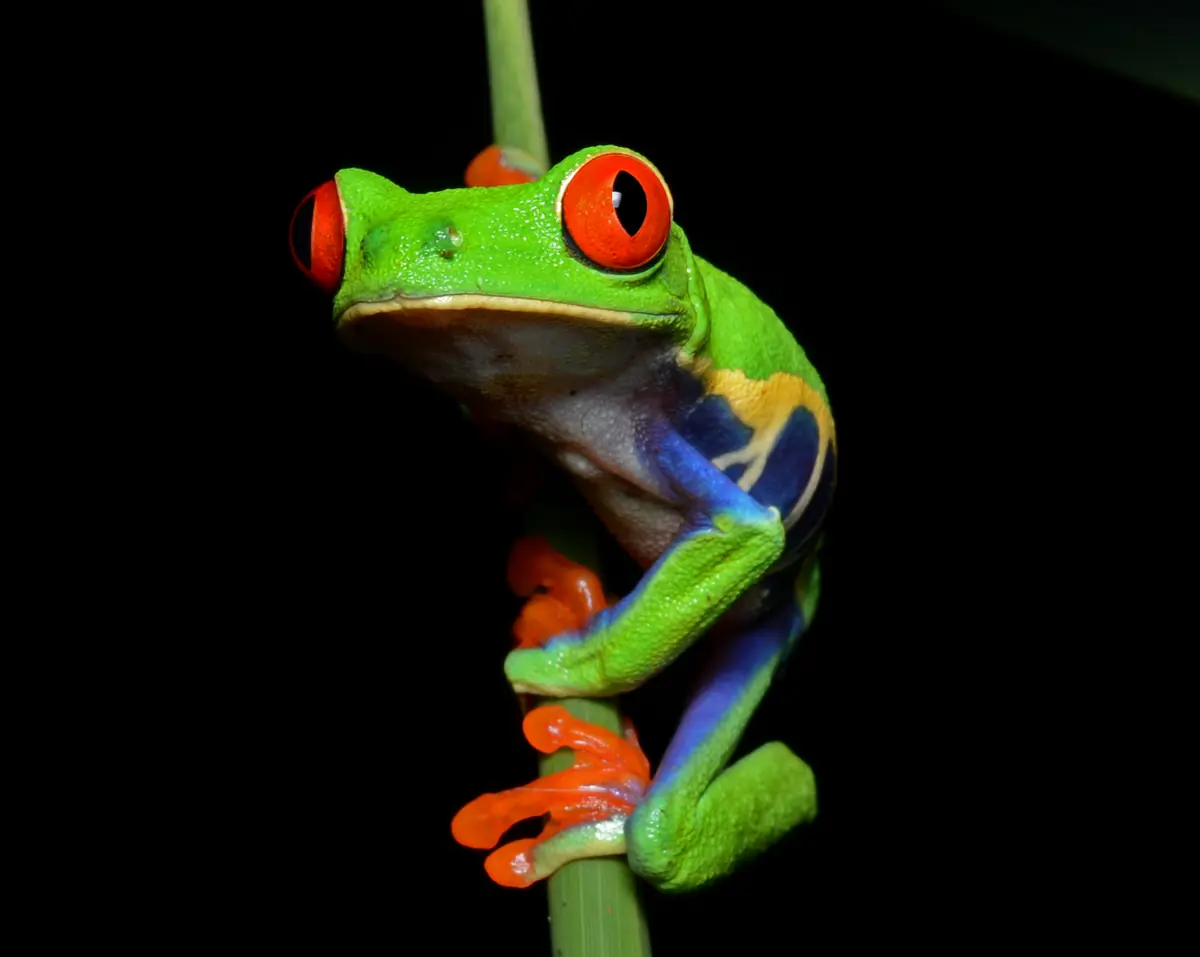
Native Biome: Tropical rainforest canopy and understory leaves near ponds.
Red-Eyed Tree Frog
Agalychnis callidryas
Genus Agalychnis refers to “beautiful night” tree frogs; callidryas means “beautiful oak nymph,” nodding to canopy leaf habitats.
Linnaean Taxonomic Tree
10–15 g
Female: 12–20 g (females often larger)Quick leap between leaves; not a ground sprinter
Burst Acceleration~5 years
Captivity: 5–10 years with careCompare Look-Alikes
vs Golden Poison Frog
🐣Growth & Lifespan
Birth to old age slider
🔍 Distinctive Diagnostic Markings & Anatomy
Critical morphological field marks naturalists use to verify species identification in the wild.
Neon lime-green dorsum; sky-blue and cream/yellow vertical flank bars; orange-red toe pads; white ventral surface.
Broad flat head with soft amphibian skull; no fangs — insectivorous mouth.
Huge crimson-red irises with vertical pupils — the signature field mark.
Long climbing limbs with expanded orange suction toe pads for leaf adhesion.
No adult tail; tadpoles have fins before metamorphosis.
Females typically larger-bodied than males.
🍖 Trophic Role & Hunting Strategy
MesopredatorNocturnal sit-and-wait insectivore; lunges from leaves to snatch moths and crickets.
🏕️ Social Behavior & Activity Rhythms
Strictly NocturnalMostly solitary adults; congregate at breeding ponds
No parental care after egg deposition; tadpoles drop into water
Life Cycle, Growth & Lifespan Journey
| Age | Stage | Length/Height | Weight |
|---|---|---|---|
| Oviposition | Arboreal Egg | 2–2.5 mm | 4–7 mg |
| 7 Days | Hatchling Tadpole | 7–9 mm | 10–18 mg |
| 6 Weeks | Late Stage Tadpole | 38–48 mm | 800–1200 mg |
| 8 Weeks | Emerging Froglet | 18–24 mm | 500–750 mg |
| 1 Year | Mature Breeding Adult | 50–75 mm | 6–15 g |
How Big Will a Red-Eyed Tree Frog Get?
Calculate estimated adult weight, shoulder height, remaining growth timeline, and weekly development rate based on current age and biometrics.
Conservation Status & Population Dynamics
Locally common in suitable rainforest
Subject to ongoing wildlife telemetry monitoring
- •Habitat loss
- •Pesticides
- •Climate drying of breeding sites
- Rainforest corridor protection
- Captive breeding education exhibits
Field Intelligence & Diagnostic Hub for Red-Eyed Tree Frog
No adult tail; tadpoles have fins before metamorphosis.
Audio frequency analysis, territorial roar/call synthesis, and harmonic resonance measurements.
Ecosystem food web, trophic interactions, and cohabiting species in Central America.
⚖️ Look-Alike Species Differentiation Matrix
Instant one-click comparison tools to prevent common field misidentifications
Red-Eyed Tree Frog vs. Golden Poison Frog
Key DifferentiationPoison dart frogs are tiny terrestrial/leaf-litter frogs with aposematic colors and no huge red eyes; red-eyed tree frogs are larger canopy climbers with orange toe pads.
How to Identify Red-Eyed Tree Frog from a Photograph
Standard operating procedures for photographers and field naturalists submitting sightings for verification.
- 📷Clear side profile
- 📷Head/face close-up
- 📷Full body in natural light
- 🔍Bright red eyes
- 🔍Neon green back
- 🔍Blue/yellow side bars
- 🔍Orange toe pads
- ⚠️Confusing with other green tree frogs lacking red eyes
- ⚠️Assuming any colorful frog is toxic
Frequently Asked Questions About Red-Eyed Tree Frog
Verified answers compiled by zoologists, wildlife biologists, and field guides.
Related Identification Tools
Identify similar animals with focused photo tools for dogs, cats, birds, reptiles, fish, bugs, and more.