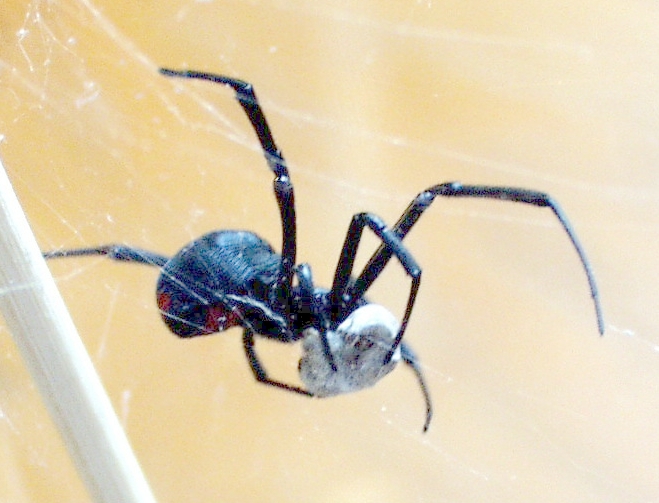
Native Biome: Dark, sheltered spaces, woodpiles, sheds, stone walls, and basements.
Southern Black Widow
Latrodectus mactans
Latrodectus means “biting in secret”; mactans means “murderous,” reflecting the potent neurotoxic venom reputation.
Linnaean Taxonomic Tree
Very light — males much smaller than females
Female: ~1 g typical adult femaleSlow deliberate walker; relies on web, not speed
Burst AccelerationFemales ~1–3 years; males shorter
Captivity: Similar with careful husbandryCompare Look-Alikes
vs Brown Recluse Spider
🐣Growth & Lifespan
Birth to old age slider
🔍 Distinctive Diagnostic Markings & Anatomy
Critical morphological field marks naturalists use to verify species identification in the wild.
Females: shiny black abdomen with red hourglass on the underside; sometimes red dorsal spots.
Chelicerae deliver neurotoxic venom; no mammal dentition.
Eight small eyes arranged for detecting vibration/motion more than sharp images.
Eight legs; spinnerets produce strong irregular tangle webs.
No tail; abdomen ends at spinnerets.
Extreme — females large, glossy black with red markings; males tiny, lighter, often striped.
🍖 Trophic Role & Hunting Strategy
MesopredatorSit-and-wait web predator; vibratory cues trigger wrap-and-bite of insects.
🏕️ Social Behavior & Activity Rhythms
Strictly NocturnalSolitary; females may cannibalize mates after pairing (not always)
Female guards egg sacs; spiderlings disperse
Life Cycle, Growth & Lifespan Journey
| Age | Stage | Length/Height | Weight |
|---|---|---|---|
| Birth / Hatch / Day 0 | Young | 1–2 mm | 0.01–0.02 g |
| Early growth | Young | 2.1–3.6 mm | 0.069–0.138 g |
| Mid juvenile | Juvenile | 4.2–6.6 mm | 0.182–0.363 g |
| Late juvenile | Juvenile | 6.4–9.8 mm | 0.304–0.608 g |
| Near maturity | Adult | 8.6–13.1 mm | 0.427–0.853 g |
How Big Will a Southern Black Widow Get?
Calculate estimated adult weight, shoulder height, remaining growth timeline, and weekly development rate based on current age and biometrics.
Conservation Status & Population Dynamics
Widespread in suitable habitat
Subject to ongoing wildlife telemetry monitoring
- •Habitat disturbance
- •Pesticide use
- •Persecution
- Habitat protection
- Public education
Field Intelligence & Diagnostic Hub for Southern Black Widow
No tail; abdomen ends at spinnerets.
Audio frequency analysis, territorial roar/call synthesis, and harmonic resonance measurements.
Ecosystem food web, trophic interactions, and cohabiting species in North America.
⚖️ Look-Alike Species Differentiation Matrix
Instant one-click comparison tools to prevent common field misidentifications
Southern Black Widow vs. Brown Recluse Spider
Key DifferentiationBrown recluses are tan/brown with a violin mark and lack a red hourglass; widows are glossy black with red markings.
How to Identify Southern Black Widow from a Photograph
Standard operating procedures for photographers and field naturalists submitting sightings for verification.
- 📷Clear side profile
- 📷Head/face close-up
- 📷Full body in natural light
- 🔍Glossy black female
- 🔍Red ventral hourglass
- 🔍Irregular tangle web in dark corners
- ⚠️Assuming every black spider is a widow
- ⚠️Mis-ID of harmless false widows
Frequently Asked Questions About Southern Black Widow
Verified answers compiled by zoologists, wildlife biologists, and field guides.
Related Identification Tools
Identify similar animals with focused photo tools for dogs, cats, birds, reptiles, fish, bugs, and more.



