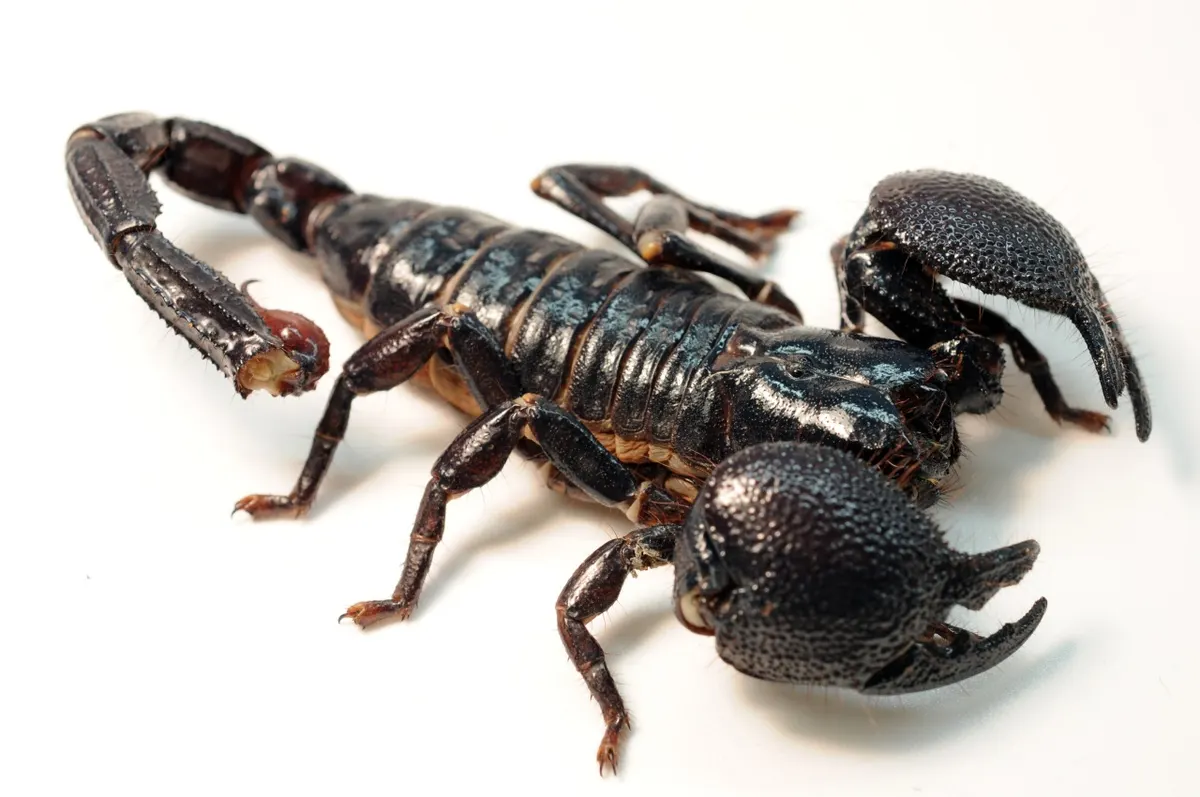
Native Biome: Tropical rainforests, humid savannah burrows, and leaf litter under logs.
Emperor Scorpion
Pandinus imperator
Pandinus is an African scorpion genus; imperator means emperor — for its large size.
Linnaean Taxonomic Tree
~30 g
Female: Up to ~30–50 g large adultsSlow deliberate walker; defensive posture when threatened
Burst Acceleration6–8 years
Captivity: 6–8+ years in captivityCompare Look-Alikes
vs Southern Black Widow
🐣Growth & Lifespan
Birth to old age slider
🔍 Distinctive Diagnostic Markings & Anatomy
Critical morphological field marks naturalists use to verify species identification in the wild.
Glossy black exoskeleton; thick pedipalp claws; high fluorescence under UV.
Chelicerae and large pincers; venomous telson sting (mild for this species relative to size).
Multiple simple eyes; primarily vibration/chemical sensing.
Four pairs of walking legs; huge pedipalp claws for prey capture.
Five-segmented metasoma ending in stinger (telson).
Males often have longer tail segments; females heavier-bodied.
🍖 Trophic Role & Hunting Strategy
MesopredatorNocturnal ambush — seizes prey with powerful claws; sting secondary.
🏕️ Social Behavior & Activity Rhythms
Strictly NocturnalSomewhat tolerant aggregations compared with many scorpions
Young ride on mother’s back initially
Life Cycle, Growth & Lifespan Journey
| Age | Stage | Length/Height | Weight |
|---|---|---|---|
| Birth / Hatch / Day 0 | Young | 1–1.5 cm | 0.05–0.1 g |
| Early growth | Young | 2.7–3.7 cm | 2.4–4.9 g |
| Mid juvenile | Juvenile | 5.9–8 cm | 7–14.1 g |
| Late juvenile | Juvenile | 9.4–12.6 cm | 12–24 g |
| Near maturity | Adult | 12.9–17.2 cm | 17–34 g |
How Big Will a Emperor Scorpion Get?
Calculate estimated adult weight, shoulder height, remaining growth timeline, and weekly development rate based on current age and biometrics.
Conservation Status & Population Dynamics
Declining in places due to collection; still present across range
Subject to ongoing wildlife telemetry monitoring
- •Pet trade collection
- •Habitat loss
- CITES trade controls
- Captive breeding for pets
Field Intelligence & Diagnostic Hub for Emperor Scorpion
Five-segmented metasoma ending in stinger (telson).
Audio frequency analysis, territorial roar/call synthesis, and harmonic resonance measurements.
Ecosystem food web, trophic interactions, and cohabiting species in Africa.
⚖️ Look-Alike Species Differentiation Matrix
Instant one-click comparison tools to prevent common field misidentifications
Emperor Scorpion vs. Southern Black Widow
Key DifferentiationWidows are spiders with hourglass markings; emperor scorpions are large clawed arachnids with a segmented stinging tail.
How to Identify Emperor Scorpion from a Photograph
Standard operating procedures for photographers and field naturalists submitting sightings for verification.
- 📷Clear side profile
- 📷Head/face close-up
- 📷Full body in natural light
- 🔍Large black body
- 🔍Massive claws
- 🔍UV glow
- 🔍Thick tail with stinger
- ⚠️Assuming venom is as dangerous as slender-tailed species
- ⚠️Handling wild scorpions
Frequently Asked Questions About Emperor Scorpion
Verified answers compiled by zoologists, wildlife biologists, and field guides.
Related Identification Tools
Identify similar animals with focused photo tools for dogs, cats, birds, reptiles, fish, bugs, and more.