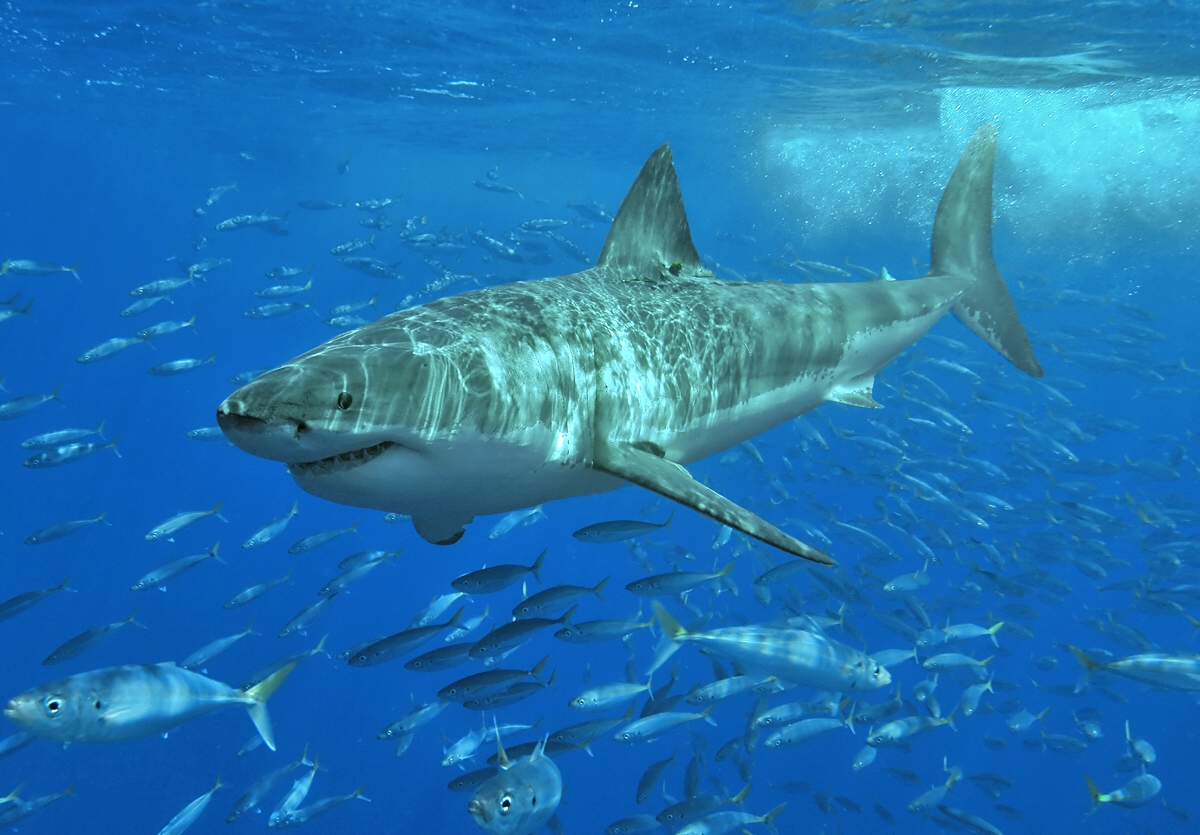
Native Biome: Coastal waters in cool temperate oceans worldwide.
Great White Shark
Carcharodon carcharias
Iconic lamnid shark; countershaded white belly.
Linnaean Taxonomic Tree
500–1,000+ kg
Female: Often largerBurst speeds over 50 km/h reported
Burst Acceleration30–70 years estimates
Captivity: N/ACompare Look-Alikes
vs Giant Oceanic Manta Ray
Vision
Through their eyes
🐣Growth & Lifespan
Birth to old age slider
🔍 Distinctive Diagnostic Markings & Anatomy
Critical morphological field marks naturalists use to verify species identification in the wild.
Gray dorsal, white ventral; large triangular serrated teeth.
Conical snout; black eye; huge jaws.
Black, no nictitating membrane.
Tall first dorsal; crescent tail.
Lunate caudal for sustained power.
Females larger on average
🍖 Trophic Role & Hunting Strategy
Apex PredatorAmbush from below on seals; investigative biting.
🏕️ Social Behavior & Activity Rhythms
DiurnalMostly solitary
No post-birth care
Life Cycle, Growth & Lifespan Journey
| Age | Stage | Length/Height | Weight |
|---|---|---|---|
| Birth / Hatch / Day 0 | Young | 120–150 cm | 20–30 kg |
| Early growth | Young | 160–205 cm | 99.2–298.8 kg |
| Mid juvenile | Juvenile | 236–311 cm | 251–814 kg |
| Late juvenile | Juvenile | 318–426 cm | 416–1374 kg |
| Near maturity | Adult | 401–541 cm | 581–1934 kg |
How Big Will a Great White Shark Get?
Calculate estimated adult weight, shoulder height, remaining growth timeline, and weekly development rate based on current age and biometrics.
Conservation Status & Population Dynamics
Unknown; regionally uncommon
Subject to ongoing wildlife telemetry monitoring
- •Bycatch
- •Persecution
- •Prey declines
- Habitat protection
- Public education
Field Intelligence & Diagnostic Hub for Great White Shark
Lunate caudal for sustained power.
Audio frequency analysis, territorial roar/call synthesis, and harmonic resonance measurements.
Ecosystem food web, trophic interactions, and cohabiting species in Global Oceans.
⚖️ Look-Alike Species Differentiation Matrix
Instant one-click comparison tools to prevent common field misidentifications
Great White Shark vs. Giant Oceanic Manta Ray
Key DifferentiationMantas are filter-feeding rays with cephalic fins; great whites are predatory sharks with triangular teeth.
How to Identify Great White Shark from a Photograph
Standard operating procedures for photographers and field naturalists submitting sightings for verification.
- 📷Clear side profile
- 📷Head/face close-up
- 📷Full body in natural light
- 🔍Countershaded gray/white
- 🔍Triangular serrated teeth
- 🔍Tall dorsal
- 🔍Lunate tail
- ⚠️Mis-ID of other large sharks from poor photos
Frequently Asked Questions About Great White Shark
Verified answers compiled by zoologists, wildlife biologists, and field guides.
Related Identification Tools
Identify similar animals with focused photo tools for dogs, cats, birds, reptiles, fish, bugs, and more.



