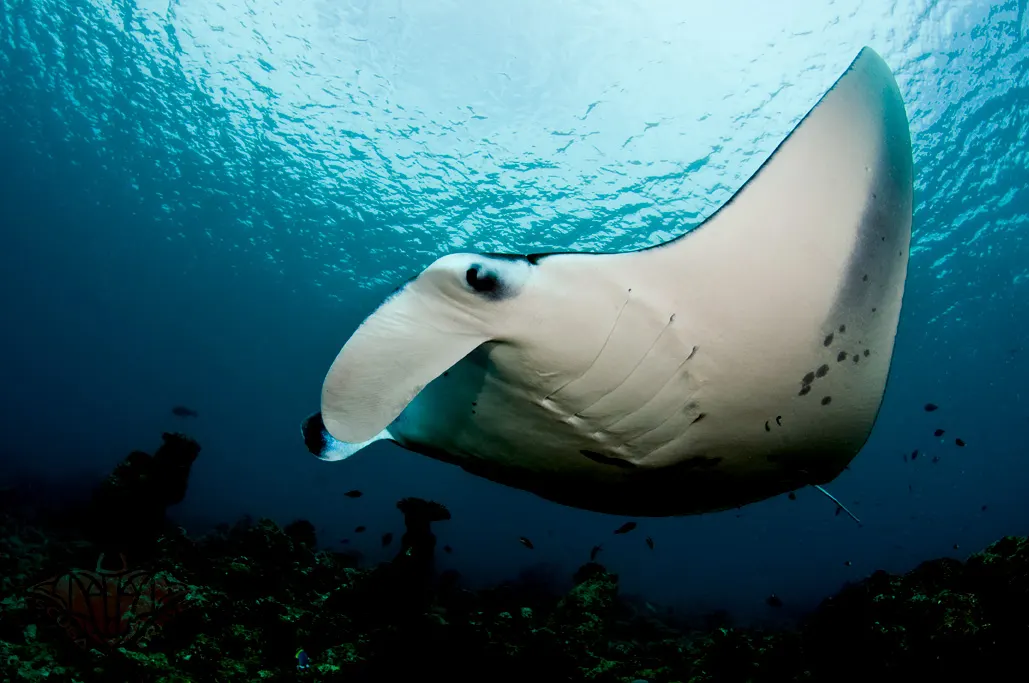
Native Biome: Pelagic open ocean waters, offshore seamounts, and coastal cleaning stations.
Giant Oceanic Manta Ray
Mobula birostris
Largest rays; cephalic fins look like horns; filter feeders.
Linnaean Taxonomic Tree
Up to ~1,000+ kg
Female: Similar / largerGraceful cruising; powerful leaps
Burst AccelerationDecades
Captivity: N/ACompare Look-Alikes
vs Great White Shark
🐣Growth & Lifespan
Birth to old age slider
🔍 Distinctive Diagnostic Markings & Anatomy
Critical morphological field marks naturalists use to verify species identification in the wild.
Black dorsal, white ventral with unique spot patterns.
Cephalic lobes funnel plankton; tooth band on lower jaw only.
Side-mounted.
Wing-like pectoral fins.
Long thin whip without barb (unlike many stingrays).
Subtle
🍖 Trophic Role & Hunting Strategy
OmnivoreFilter feeding on zooplankton.
🏕️ Social Behavior & Activity Rhythms
DiurnalMay aggregate at cleaning stations
Limited
Life Cycle, Growth & Lifespan Journey
| Age | Stage | Length/Height | Weight |
|---|---|---|---|
| Birth / Hatch / Day 0 | Young | 1–1.5 m | 10–15 kg |
| Early growth | Young | 1.4–2.2 m | 128.8–253.2 kg |
| Mid juvenile | Juvenile | 2.2–3.4 m | 356.5–709.8 kg |
| Late juvenile | Juvenile | 3.1–4.8 m | 604–1206 kg |
| Near maturity | Adult | 4–6.2 m | 851.5–1702.3 kg |
How Big Will a Giant Oceanic Manta Ray Get?
Calculate estimated adult weight, shoulder height, remaining growth timeline, and weekly development rate based on current age and biometrics.
Conservation Status & Population Dynamics
Declining
Subject to ongoing wildlife telemetry monitoring
- •Bycatch
- •Targeted fisheries
- •Boat strikes
- Habitat protection
- Public education
Field Intelligence & Diagnostic Hub for Giant Oceanic Manta Ray
Long thin whip without barb (unlike many stingrays).
Audio frequency analysis, territorial roar/call synthesis, and harmonic resonance measurements.
Ecosystem food web, trophic interactions, and cohabiting species in Global Oceans.
⚖️ Look-Alike Species Differentiation Matrix
Instant one-click comparison tools to prevent common field misidentifications
Giant Oceanic Manta Ray vs. Great White Shark
Key DifferentiationSharks are fusiform predators; mantas are flattened filter-feeding rays.
How to Identify Giant Oceanic Manta Ray from a Photograph
Standard operating procedures for photographers and field naturalists submitting sightings for verification.
- 📷Clear side profile
- 📷Head/face close-up
- 📷Full body in natural light
- 🔍Huge wing disc
- 🔍Cephalic fins
- 🔍Ventral spot ID pattern
- 🔍No stinging barb
- ⚠️Confusing with reef manta
- ⚠️Assuming stingray barb
Frequently Asked Questions About Giant Oceanic Manta Ray
Verified answers compiled by zoologists, wildlife biologists, and field guides.
Related Identification Tools
Identify similar animals with focused photo tools for dogs, cats, birds, reptiles, fish, bugs, and more.



