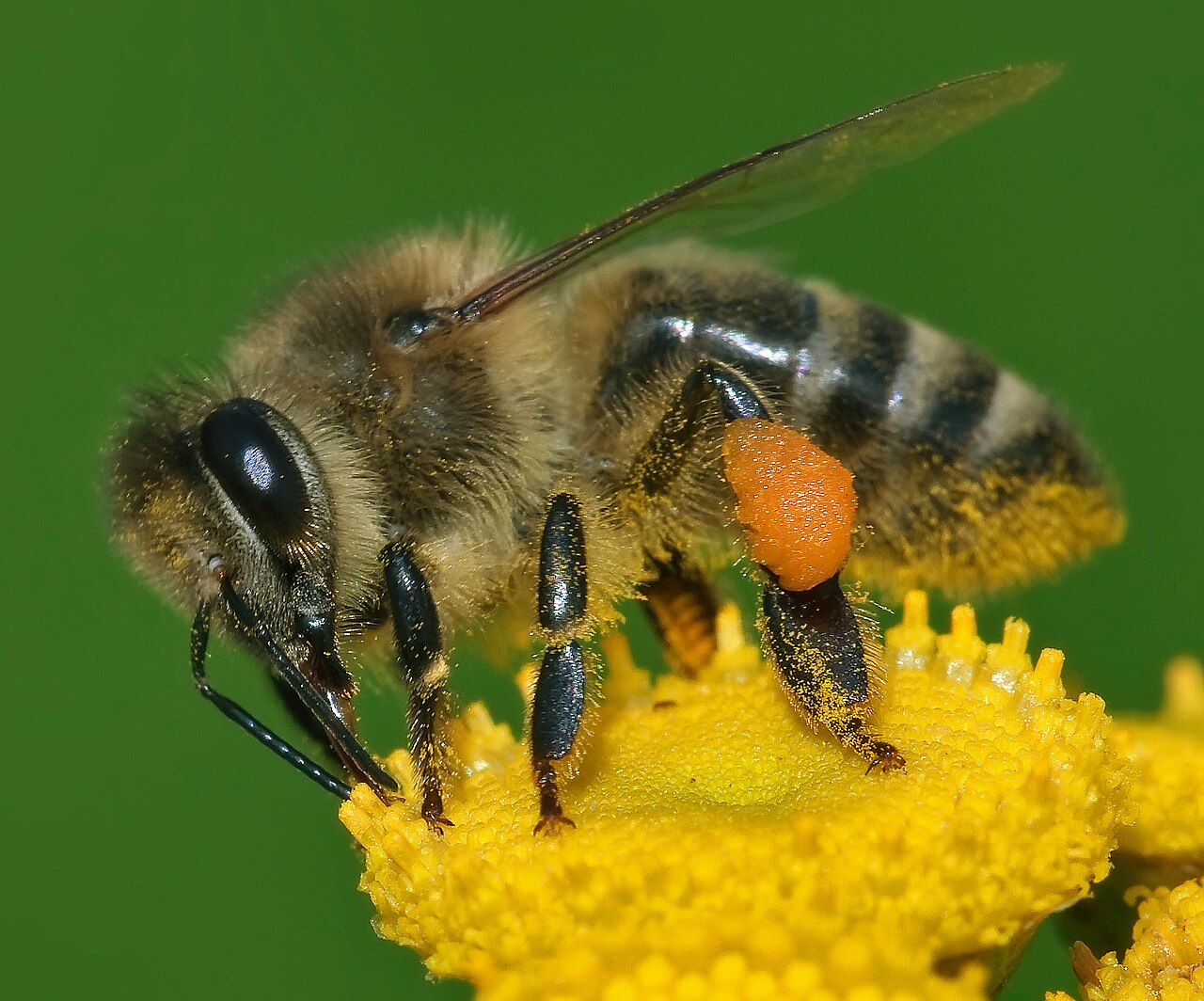
Native Biome: Gardens, orchards, meadows, and hollow tree trunks.
Western Honey Bee
Apis mellifera
Apis is Latin for bee; mellifera means “honey-bearing.”
Linnaean Taxonomic Tree
Drones ~0.2 g
Female: Workers ~0.1 g; queens heavierForaging flight ~20–25 km/h
Burst AccelerationWorkers weeks to months; queens 2–5 years
Captivity: Managed hives similarCompare Look-Alikes
vs Yellowjacket Wasp
Vision
Through their eyes
🐣Growth & Lifespan
Birth to old age slider
🔍 Distinctive Diagnostic Markings & Anatomy
Critical morphological field marks naturalists use to verify species identification in the wild.
Amber to brown banded abdomen with hair; pollen baskets on hind legs of workers.
Chewing-lapping mouthparts; mandibles for wax/work; no vertebrate skull.
Compound eyes; drones have enlarged eyes for mate-finding.
Six legs; corbiculae (pollen baskets) on worker hind legs.
Barbed stinger in workers (derived ovipositor); dies after stinging mammals.
Queens large; workers sterile females; drones larger-eyed males without stingers.
🍖 Trophic Role & Hunting Strategy
OmnivoreNot a hunter — forages nectar and pollen; feeds larvae glandular secretions and honey stores.
🏕️ Social Behavior & Activity Rhythms
DiurnalEusocial colony with queen, workers, seasonal drones
Workers nurse brood; queen lays eggs
Life Cycle, Growth & Lifespan Journey
| Age | Stage | Length/Height | Weight |
|---|---|---|---|
| Birth / Hatch / Day 0 | Larva | 1.5–2 mm | 0.1–0.15 g |
| Early growth | Larva | 2.8–3.6 mm | 0.099–0.146 g |
| Mid juvenile | Pupa | 5.2–6.6 mm | 0.097–0.139 g |
| Late juvenile | Adult | 7.8–9.8 mm | 0.094–0.132 g |
| Near maturity | Adult | 10.4–13.1 mm | 0.092–0.125 g |
How Big Will a Western Honey Bee Get?
Calculate estimated adult weight, shoulder height, remaining growth timeline, and weekly development rate based on current age and biometrics.
Conservation Status & Population Dynamics
Billions in managed colonies; wild nests patchy
Subject to ongoing wildlife telemetry monitoring
- •Varroa mites
- •Pesticides
- •Habitat loss
- •Colony Collapse Disorder factors
- Beekeeper husbandry
- Pollinator habitat plantings
- Varroa IPM
Field Intelligence & Diagnostic Hub for Western Honey Bee
Barbed stinger in workers (derived ovipositor); dies after stinging mammals.
Audio frequency analysis, territorial roar/call synthesis, and harmonic resonance measurements.
Ecosystem food web, trophic interactions, and cohabiting species in Global.
⚖️ Look-Alike Species Differentiation Matrix
Instant one-click comparison tools to prevent common field misidentifications
Western Honey Bee vs. Yellowjacket Wasp
Key DifferentiationYellowjackets are nearly hairless with vivid yellow-black bands and lack pollen baskets; honey bees are hairier and amber-toned.
How to Identify Western Honey Bee from a Photograph
Standard operating procedures for photographers and field naturalists submitting sightings for verification.
- 📷Clear side profile
- 📷Head/face close-up
- 📷Full body in natural light
- 🔍Hairy amber-banded body
- 🔍Pollen baskets
- 🔍Colony nest in cavities/hives
- ⚠️Confusing with yellowjackets (smoother, brighter yellow/black, no pollen baskets)
- ⚠️Assuming all bees are honey bees
Frequently Asked Questions About Western Honey Bee
Verified answers compiled by zoologists, wildlife biologists, and field guides.
Related Identification Tools
Identify similar animals with focused photo tools for dogs, cats, birds, reptiles, fish, bugs, and more.



