Native Biome: Meadows, gardens, agricultural crops, and shrubby fields.
European Praying Mantis
Mantis religiosa
Mantis from Greek for prophet; religiosa refers to the prayer-like foreleg posture.
Linnaean Taxonomic Tree
Light — under a few grams
Female: Heavier-bodiedSlow walk; lightning foreleg strike
Burst AccelerationOne season for adults; eggs overwinter
Captivity: Months as adult in captivityCompare Look-Alikes
vs Luna Moth
🐣Growth & Lifespan
Birth to old age slider
🔍 Distinctive Diagnostic Markings & Anatomy
Critical morphological field marks naturalists use to verify species identification in the wild.
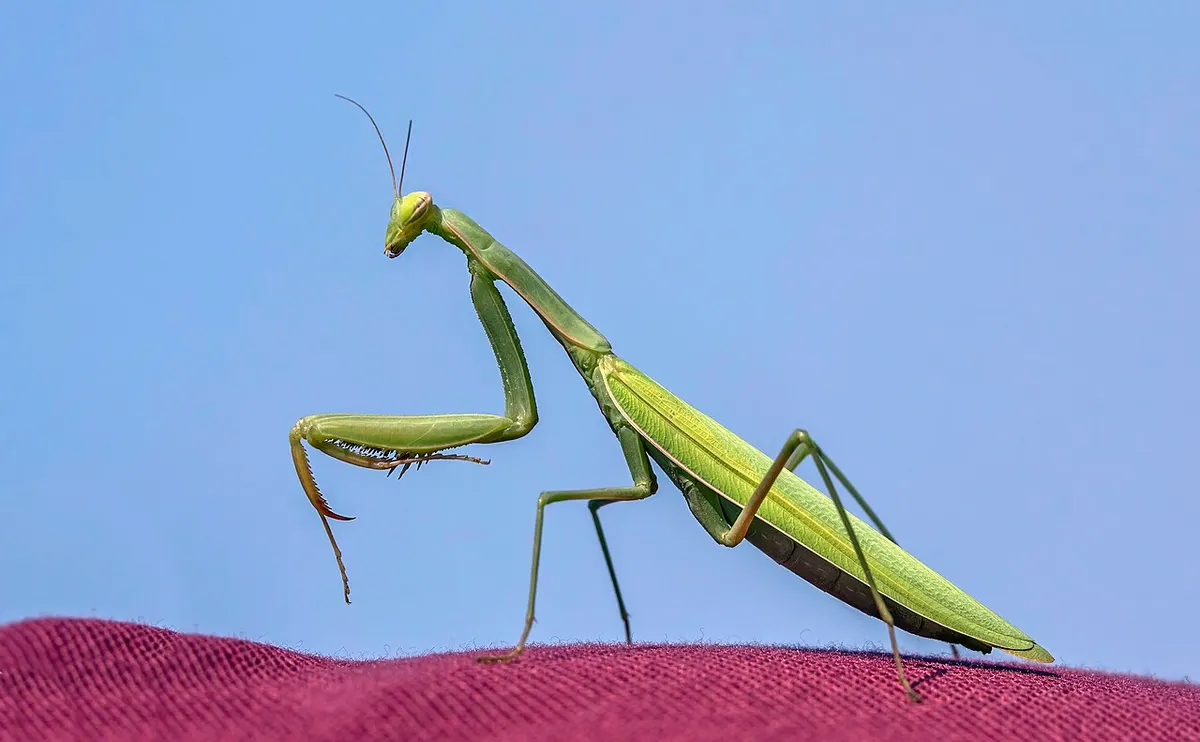
Green or brown camouflage; triangular head; raptorial spiked forelegs held folded.
Triangular head with chewing mouthparts; can rotate nearly 180°.
Large compound eyes with binocular stereopsis for strike aiming; simple eyes present.
Spiked raptorial forelegs; four walking legs behind.
Abdomen tip with cerci; females heavier abdomen.
Females larger; males slimmer flyers; sexual cannibalism sometimes occurs.
🍖 Trophic Role & Hunting Strategy
MesopredatorAmbush predator — remains still then strikes insects with spiked forelegs.
🏕️ Social Behavior & Activity Rhythms
DiurnalSolitary
No care after ootheca deposition
Life Cycle, Growth & Lifespan Journey
| Age | Stage | Length/Height | Weight |
|---|---|---|---|
| Birth / Hatch / Day 0 | Young | 5–8 mm | 0.02–0.04 g |
| Early growth | Young | 10.4–16.6 mm | 0.258–0.635 g |
| Mid juvenile | Juvenile | 20.8–33.2 mm | 0.713–1.8 g |
| Late juvenile | Juvenile | 32–51.2 mm | 1.2–3 g |
| Near maturity | Adult | 43.3–69.2 mm | 1.7–4.3 g |
How Big Will a European Praying Mantis Get?
Calculate estimated adult weight, shoulder height, remaining growth timeline, and weekly development rate based on current age and biometrics.
Conservation Status & Population Dynamics
Common where established
Subject to ongoing wildlife telemetry monitoring
- •Pesticides
- •Habitat homogenization
- Habitat protection
- Public education
Field Intelligence & Diagnostic Hub for European Praying Mantis
Abdomen tip with cerci; females heavier abdomen.
Audio frequency analysis, territorial roar/call synthesis, and harmonic resonance measurements.
Ecosystem food web, trophic interactions, and cohabiting species in Global.
⚖️ Look-Alike Species Differentiation Matrix
Instant one-click comparison tools to prevent common field misidentifications
European Praying Mantis vs. Luna Moth
Key DifferentiationLuna moths are winged nocturnal moths; praying mantises are predatory insects with spiked forelegs and triangular heads.
How to Identify European Praying Mantis from a Photograph
Standard operating procedures for photographers and field naturalists submitting sightings for verification.
- 📷Clear side profile
- 📷Head/face close-up
- 📷Full body in natural light
- 🔍Prayer-folded spiked forelegs
- 🔍Triangular rotating head
- 🔍Green/brown camouflage
- ⚠️Assuming all mantids are the same species
- ⚠️Confusing with stick insects at a glance
Frequently Asked Questions About European Praying Mantis
Verified answers compiled by zoologists, wildlife biologists, and field guides.
Related Identification Tools
Identify similar animals with focused photo tools for dogs, cats, birds, reptiles, fish, bugs, and more.



