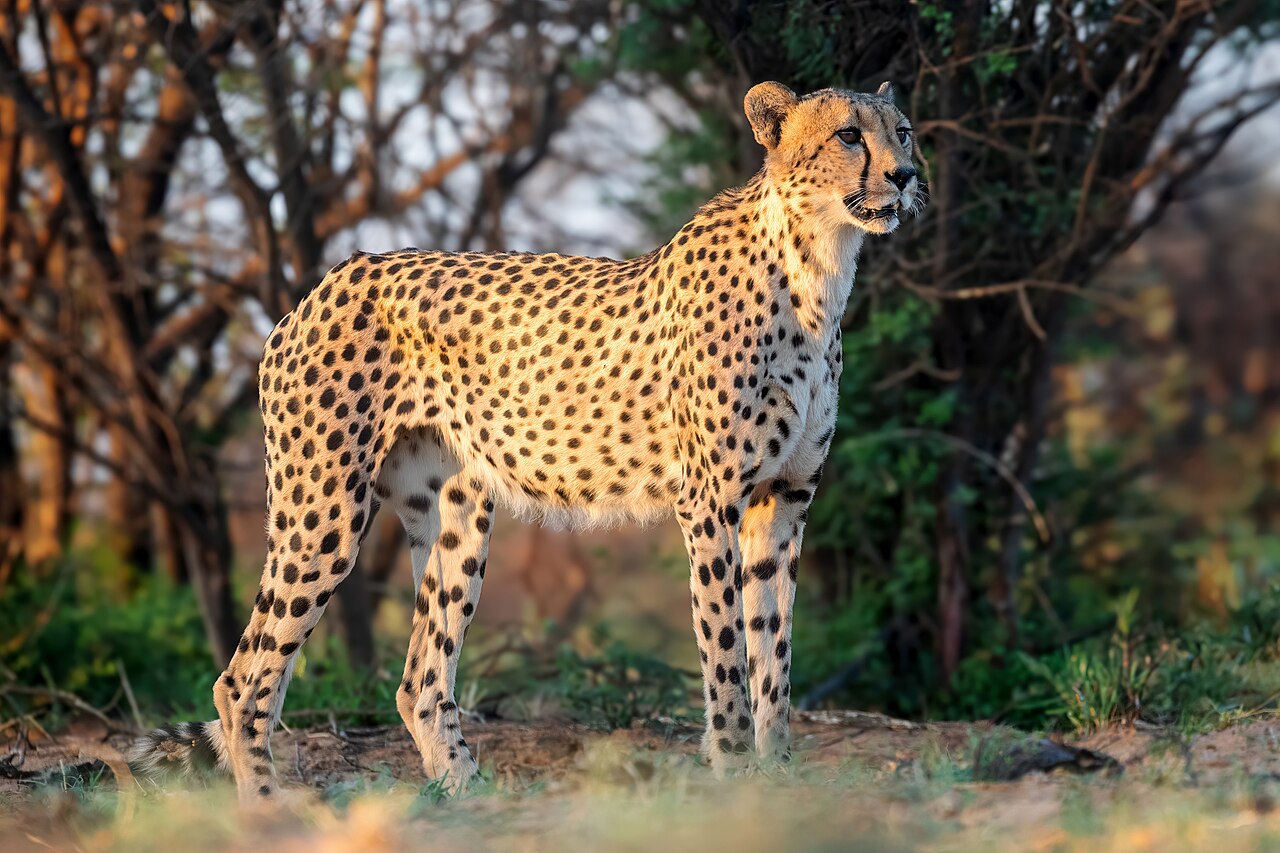
Native Biome: Open savannahs, scrub forests, and arid grasslands.
Cheetah
Acinonyx jubatus
Acinonyx means “non-moving claw” (semi-retractable); jubatus means “maned,” referring to cub mantle/nuchal crest.
Linnaean Taxonomic Tree
40–65 kg
Female: 35–50 kgUp to ~100–112 km/h in short sprints — fastest land animal
Burst Acceleration8–12 years
Captivity: 12–17 yearsCompare Look-Alikes
vs Leopard
Vision
Through their eyes
🐣Growth & Lifespan
Birth to old age slider
🔍 Distinctive Diagnostic Markings & Anatomy
Critical morphological field marks naturalists use to verify species identification in the wild.
Tan coat with solid black spots; distinctive black “tear marks” from eye to mouth.
Small rounded skull; lighter bite than other big cats; adapted for speed not bone-crushing.
High-set eyes with tear stripes reducing sun glare.
Extremely long legs; semi-retractable blunt claws for traction (like cleats).
Long counterbalancing tail with ringed tip used as a rudder in turns.
Males slightly larger; both sexes spotted; no heavy mane like lions.
🍖 Trophic Role & Hunting Strategy
Apex PredatorDiurnal visual stalk then explosive sprint; trips prey with dewclaw/forepaw swipe then throat bite.
🏕️ Social Behavior & Activity Rhythms
DiurnalFemales solitary with cubs; males may form coalitions
Mother alone raises cubs; high cub mortality from predators
Life Cycle, Growth & Lifespan Journey
| Age | Stage | Length/Height | Weight |
|---|---|---|---|
| Birth | Mantle Cub | 25–32 cm | 250–400 g |
| 6 Months | Sprint Apprentice | 90–110 cm | 14–20 kg |
| 2+ Years | Prime Speed Hunter | 180–220 cm | 38–60 kg |
How Big Will a Cheetah Get?
Calculate estimated adult weight, shoulder height, remaining growth timeline, and weekly development rate based on current age and biometrics.
Conservation Status & Population Dynamics
~6,500–7,500 mature individuals estimated
Subject to ongoing wildlife telemetry monitoring
- •Habitat fragmentation
- •Human conflict
- •Low genetic diversity
- •Cub predation
- Cheetah Conservation Fund
- Corridor protection
- Livestock guarding dog programs
Field Intelligence & Diagnostic Hub for Cheetah
Long counterbalancing tail with ringed tip used as a rudder in turns.
Audio frequency analysis, territorial roar/call synthesis, and harmonic resonance measurements.
Ecosystem food web, trophic interactions, and cohabiting species in Africa.
⚖️ Look-Alike Species Differentiation Matrix
Instant one-click comparison tools to prevent common field misidentifications
Cheetah vs. Leopard
Key DifferentiationLeopards have rosette spots, are stockier, and are primarily nocturnal climbers; cheetahs have tear marks and solid spots.
Cheetah vs. Jaguar
Key DifferentiationJaguars are heavier with rosettes that often have central spots; New World only.
How to Identify Cheetah from a Photograph
Standard operating procedures for photographers and field naturalists submitting sightings for verification.
- 📷Clear side profile
- 📷Head/face close-up
- 📷Full body in natural light
- 🔍Tear marks
- 🔍Solid spots (not rosettes)
- 🔍Deep chest / skinny waist
- 🔍Long rudder tail
- ⚠️Confusing with leopard (rosettes vs solid spots)
- ⚠️Confusing with king cheetah rare morph
Frequently Asked Questions About Cheetah
Verified answers compiled by zoologists, wildlife biologists, and field guides.
Related Identification Tools
Identify similar animals with focused photo tools for dogs, cats, birds, reptiles, fish, bugs, and more.



