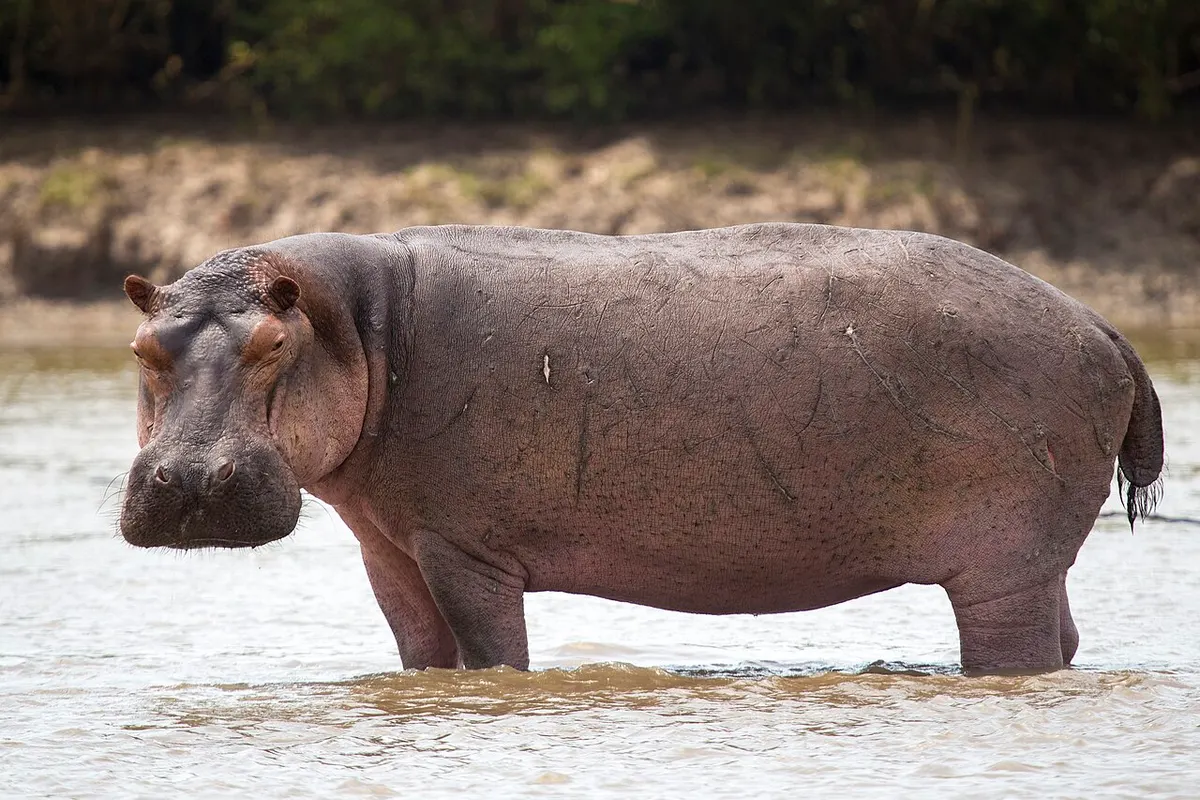
Native Biome: Rivers, freshwater lakes, swamps, and surrounding grazing pastures.
Common Hippopotamus
Hippopotamus amphibius
Hippopotamus means “river horse” in Greek; amphibius refers to dual water–land life.
Linnaean Taxonomic Tree
1,500–1,800+ kg
Female: 1,300–1,500 kg~30–50 km/h surprisingly fast on land short distances
Burst Acceleration40–50 years
Captivity: 50+ yearsCompare Look-Alikes
vs American Alligator
🐣Growth & Lifespan
Birth to old age slider
🔍 Distinctive Diagnostic Markings & Anatomy
Critical morphological field marks naturalists use to verify species identification in the wild.
Nearly hairless gray-brown skin secreting reddish “blood sweat” sunscreen mucus; huge barrel body.
Enormous mouth with tusk-like canines and incisors for combat, not grazing (lips crop grass).
Eyes, ears, nostrils on top of head for submerged sensing.
Short stout legs; four-toed feet.
Short flattened tail.
Males larger with thicker necks and larger tusks/incisors.
🍖 Trophic Role & Hunting Strategy
Primary HerbivoreNight grazing on land; rests in water by day.
🏕️ Social Behavior & Activity Rhythms
Strictly NocturnalGroups (pods/schools) in water; territorial bulls
Calves nurse underwater; mothers highly protective
Life Cycle, Growth & Lifespan Journey
| Age | Stage | Length/Height | Weight |
|---|---|---|---|
| Birth / Hatch / Day 0 | Young | 1–1.2 m | 25–45 kg |
| Early growth | Young | 1.2–1.5 m | 178–255.6 kg |
| Mid juvenile | Juvenile | 1.7–2.2 m | 471.3–659.3 kg |
| Late juvenile | Juvenile | 2.2–2.9 m | 790–1098 kg |
| Near maturity | Adult | 2.7–3.6 m | 1108.8–1536.8 kg |
How Big Will a Common Hippopotamus Get?
Calculate estimated adult weight, shoulder height, remaining growth timeline, and weekly development rate based on current age and biometrics.
Conservation Status & Population Dynamics
~115,000–130,000 estimated
Subject to ongoing wildlife telemetry monitoring
- •Hunting for meat/ivory teeth
- •Habitat loss
- •Conflict
- Protected wetlands
- Anti-poaching
- Community conservation
Field Intelligence & Diagnostic Hub for Common Hippopotamus
Short flattened tail.
Audio frequency analysis, territorial roar/call synthesis, and harmonic resonance measurements.
Ecosystem food web, trophic interactions, and cohabiting species in Africa.
⚖️ Look-Alike Species Differentiation Matrix
Instant one-click comparison tools to prevent common field misidentifications
Common Hippopotamus vs. American Alligator
Key DifferentiationAlligators are armored reptiles; hippos are huge aquatic mammals with blunt heads and grazing lips.
How to Identify Common Hippopotamus from a Photograph
Standard operating procedures for photographers and field naturalists submitting sightings for verification.
- 📷Clear side profile
- 📷Head/face close-up
- 📷Full body in natural light
- 🔍Huge mouth
- 🔍Eyes/ears/nostrils on top
- 🔍Barrel body
- 🔍Nearly hairless skin
- ⚠️Thinking they are friendly
- ⚠️Approaching between hippos and water
Frequently Asked Questions About Common Hippopotamus
Verified answers compiled by zoologists, wildlife biologists, and field guides.
Related Identification Tools
Identify similar animals with focused photo tools for dogs, cats, birds, reptiles, fish, bugs, and more.



