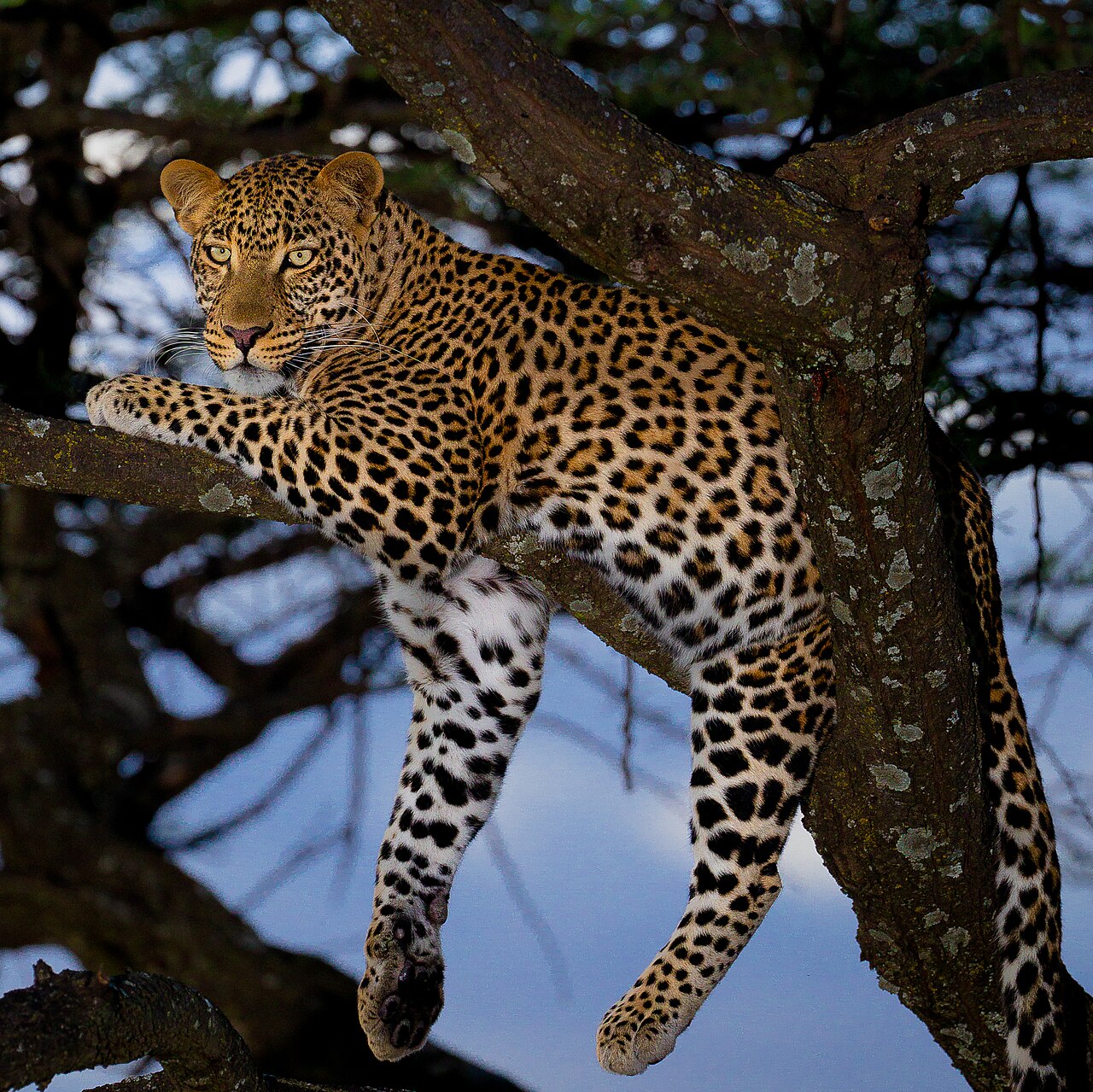
Native Biome: Savannahs, woodlands, mountain forests, and semi-deserts.
African Leopard
Panthera pardus
From Greek "leōn" (lion) and "pardos" (male panther), historically believed to be a hybrid between a lion and a mythical panther.
Linnaean Taxonomic Tree
60 to 90 kg (130 to 200 lbs)
Female: 35 to 55 kg (77 to 120 lbs)58 km/h (36 mph)
Burst Acceleration310 PSI
Crushing Power12 to 17 years
Captivity: 20 to 23 yearsCompare Look-Alikes
vs Jaguar
Vision
Through their eyes
🐣Growth & Lifespan
Birth to old age slider
🔍 Distinctive Diagnostic Markings & Anatomy
Critical morphological field marks naturalists use to verify species identification in the wild.
Tawny yellow-gold coat covered in hollow rosettes (circular clusters of dark spots WITHOUT a central spot). White underbelly with solid black spots.
Streamlined, compact skull with strong sagittal ridge and prominent zygomatic arches.
Round pupils with bright emerald green, turquoise, or golden-yellow irises.
Rounded ears with black backings. Large broad paws with strong curved climbing claws.
Very long, slender tail with a white underside tip that acts as a beacon for cubs following through high grass.
Males are 30% heavier with broader cheeks and thicker shoulder musculature.
🍖 Trophic Role & Hunting Strategy
Apex PredatorUltimate stealth stalker. Creeps within 3–5 meters of prey using belly-crawl concealment, then delivers a rapid asphyxiating throat clamp.
🏕️ Social Behavior & Activity Rhythms
Strictly NocturnalStrictly solitary except during mating or when females rear cubs.
Female hides cubs in rock crevices or hollow baobab trees for 3 months.
Life Cycle, Growth & Lifespan Journey
| Age | Stage | Length/Height | Weight |
|---|---|---|---|
| Birth / Hatch / Day 0 | Cub | 30–40 cm | 0.4–0.7 kg |
| Early growth | Cub | 45.6–60.4 cm | 4–11.4 kg |
| Mid juvenile | Juvenile | 75.5–99.5 cm | 10.8–32 kg |
| Late juvenile | Subadult | 108–142 cm | 18.2–54.3 kg |
| Near maturity | Adult | 141–185 cm | 25.6–76.6 kg |
How Big Will a African Leopard Get?
Calculate estimated adult weight, shoulder height, remaining growth timeline, and weekly development rate based on current age and biometrics.
Conservation Status & Population Dynamics
~700,000 across Africa (many subspecies critically endangered)
Subject to ongoing wildlife telemetry monitoring
- •Human-wildlife conflict and trophy hunting
- •Skin and tooth poaching
- •Deforestation and prey base depletion
- Panthera Leopard Program
- African Wildlife Foundation
Field Intelligence & Diagnostic Hub for African Leopard
Very long, slender tail with a white underside tip that acts as a beacon for cubs following through high grass.
Audio frequency analysis, territorial roar/call synthesis, and harmonic resonance measurements.
Ecosystem food web, trophic interactions, and cohabiting species in Africa & Asia.
⚖️ Look-Alike Species Differentiation Matrix
Instant one-click comparison tools to prevent common field misidentifications
African Leopard vs. Jaguar
Key DifferentiationLeopards have hollow rosettes without central spots; Jaguars have larger rosettes containing one or more distinct central black dots.
African Leopard vs. Cheetah
Key DifferentiationLeopards have muscular bodies, hollow rosettes, and climb trees; Cheetahs have lean greyhound builds, solid round black spots, and distinctive black tear marks down the face.
How to Identify African Leopard from a Photograph
Standard operating procedures for photographers and field naturalists submitting sightings for verification.
- 📷Flank rosette cluster profile
- 📷Tree branch silhouette looking up
- 📷Facial whisker dot pattern
- 🔍Hollow rosettes with no center dot (contrasting with Jaguar)
- 🔍Long slender body with lower center of gravity than Cheetah
- 🔍White underside of tail tip
- ⚠️Confusing with Cheetah (Leopards lack black tear stripes)
Frequently Asked Questions About African Leopard
Verified answers compiled by zoologists, wildlife biologists, and field guides.
Related Identification Tools
Identify similar animals with focused photo tools for dogs, cats, birds, reptiles, fish, bugs, and more.