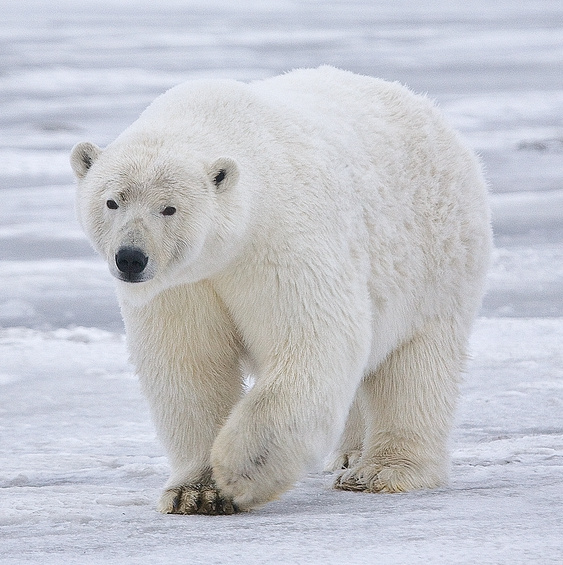
Native Biome: Arctic pack ice, coastal tundra, and freezing ocean waters.
Polar Bear
Ursus maritimus
Ursus maritimus means “maritime bear,” reflecting its sea-ice hunting lifestyle.
Linnaean Taxonomic Tree
350–700 kg
Female: 150–300 kg~40 km/h on land short bursts; strong swimmers
Burst Acceleration15–18 years typical
Captivity: 20–30 yearsCompare Look-Alikes
vs Grizzly Bear
🐣Growth & Lifespan
Birth to old age slider
🔍 Distinctive Diagnostic Markings & Anatomy
Critical morphological field marks naturalists use to verify species identification in the wild.
Cream to yellowish white guard hairs over black skin; dense insulating fur.
Elongated skull vs brown bears; large canines for seal hunting.
Dark eyes adapted to bright ice glare and low Arctic light.
Huge paws with hair on soles for traction/insulation; non-retractable claws.
Short stubby tail.
Males much larger; females smaller with cubs often nearby.
🍖 Trophic Role & Hunting Strategy
Apex PredatorStill-hunts seals at breathing holes; also stalks on ice and scavenges carcasses.
🏕️ Social Behavior & Activity Rhythms
CathemeralMostly solitary except mothers with cubs and temporary aggregations at food
Denning mothers nurse cubs through Arctic winter
Life Cycle, Growth & Lifespan Journey
| Age | Stage | Length/Height | Weight |
|---|---|---|---|
| Birth / Hatch / Day 0 | Cub | 30–35 cm | 0.5–0.7 kg |
| Early growth | Cub | 55.2–66.8 cm | 42.4–84.6 kg |
| Mid juvenile | Yearling | 104–128 cm | 122.8–245.5 kg |
| Late juvenile | Subadult | 156–194 cm | 210.2–420.3 kg |
| Near maturity | Adult | 209–260 cm | 297.6–595.1 kg |
How Big Will a Polar Bear Get?
Calculate estimated adult weight, shoulder height, remaining growth timeline, and weekly development rate based on current age and biometrics.
Conservation Status & Population Dynamics
~22,000–31,000 estimated
Subject to ongoing wildlife telemetry monitoring
- •Sea-ice loss from climate change
- •Pollution
- •Human conflict
- Arctic protected areas
- Climate policy advocacy
- Conflict patrols
Field Intelligence & Diagnostic Hub for Polar Bear
Short stubby tail.
Audio frequency analysis, territorial roar/call synthesis, and harmonic resonance measurements.
Ecosystem food web, trophic interactions, and cohabiting species in Arctic.
⚖️ Look-Alike Species Differentiation Matrix
Instant one-click comparison tools to prevent common field misidentifications
Polar Bear vs. Grizzly Bear
Key DifferentiationGrizzlies are brown with a shoulder hump and shorter face; polar bears are white with longer necks and live on sea ice.
How to Identify Polar Bear from a Photograph
Standard operating procedures for photographers and field naturalists submitting sightings for verification.
- 📷Clear side profile
- 📷Head/face close-up
- 📷Full body in natural light
- 🔍White/cream coat
- 🔍Long neck/skull
- 🔍Huge black nose
- 🔍Massive paws
- ⚠️Confusing distant pale brown bears
- ⚠️Assuming all white bears are healthy/fat year-round
Frequently Asked Questions About Polar Bear
Verified answers compiled by zoologists, wildlife biologists, and field guides.
Related Identification Tools
Identify similar animals with focused photo tools for dogs, cats, birds, reptiles, fish, bugs, and more.



