Native Biome: Gallery forests, spiny scrublands, and dry deciduous forests.
Ring-tailed Lemur
Lemur catta
Lemur from Latin lemures (spirits of the dead); catta suggests cat-like; ring-tailed describes the banded tail.
Linnaean Taxonomic Tree
2.0–2.5 kg
Female: SimilarAgile terrestrial gallop and arboreal leaps
Burst Acceleration15–16 years
Captivity: 20+ yearsCompare Look-Alikes
vs Koala
🐣Growth & Lifespan
Birth to old age slider
🔍 Distinctive Diagnostic Markings & Anatomy
Critical morphological field marks naturalists use to verify species identification in the wild.
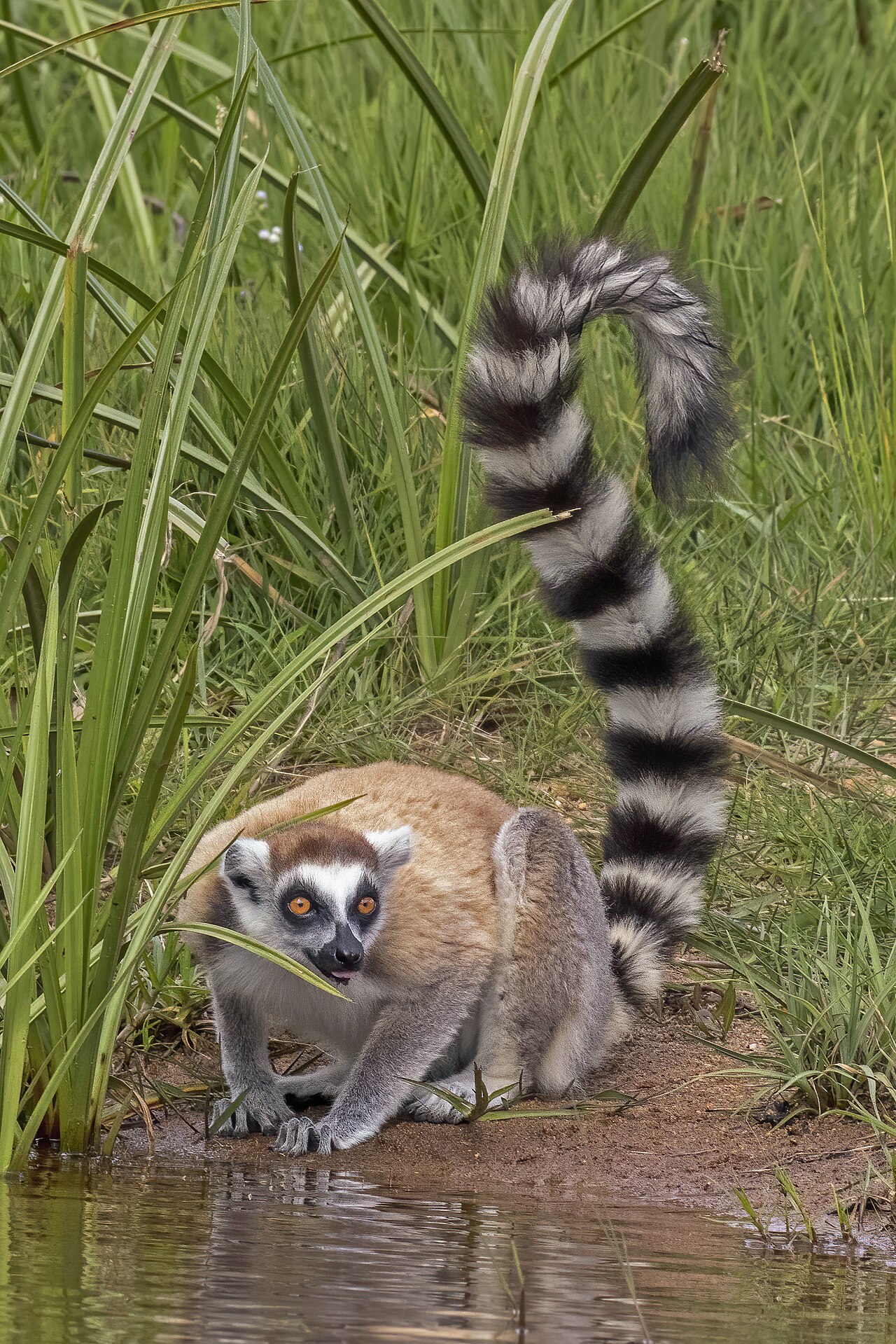
Gray back, white belly/face, black eye rings and muzzle; iconic black-and-white banded tail.
Fox-like muzzle with wet nose (strepsirrhine); dental toothcomb.
Amber eyes with reflective tapetum; diurnal despite strepsirrhine ancestry.
Grasping hands/feet; hind limbs strong for leaping.
Long banded tail used for balance and visual signaling (stink fights in males).
Subtle size differences; both sexes show identical ringed tails.
🍖 Trophic Role & Hunting Strategy
OmnivoreForages fruit, leaves, flowers; opportunistically takes insects.
🏕️ Social Behavior & Activity Rhythms
DiurnalFemale-dominant troops of ~10–30
Infants cling to mother’s belly then back; allomothering occurs
Life Cycle, Growth & Lifespan Journey
| Age | Stage | Length/Height | Weight |
|---|---|---|---|
| Birth / Hatch / Day 0 | Young | 8–10 cm | 0.06–0.08 kg |
| Early growth | Young | 11.7–14.3 cm | 0.317–0.37 kg |
| Mid juvenile | Juvenile | 18.9–22.6 cm | 0.809–0.927 kg |
| Late juvenile | Juvenile | 26.6–31.6 cm | 1.3–1.5 kg |
| Near maturity | Adult | 34.3–40.6 cm | 1.9–2.1 kg |
How Big Will a Ring-tailed Lemur Get?
Calculate estimated adult weight, shoulder height, remaining growth timeline, and weekly development rate based on current age and biometrics.
Conservation Status & Population Dynamics
Declining with habitat loss; tens of thousands estimated historically, now fragmented
Subject to ongoing wildlife telemetry monitoring
- •Deforestation
- •Hunting
- •Drought
- •Habitat fragmentation
- Madagascar protected areas
- Community forests
- Captive breeding SSP
Field Intelligence & Diagnostic Hub for Ring-tailed Lemur
Long banded tail used for balance and visual signaling (stink fights in males).
Audio frequency analysis, territorial roar/call synthesis, and harmonic resonance measurements.
Ecosystem food web, trophic interactions, and cohabiting species in Madagascar.
⚖️ Look-Alike Species Differentiation Matrix
Instant one-click comparison tools to prevent common field misidentifications
Ring-tailed Lemur vs. Koala
Key DifferentiationKoalas are Australian marsupials with no ringed tail; ring-tailed lemurs are Madagascan primates with banded tails.
How to Identify Ring-tailed Lemur from a Photograph
Standard operating procedures for photographers and field naturalists submitting sightings for verification.
- 📷Clear side profile
- 📷Head/face close-up
- 📷Full body in natural light
- 🔍Black-and-white ringed tail
- 🔍White face with black eye patches
- 🔍Gray body
- 🔍Terrestrial troop movement
- ⚠️Confusing with other lemur species lacking ringed tails
- ⚠️Assuming all Madagascar primates are ring-tailed
Frequently Asked Questions About Ring-tailed Lemur
Verified answers compiled by zoologists, wildlife biologists, and field guides.
Related Identification Tools
Identify similar animals with focused photo tools for dogs, cats, birds, reptiles, fish, bugs, and more.