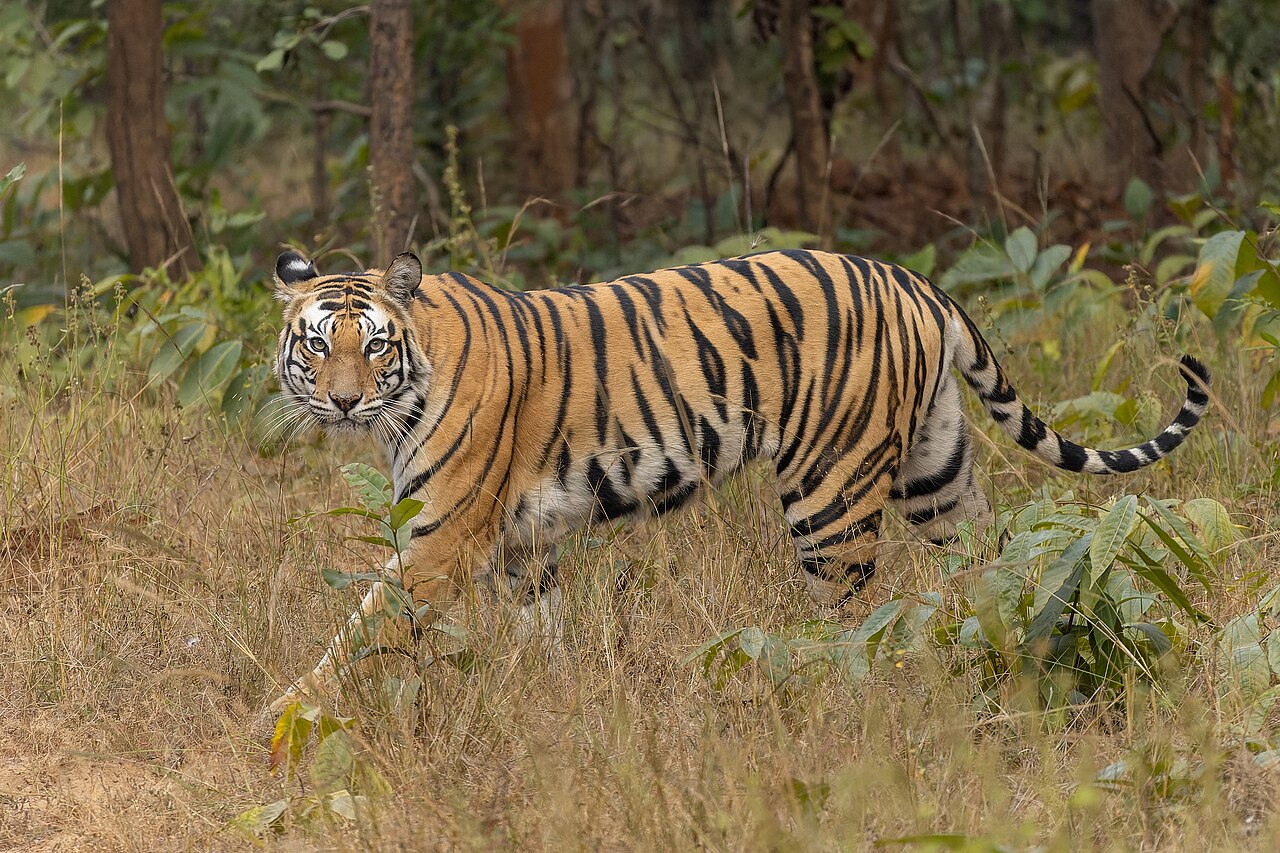
Native Biome: Tropical rainforests, mangroves, deciduous forests, and tall grasslands.
Bengal Tiger
Panthera tigris tigris
The genus "Panthera" derives from classical Greek "pān-thēr" (all beast), while "tigris" traces to Old Persian "tigra" meaning sharp, pointed, or swift as an arrow.
Linnaean Taxonomic Tree
200 to 260 kg (440 to 570 lbs)
Female: 140 to 180 kg (310 to 400 lbs)65 km/h (40 mph) in explosive 20-meter sprint bursts
Burst Acceleration1,050 PSI (nearly twice the bite force of a lion)
Crushing Power10 to 15 years in the wild
Captivity: 18 to 22 years in managed zoological careCompare Look-Alikes
vs African Leopard
Vision
Through their eyes
🐣Growth & Lifespan
Birth to old age slider
🔍 Distinctive Diagnostic Markings & Anatomy
Critical morphological field marks naturalists use to verify species identification in the wild.
Vibrant reddish-orange dorsal background with individual vertical black-to-dark-brown stripes. White ventral underbelly, throat, and inside legs.
Massive robust skull with elevated sagittal crest for jaw muscle anchor. Canines measure up to 7.5–10 cm (3–4 in)—the longest of any living cat.
Circular pupils with golden-amber irises (adapted for day and twilight vision, unlike small domestic cats which have vertical slits).
Rounded black ears with a striking central white spot ("ocelli" or false eyes). Enormous front paws with fully retractable claws up to 10 cm.
Thick ringed tail with a solid black tip used as a rudder during water swimming and as a signaling flag for cubs.
Males are approximately 30–40% heavier with distinctly broader jowls and thicker ruffs around the neck.
🍖 Trophic Role & Hunting Strategy
Apex PredatorSolitary stealth ambush hunter. Stalks through tall grass or mangrove water to within 10–20 meters before exploding into a devastating neck or throat bite that crushes the cervical vertebrae.
🏕️ Social Behavior & Activity Rhythms
CrepuscularSolitary and highly territorial. Male territories encompass 60–100 km² and overlap with 2–4 female ranges.
Mother raises cubs alone for 18–24 months before juveniles disperse to claim their own territories.
Life Cycle, Growth & Lifespan Journey
| Age | Stage | Length/Height | Weight |
|---|---|---|---|
| Birth | Blind Cub | 28–35 cm | 0.8–1.4 kg |
| 6 Months | Active Juvenile | 110–135 cm | 25–38 kg |
| 2 Years | Dispersing Subadult | 220–270 cm | 130–175 kg |
| 4+ Years | Prime Resident Apex Tiger | 260–330 cm | 180–260 kg |
How Big Will a Bengal Tiger Get?
Calculate estimated adult weight, shoulder height, remaining growth timeline, and weekly development rate based on current age and biometrics.
Conservation Status & Population Dynamics
~4,500 to 5,500 mature individuals worldwide (over 70% in India)
Subject to ongoing wildlife telemetry monitoring
- •Poaching for traditional medicine bone trade and skin pelts
- •Severe habitat fragmentation due to highway corridors and agricultural conversion
- •Retaliatory killing by rural villagers following livestock predation
- India Project Tiger & National Tiger Conservation Authority (NTCA)
- Global Tiger Forum (GTF)
- TX2 Global Tiger Recovery Program
Field Intelligence & Diagnostic Hub for Bengal Tiger
Thick ringed tail with a solid black tip used as a rudder during water swimming and as a signaling flag for cubs.
Audio frequency analysis, territorial roar/call synthesis, and harmonic resonance measurements.
Ecosystem food web, trophic interactions, and cohabiting species in Asia.
⚖️ Look-Alike Species Differentiation Matrix
Instant one-click comparison tools to prevent common field misidentifications
Bengal Tiger vs. African Leopard
Key DifferentiationTigers have vertical stripes and massive 200+ kg bulk; Leopards have rosette spots, lean 60 kg frame, and spend hours resting in tree branches.
Bengal Tiger vs. Jaguar
Key DifferentiationTigers have stripes and live in Asia; Jaguars have rosette markings with interior black spots, ultra-compact bulldog physiques, and live in the Americas.
Bengal Tiger vs. African Lion
Key DifferentiationTigers are solitary with striped orange coats; Lions live in social prides, possess uniform tawny-sand coats, and adult males feature magnificent dark manes.
How to Identify Bengal Tiger from a Photograph
Standard operating procedures for photographers and field naturalists submitting sightings for verification.
- 📷Right and left flank profiles: Stripe patterns are entirely asymmetrical and unique to each individual cat
- 📷Frontal head portrait: Facial whisker spot patterns and forehead markings allow algorithmic computer-vision recognition
- 📷Close-up of paw prints with a physical ruler for pugmark censusing
- 🔍Pure vertical stripe orientation (contrasting with leopard/jaguar rosettes)
- 🔍White ocelli spots on back of ears (visible from behind in dense brush)
- 🔍Heavy muscular shoulder hump and massive skull
- ⚠️Confusing distant orange blur with Leopard in thick forest canopies
- ⚠️Overexposing white belly fur in harsh direct sunlight
Frequently Asked Questions About Bengal Tiger
Verified answers compiled by zoologists, wildlife biologists, and field guides.
Related Identification Tools
Identify similar animals with focused photo tools for dogs, cats, birds, reptiles, fish, bugs, and more.