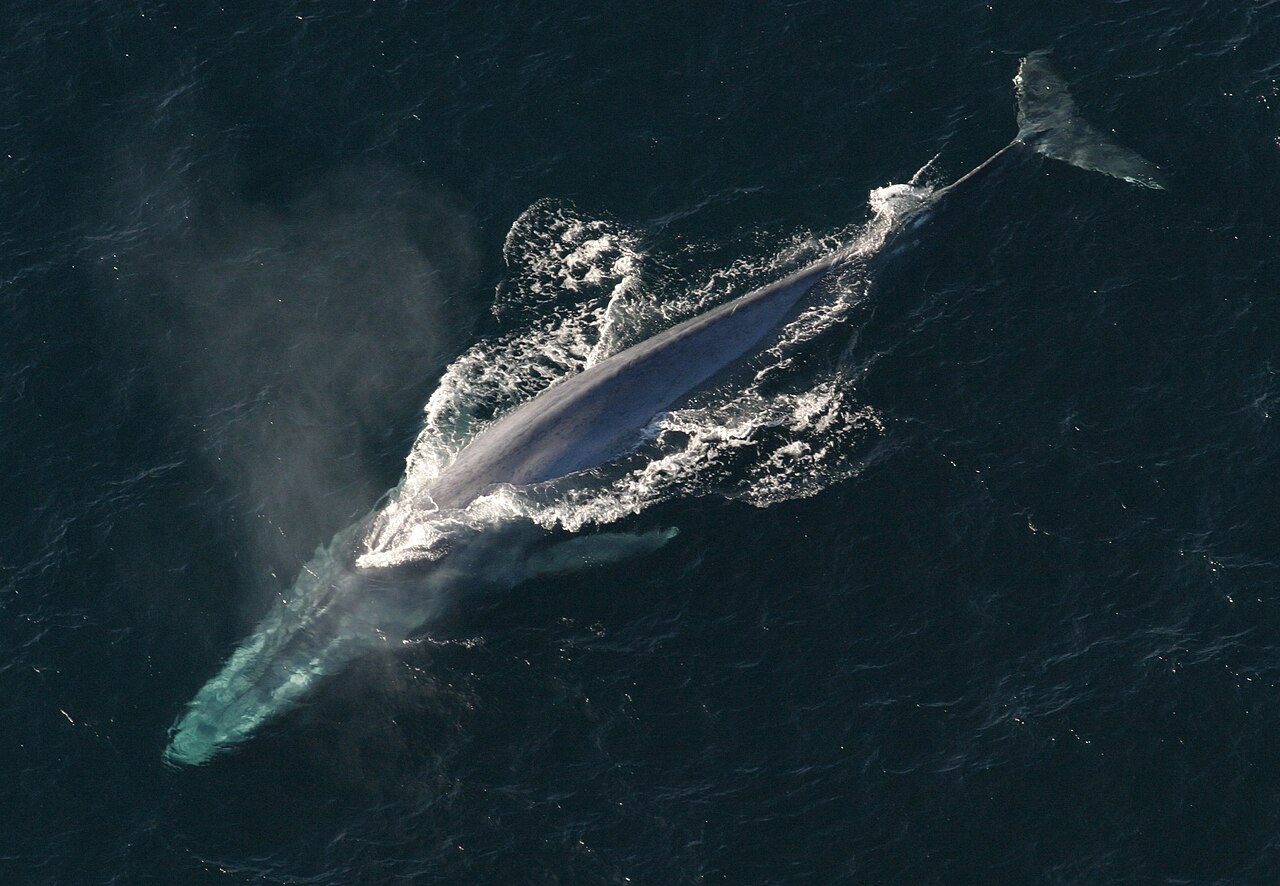
Native Biome: Open oceans worldwide, migrating between polar feeding grounds and tropical breeding waters.
Blue Whale
Balaenoptera musculus
Balaenoptera means “winged whale” (referring to dorsal fin form); musculus is Latin for “muscular” or historically “mouse” as ironic understatement for the largest animal.
Linnaean Taxonomic Tree
Up to ~100–150+ tonnes (adults)
Female: Females typically larger — up to ~150–180+ tonnes record classCruising ~20 km/h; bursts near 40–50 km/h reported when fleeing
Burst Acceleration70–90+ years
Captivity: Not kept in captivityCompare Look-Alikes
vs Orca
🐣Growth & Lifespan
Birth to old age slider
🔍 Distinctive Diagnostic Markings & Anatomy
Critical morphological field marks naturalists use to verify species identification in the wild.
Mottled blue-gray skin with unique pigment patterns usable for photo-ID; pale underside; small dorsal fin far aft.
Broad U-shaped rostrum with ~270–395 baleen plates per side; dual blowholes.
Relatively small eyes for body size, adapted to open ocean light.
Pectoral flippers; no hind limbs externally; massive flukes for propulsion.
Horizontal flukes up to ~7 m across; powerful upstroke drive.
Females average longer/heavier than males.
🍖 Trophic Role & Hunting Strategy
OmnivoreLunge-feeding on dense krill swarms — throat pleats expand enormously then water is filtered through baleen.
🏕️ Social Behavior & Activity Rhythms
CathemeralGenerally solitary or mother–calf pairs; loose aggregations on rich feeding grounds
Calves nurse rich milk for 6–8+ months; strong mother–calf bond
Life Cycle, Growth & Lifespan Journey
| Age | Stage | Length/Height | Weight |
|---|---|---|---|
| Birth / Hatch / Day 0 | Calf | 6–7 m | 2000–3000 kg |
| Early growth | Calf | 8.2–9.8 m | 13760–20640 kg |
| Mid juvenile | Juvenile | 12.3–15.1 m | 36300–54450 kg |
| Late juvenile | Juvenile | 16.8–20.8 m | 60800–91200 kg |
| Near maturity | Adult | 21.3–26.6 m | 85300–127950 kg |
How Big Will a Blue Whale Get?
Calculate estimated adult weight, shoulder height, remaining growth timeline, and weekly development rate based on current age and biometrics.
Conservation Status & Population Dynamics
Tens of thousands globally after near-extinction from whaling; still below pre-whaling numbers
Subject to ongoing wildlife telemetry monitoring
- •Ship strikes
- •Entanglement
- •Ocean noise
- •Climate-driven krill shifts
- IWC protections
- Shipping lane adjustments
- Photo-ID catalogs
Field Intelligence & Diagnostic Hub for Blue Whale
Horizontal flukes up to ~7 m across; powerful upstroke drive.
Audio frequency analysis, territorial roar/call synthesis, and harmonic resonance measurements.
Ecosystem food web, trophic interactions, and cohabiting species in Global Oceans.
⚖️ Look-Alike Species Differentiation Matrix
Instant one-click comparison tools to prevent common field misidentifications
Blue Whale vs. Orca
Key DifferentiationOrcas are much smaller black-and-white toothed whales; blue whales are enormous mottled blue-gray baleen whales.
How to Identify Blue Whale from a Photograph
Standard operating procedures for photographers and field naturalists submitting sightings for verification.
- 📷Clear side profile
- 📷Head/face close-up
- 📷Full body in natural light
- 🔍Immense size
- 🔍Mottled blue-gray skin
- 🔍Tiny dorsal far back
- 🔍Tall columnar blow
- ⚠️Confusing distant blows with fin whale
- ⚠️Underestimating length without scale reference
Frequently Asked Questions About Blue Whale
Verified answers compiled by zoologists, wildlife biologists, and field guides.
Related Identification Tools
Identify similar animals with focused photo tools for dogs, cats, birds, reptiles, fish, bugs, and more.



