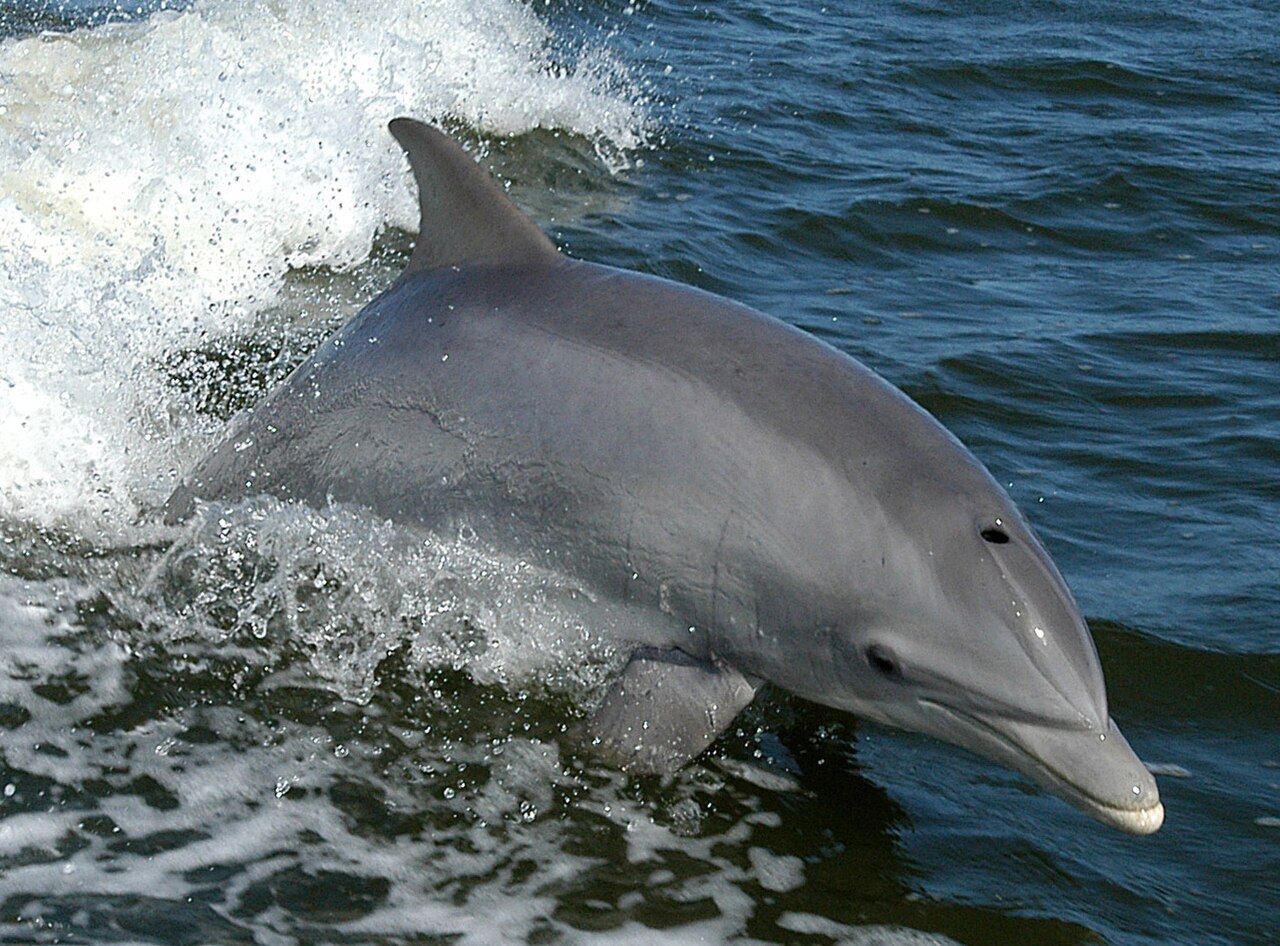
Native Biome: Warm temperate and tropical coastal waters, bays, estuaries, and offshore seas.
Common Bottlenose Dolphin
Tursiops truncatus
Tursiops means dolphin-like face; truncatus refers to the truncated/short snout look of the “bottle nose.”
Linnaean Taxonomic Tree
150–300 kg
Female: 150–250 kg~35–40 km/h bursts
Burst Acceleration40–50+ years
Captivity: 40–50 yearsCompare Look-Alikes
vs Orca
🐣Growth & Lifespan
Birth to old age slider
🔍 Distinctive Diagnostic Markings & Anatomy
Critical morphological field marks naturalists use to verify species identification in the wild.
Uniform gray fading to pale belly; short stout rostrum (“bottle nose”); curved dorsal fin.
Melon and conical teeth (~80–100); echolocation specialist.
Good vision above/below water; often spy-hop.
Pectoral flippers; flukes.
Horizontal flukes with midline notch.
Males often slightly larger; both sexes similar gray coloration.
🍖 Trophic Role & Hunting Strategy
Apex PredatorCooperative fish herding, strand feeding in some regions, individual hunting.
🏕️ Social Behavior & Activity Rhythms
CathemeralFission–fusion pods; complex alliances especially in males
Calves nurse 1–2+ years; strong mother–calf bond
Life Cycle, Growth & Lifespan Journey
| Age | Stage | Length/Height | Weight |
|---|---|---|---|
| Birth / Hatch / Day 0 | Calf | 0.9–1.3 m | 10–20 kg |
| Early growth | Calf | 1.1–1.6 m | 26.8–53.6 kg |
| Mid juvenile | Juvenile | 1.5–2.2 m | 59–118 kg |
| Late juvenile | Juvenile | 1.9–2.9 m | 94–188 kg |
| Near maturity | Adult | 2.3–3.6 m | 129–258 kg |
How Big Will a Common Bottlenose Dolphin Get?
Calculate estimated adult weight, shoulder height, remaining growth timeline, and weekly development rate based on current age and biometrics.
Conservation Status & Population Dynamics
Hundreds of thousands globally; some local populations threatened
Subject to ongoing wildlife telemetry monitoring
- •Bycatch
- •Pollution
- •Habitat degradation
- •Boat strikes
- •Captivity issues
- Marine protected areas
- Fishing gear reforms
- Strand response networks
Field Intelligence & Diagnostic Hub for Common Bottlenose Dolphin
Horizontal flukes with midline notch.
Audio frequency analysis, territorial roar/call synthesis, and harmonic resonance measurements.
Ecosystem food web, trophic interactions, and cohabiting species in Global Oceans.
⚖️ Look-Alike Species Differentiation Matrix
Instant one-click comparison tools to prevent common field misidentifications
Common Bottlenose Dolphin vs. Orca
Key DifferentiationOrcas are larger with black-white patterning and taller dorsals; bottlenose are mid-sized and gray.
How to Identify Common Bottlenose Dolphin from a Photograph
Standard operating procedures for photographers and field naturalists submitting sightings for verification.
- 📷Clear side profile
- 📷Head/face close-up
- 📷Full body in natural light
- 🔍Short bottle nose
- 🔍Uniform gray
- 🔍Curved dorsal
- 🔍Playful leaping
- ⚠️Confusing with other Tursiops/coastal dolphins
- ⚠️Assuming all smiling faces are happy (anatomy, not emotion)
Frequently Asked Questions About Common Bottlenose Dolphin
Verified answers compiled by zoologists, wildlife biologists, and field guides.
Related Identification Tools
Identify similar animals with focused photo tools for dogs, cats, birds, reptiles, fish, bugs, and more.



