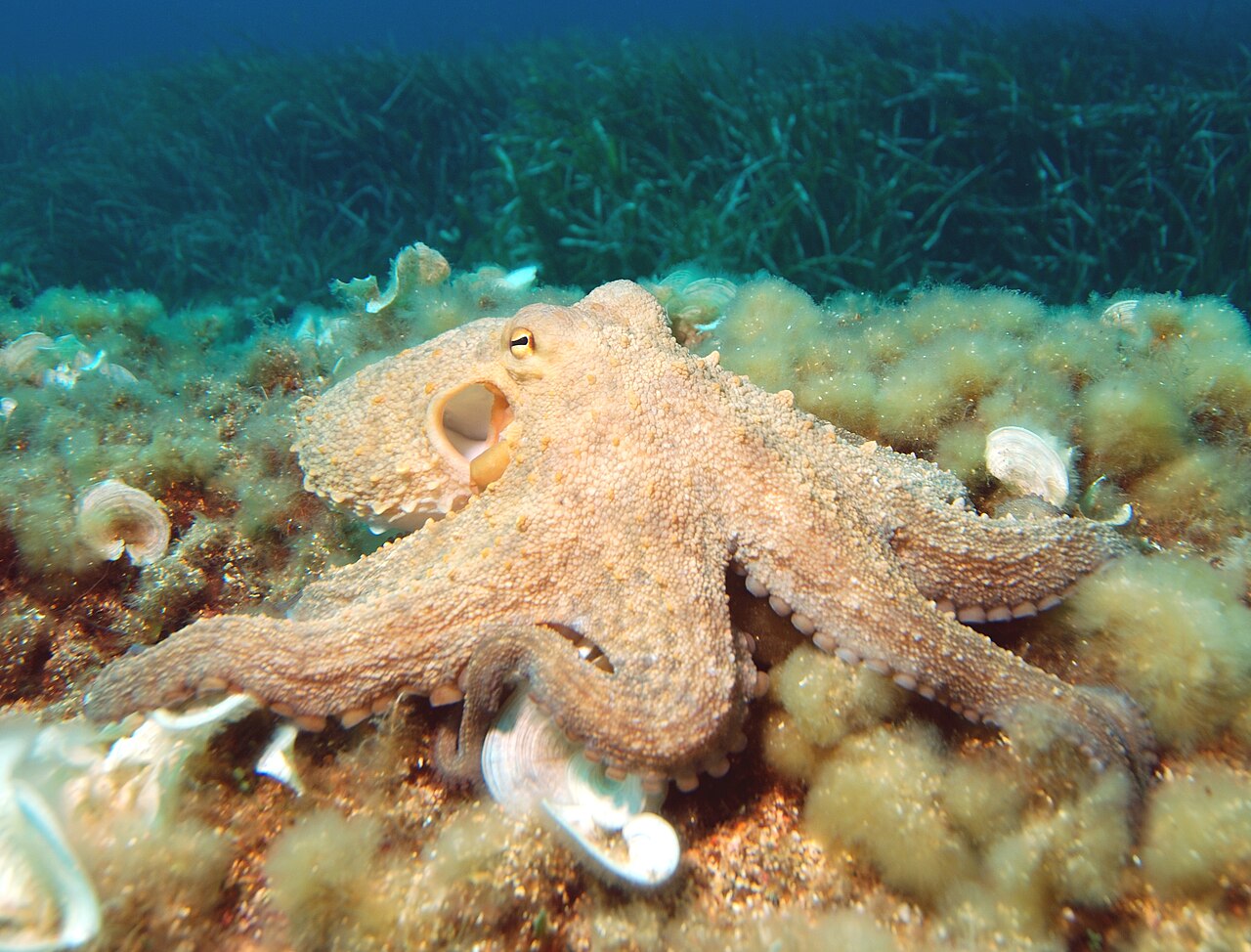
Native Biome: Cold rocky coastal ocean dens, kelp forests, and deep ocean reefs down to 1,500 meters.
Giant Pacific Octopus
Enteroctopus dofleini
Enteroctopus means “entrails octopus” historically; dofleini honors Franz Doflein; “giant Pacific” describes size and range.
Linnaean Taxonomic Tree
Up to ~15–50+ kg large adults
Female: Similar; females huge when gravidJet propulsion bursts via siphon; usually crawls
Burst Acceleration3–5 years typical
Captivity: Similar; females die after broodingCompare Look-Alikes
vs Common Bottlenose Dolphin
🐣Growth & Lifespan
Birth to old age slider
🔍 Distinctive Diagnostic Markings & Anatomy
Critical morphological field marks naturalists use to verify species identification in the wild.
Reddish to mottled brown skin with papillae; soft body; eight arms with suckers; no bones except beak.
Chitinous beak; advanced camera eyes; large brain relative to invertebrates.
Camera-style eyes with excellent vision; W-shaped pupils sometimes noted in octopuses.
Eight arms lined with suckers; no tentacles (those are squid/cuttlefish features).
No tail — mantle and funnel for jetting.
Males have a hectocotylus arm for mating; females brood eggs.
🍖 Trophic Role & Hunting Strategy
Apex PredatorNocturnal hunter — uses arms and beak on crabs, clams, fish; venomous saliva aids subdual.
🏕️ Social Behavior & Activity Rhythms
Strictly NocturnalSolitary; short adult lifespan after reproduction (semelparous)
Female constantly tends eggs then dies; no further care
Life Cycle, Growth & Lifespan Journey
| Age | Stage | Length/Height | Weight |
|---|---|---|---|
| Birth / Hatch / Day 0 | Hatchling | 1–2 cm | 0.02–0.05 kg |
| Early growth | Hatchling | 36.9–61.8 cm | 1.8–6 kg |
| Mid juvenile | Juvenile | 106–176 cm | 5.3–17.5 kg |
| Late juvenile | Juvenile | 180–301 cm | 9–30 kg |
| Near maturity | Adult | 255–425 cm | 12.8–42.5 kg |
How Big Will a Giant Pacific Octopus Get?
Calculate estimated adult weight, shoulder height, remaining growth timeline, and weekly development rate based on current age and biometrics.
Conservation Status & Population Dynamics
Widespread in North Pacific; hard to census
Subject to ongoing wildlife telemetry monitoring
- •Fisheries bycatch/harvest
- •Ocean warming
- •Acidification impacts on prey
- Fishery management
- Aquarium education
- Habitat protection
Field Intelligence & Diagnostic Hub for Giant Pacific Octopus
No tail — mantle and funnel for jetting.
Audio frequency analysis, territorial roar/call synthesis, and harmonic resonance measurements.
Ecosystem food web, trophic interactions, and cohabiting species in Global Oceans.
⚖️ Look-Alike Species Differentiation Matrix
Instant one-click comparison tools to prevent common field misidentifications
Giant Pacific Octopus vs. Common Bottlenose Dolphin
Key DifferentiationDolphins are mammals with flukes; giant Pacific octopuses are soft-bodied cephalopods with eight arms.
How to Identify Giant Pacific Octopus from a Photograph
Standard operating procedures for photographers and field naturalists submitting sightings for verification.
- 📷Clear side profile
- 📷Head/face close-up
- 📷Full body in natural light
- 🔍Eight suckered arms
- 🔍No fins like squid
- 🔍Color-changing skin
- 🔍Large size for octopus
- ⚠️Calling arms tentacles
- ⚠️Confusing with squid (10 appendages, different body)
Frequently Asked Questions About Giant Pacific Octopus
Verified answers compiled by zoologists, wildlife biologists, and field guides.
Related Identification Tools
Identify similar animals with focused photo tools for dogs, cats, birds, reptiles, fish, bugs, and more.