Native Biome: Cold coastal waters, open pelagic oceans, and polar ice edges worldwide.
Orca (Killer Whale)
Orcinus orca
Orcinus relates to the realm of the dead/Orcus; orca historically meant a kind of whale; “killer whale” from observing predation on other whales.
Linnaean Taxonomic Tree
4,000–6,000+ kg
Female: 2,500–4,000 kg~55 km/h bursts
Burst AccelerationFemales 50–80+ years; males often 30–50
Captivity: Similar historically in marine parks (controversial)Compare Look-Alikes
vs Common Bottlenose Dolphin
🐣Growth & Lifespan
Birth to old age slider
🔍 Distinctive Diagnostic Markings & Anatomy
Critical morphological field marks naturalists use to verify species identification in the wild.
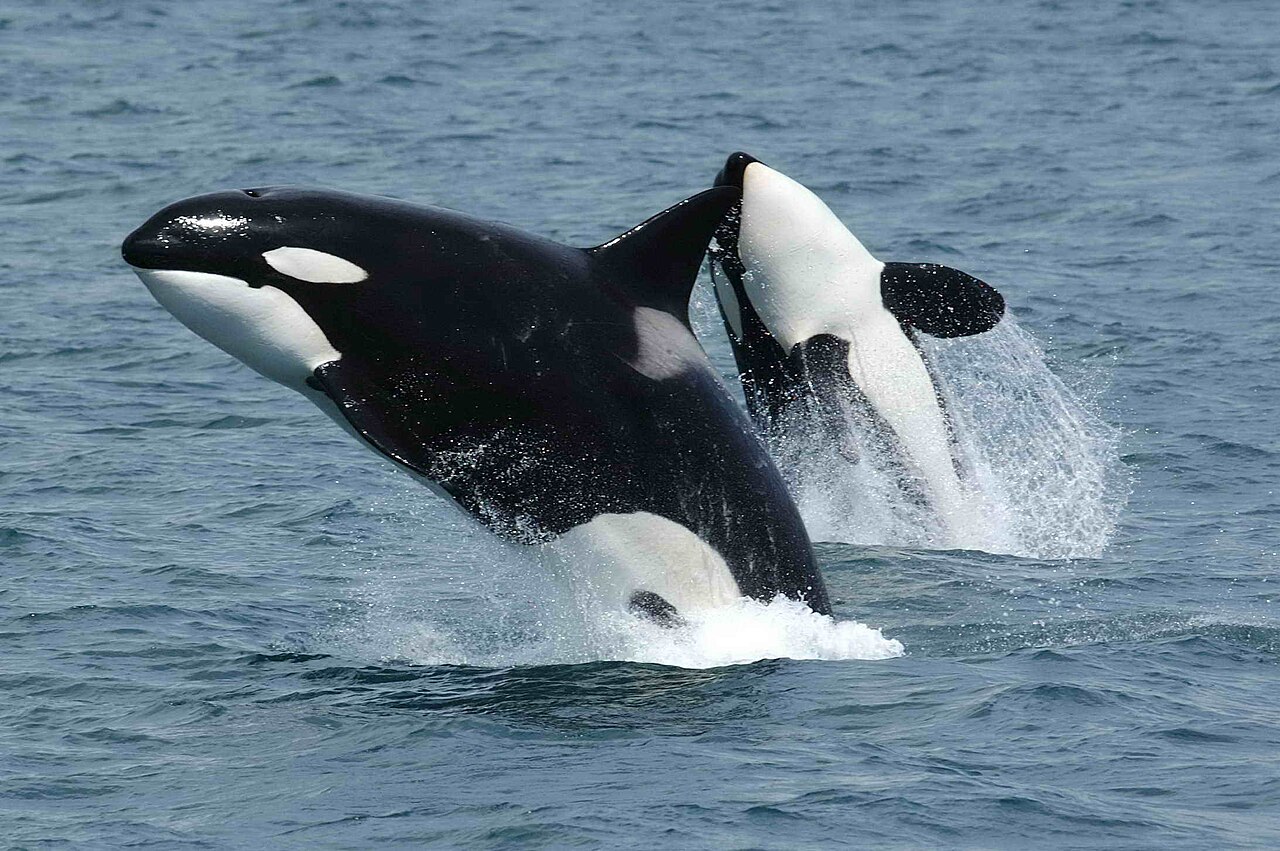
Black dorsal, white belly, white eye patch, gray saddle patch behind dorsal — pattern unique for photo-ID.
Toothed whale with conical teeth; no baleen; melon for echolocation.
Lateral eyes; echolocation primary for hunting in many conditions.
Pectoral flippers (males’ larger/paddle-like); flukes for propulsion.
Horizontal flukes; powerful underwater propulsion.
Males larger with much taller triangular dorsal fins; females’ dorsals more curved.
🍖 Trophic Role & Hunting Strategy
Apex PredatorCooperative pod hunting — fish-eating and mammal-eating ecotypes with cultural techniques (beaching, wave-washing, carousel feeding).
🏕️ Social Behavior & Activity Rhythms
CathemeralMatrilineal pods with complex culture
Long nursing and alloparental care in pods; postmenopausal females lead in some populations
Life Cycle, Growth & Lifespan Journey
| Age | Stage | Length/Height | Weight |
|---|---|---|---|
| Birth / Hatch / Day 0 | Calf | 2–2.5 m | 150–200 kg |
| Early growth | Calf | 2.4–3.3 m | 432–896 kg |
| Mid juvenile | Juvenile | 3.1–4.8 m | 972.5–2230 kg |
| Late juvenile | Juvenile | 3.8–6.4 m | 1560–3680 kg |
| Near maturity | Adult | 4.6–8 m | 2147.5–5130 kg |
How Big Will a Orca (Killer Whale) Get?
Calculate estimated adult weight, shoulder height, remaining growth timeline, and weekly development rate based on current age and biometrics.
Conservation Status & Population Dynamics
Tens of thousands globally; some populations critically small
Subject to ongoing wildlife telemetry monitoring
- •Prey depletion
- •PCBs/pollution
- •Vessel noise
- •Oil spills
- •Captivity issues
- Southern Resident recovery
- Noise reduction
- Prey restoration
Field Intelligence & Diagnostic Hub for Orca (Killer Whale)
Horizontal flukes; powerful underwater propulsion.
Audio frequency analysis, territorial roar/call synthesis, and harmonic resonance measurements.
Ecosystem food web, trophic interactions, and cohabiting species in Global Oceans.
⚖️ Look-Alike Species Differentiation Matrix
Instant one-click comparison tools to prevent common field misidentifications
Orca (Killer Whale) vs. Common Bottlenose Dolphin
Key DifferentiationBottlenose dolphins are smaller and uniformly gray without orca’s stark black-white patches and tall male dorsal.
Orca (Killer Whale) vs. Blue Whale
Key DifferentiationBlue whales are enormous mottled blue-gray baleen filter feeders; orcas are black-and-white toothed hunters.
How to Identify Orca (Killer Whale) from a Photograph
Standard operating procedures for photographers and field naturalists submitting sightings for verification.
- 📷Clear side profile
- 📷Head/face close-up
- 📷Full body in natural light
- 🔍Black-and-white pattern
- 🔍White eye patch
- 🔍Tall male dorsal
- 🔍Gray saddle
- ⚠️Confusing distant dolphins
- ⚠️Ignoring ecotype differences
Frequently Asked Questions About Orca (Killer Whale)
Verified answers compiled by zoologists, wildlife biologists, and field guides.
Related Identification Tools
Identify similar animals with focused photo tools for dogs, cats, birds, reptiles, fish, bugs, and more.