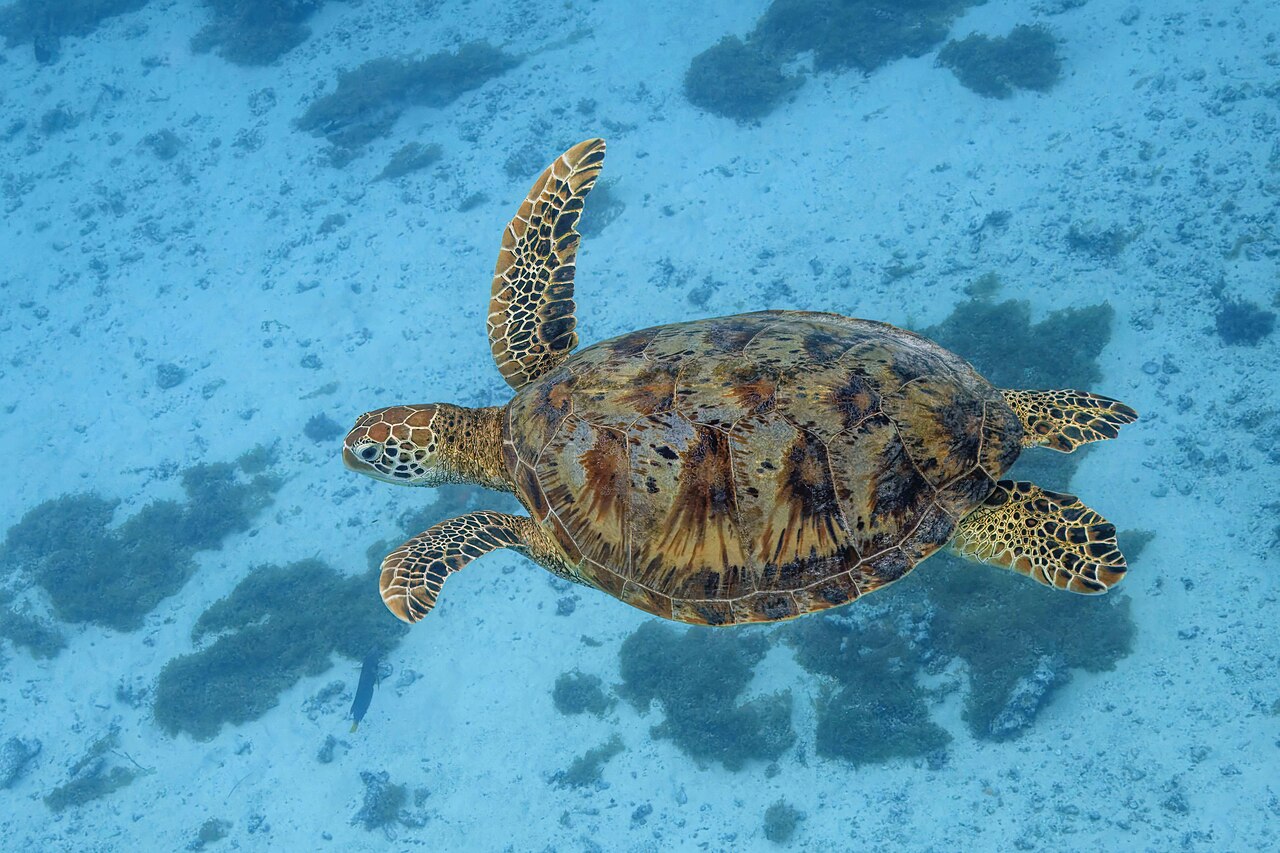
Native Biome: Tropical and subtropical coastal waters, coral reefs, and sandy nesting beaches.
Green Sea Turtle
Chelonia mydas
Named for greenish fat, not always green shell; large marine herbivore as adults.
Linnaean Taxonomic Tree
100–200 kg
Female: SimilarStrong open-ocean swimmer
Burst Acceleration60–70+ years
Captivity: N/ACompare Look-Alikes
vs Hawksbill Sea Turtle
🐣Growth & Lifespan
Birth to old age slider
🔍 Distinctive Diagnostic Markings & Anatomy
Critical morphological field marks naturalists use to verify species identification in the wild.
Smooth carapace; olive to brown; paddle flippers.
Blunt single-pair prefrontal scales typical.
Large salt-excreting.
Flippers — not feet.
Longer in males
Males longer tails
🍖 Trophic Role & Hunting Strategy
Primary HerbivoreAdults graze seagrass/algae
🏕️ Social Behavior & Activity Rhythms
DiurnalMigratory; nesting aggregations
None after nesting
Life Cycle, Growth & Lifespan Journey
| Age | Stage | Length/Height | Weight |
|---|---|---|---|
| Hatch | Hatchling Emergence | 4.5–5.5 cm | 20–30 g |
| 1 Year | Pelagic Post-Hatchling | 12–18 cm | 300–600 g |
| 10 Years | Coastal Juvenile | 45–60 cm | 18–35 kg |
| 30 Years | Prime Breeding Adult | 90–115 cm | 130–190 kg |
| 70+ Years | Centenarian Elder | 105–130 cm | 160–230 kg |
How Big Will a Green Sea Turtle Get?
Calculate estimated adult weight, shoulder height, remaining growth timeline, and weekly development rate based on current age and biometrics.
Conservation Status & Population Dynamics
Recovering in some rookeries; still threatened
Subject to ongoing wildlife telemetry monitoring
- •Bycatch
- •Hunting
- •Egg harvest
- •Plastic
- •Beach loss
- Habitat protection
- Public education
Field Intelligence & Diagnostic Hub for Green Sea Turtle
Longer in males
Audio frequency analysis, territorial roar/call synthesis, and harmonic resonance measurements.
Ecosystem food web, trophic interactions, and cohabiting species in Global Oceans.
⚖️ Look-Alike Species Differentiation Matrix
Instant one-click comparison tools to prevent common field misidentifications
Green Sea Turtle vs. Hawksbill Sea Turtle
Key DifferentiationHawksbills have overlapping scutes and a hawk-like beak; greens have smoother scutes and a blunter head.
How to Identify Green Sea Turtle from a Photograph
Standard operating procedures for photographers and field naturalists submitting sightings for verification.
- 📷Clear side profile
- 📷Head/face close-up
- 📷Full body in natural light
- 🔍Teardrop shell
- 🔍Flippers
- 🔍Smooth carapace
- 🔍Herbivore adult
- ⚠️Confusing with hawksbill (overlapping scutes, hawk beak)
Frequently Asked Questions About Green Sea Turtle
Verified answers compiled by zoologists, wildlife biologists, and field guides.
Related Identification Tools
Identify similar animals with focused photo tools for dogs, cats, birds, reptiles, fish, bugs, and more.



