Buckskin Horse: Color, Genetics, Breeds, Types, and How They Compare
The complete guide to the gold horse with black points: what makes a buckskin, every shade from light to sooty, how the genetics work, how to tell it from a dun, palomino, bay or roan, which breeds produce it, and what to check before you buy one.
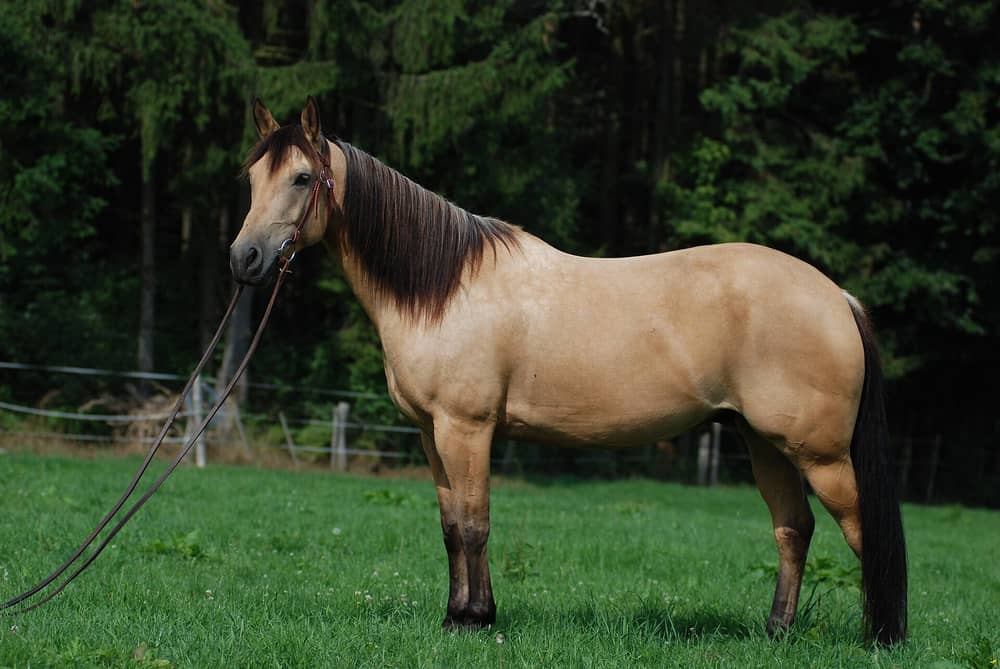
A buckskin horse has a tan, gold, yellow or bronze body with a black mane, black tail and black lower legs. The American Paint Horse Association’s color definition puts it simply: “body color yellowish or gold; mane and tail black; black on lower legs; lacks primitive markings” (APHA).
Buckskin is a coat color, not a breed. Genetically, a buckskin is a bay horse carrying one copy of the cream dilution gene. Cream lightens the bay’s red-brown body to gold but barely touches the black mane, tail and legs (UC Davis VGL). That is why many unrelated breeds, from Quarter Horses and Mustangs to Akhal-Tekes and Connemara ponies, can be buckskin.
Buckskins are often confused with duns, palominos, bays and a few rarer colors. This guide walks through the whole picture in order: what a buckskin looks like, the genetics behind it, how to identify one, how it compares with look-alikes, which breeds produce it, and what matters for care, price and buying.
Quick Facts About Buckskin Horses
| Feature | Buckskin horse |
|---|---|
| Type | Coat color, not a breed |
| Base color | Bay (black pigment limited to the “points” by the agouti gene) |
| Key gene | One copy of the cream dilution gene (N/Cr) |
| Body color | Tan, cream, gold, yellow or bronze |
| Mane and tail | Usually black |
| Legs / points | Usually black lower legs and ear rims |
| Eyes and skin | Usually brown eyes and dark skin |
| Two cream copies | Perlino: near-white body, blue eyes, pink skin (not buckskin) |
| Common breeds | Quarter Horse, Mustang, Morgan, Paint, Akhal-Teke, Lusitano, Connemara and many more |
| Temperament | Depends on breed, training and the individual horse, not on color |
| Main look-alikes | Dun, palomino, bay, amber champagne, silver bay |
What Is a Buckskin Horse?
Short answer
A buckskin horse is a horse with a tan to gold body and black points (mane, tail, lower legs and usually ear rims), created when a bay horse inherits one copy of the cream dilution gene.
The name comes from the color of tanned deer hide. Registries and veterinary references describe the same picture. USDA’s veterinary identification guide defines a buckskin as “a gold or yellowish body color with a black mane and tail,” usually black on the lower legs and usually without a dorsal stripe (USDA APHIS).
Why is the body lighter than a normal bay? A bay’s body is red-brown pigment (pheomelanin), while its points are black pigment (eumelanin). One copy of cream strongly dilutes red pigment but has little visible effect on black pigment (UC Davis VGL). The red-brown body becomes gold, while the black mane, tail and legs stay black.
Why is buckskin a color and not a breed? A breed is a population with shared ancestry, a studbook and a breed standard. Buckskin is simply a gene combination, and cream has been found in 25 of 28 breeds tested in one large study (Genes 2022). Color registries such as the International Buckskin Horse Association register horses by color across many breeds (IBHA).
Are all buckskins the same shade? No. Buckskins range from pale cream-tan to rich gold to a deep bronze that looks almost bay. Shade, sooty hairs, season, sun-bleaching and lighting all change how a buckskin looks. The shades are covered in the next section.
What Does a Buckskin Horse Look Like?
Where to look on a buckskin: numbered points match the legend below.
- 1Ear rims: Often edged in black, like a bay’s.
- 2Eye: Usually brown on adults, set in dark skin.
- 3Mane: Black. Sun can bleach the tips reddish.
- 4Back: No dorsal stripe required. A crisp stripe suggests dun.
- 5Body: Tan to gold: the bay’s red pigment diluted by one cream gene.
- 6Tail: Black, matching the mane.
- 7Front lower leg: Black “points”, unless a white sock covers them.
- 8Hind lower leg: Black points, sometimes reaching above the hock.
- 9Hooves: Usually dark; lighter under white leg markings.
Photo: Derrick Coetzee, CC0, via Wikimedia Commons
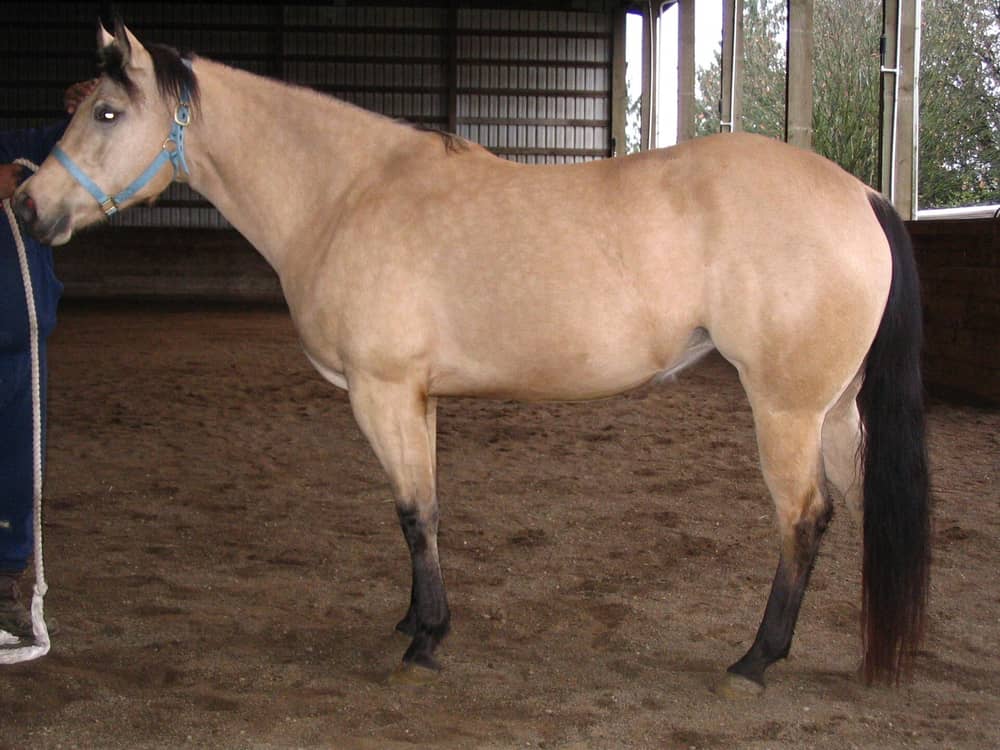
- Body: tan, cream, gold, yellow or bronze, often with a glossy sheen in summer. Some buckskins show dapples.
- Mane: black. Long sun exposure can bleach the ends reddish-brown, but the base is black.
- Tail: black, matching the mane.
- Legs: black from roughly the knees and hocks down (the “points”). White socks or stockings replace the black where they occur.
- Face: usually the same tone as the body or slightly darker, with black-edged ears. Face markings such as a star, stripe or blaze are common and unrelated to buckskin color.
- Eyes: usually brown in adult buckskins. Single-cream horses sometimes have slightly lighter brown eyes. Blue eyes with pink skin point to a double-cream horse such as a perlino, not a buckskin (UC Davis VGL).
- Skin: dark gray-black under the coat, visible around the muzzle and eyes. Pink, freckled skin suggests champagne rather than buckskin (UC Davis VGL).
- Hooves: usually dark on black legs; hooves under white markings are lighter.
Buckskin Horse Color
Buckskin color is not one fixed shade but a family of shades that share one rule: a diluted, gold-toned body with black points. Several things affect where a horse falls in that family.
Typical Buckskin Color
The textbook buckskin has an even tan-to-gold body, black mane and tail, black lower legs and black-rimmed ears. Some people call a very pale buckskin “cream” and a darker one “bronze” or “smutty”, but these are descriptive words, not separate genes.
Lighting changes everything. Bright sun can make a buckskin look almost yellow, while shade, overcast skies and indoor lighting push it toward brown. Phone cameras often shift the tone further. Judge color in soft daylight, and look at the points as well as the body.
Seasonal coat changes matter too. The sleek summer coat usually shows the clearest, glossiest gold. The longer winter coat often looks duller, dustier or darker. Foals are often born a paler, fuzzier version of their adult color and settle into it after shedding the foal coat. Sun can also bleach a black mane and tail toward rust.
Buckskin Color Variations
Horse people use four main labels for buckskin shades. The genetics of shade are still only partly understood; UC Davis notes that researchers “still have a lot to learn” about shade variation within base colors (VGL).
Light Buckskin
A light buckskin has a pale cream, sand or light tan body. It can look almost white-gold in summer sun.
How it differs from a palomino: a light buckskin keeps black mane, tail, lower legs and ear rims. A palomino has a cream-white mane and tail and no black on the legs at all. If a pale horse has black points, it is not a palomino.
Very pale horses with blue eyes and pink skin are more likely to be perlinos (bay with two cream copies) than light buckskins.
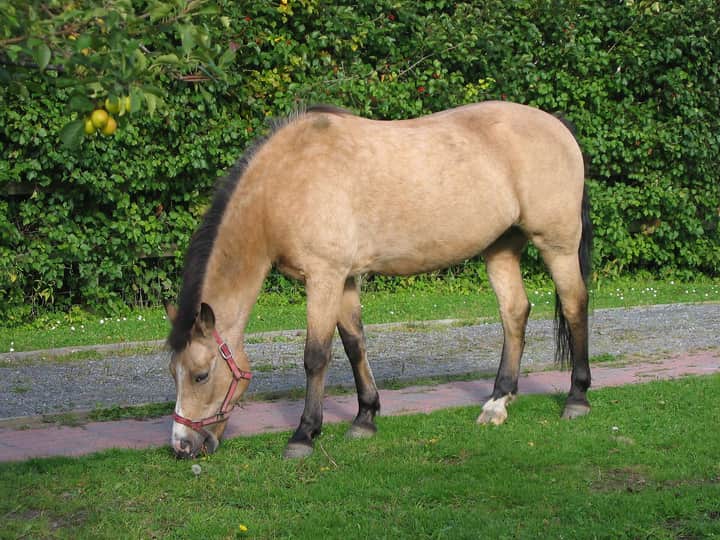
Light buckskin (New Forest pony): pale cream-tan body, but the mane, tail and legs stay dark.
Photo: Paula Jantunen, public domain, via Wikimedia Commons
Golden Buckskin
The golden buckskin is the classic, most recognizable shade: a bright, even yellow-gold body that contrasts sharply with black points. It is the look most people mean when they say “buckskin.”
In breeds with a naturally metallic coat, such as the Akhal-Teke, a golden buckskin can shine with an almost reflective gold sheen (ATAA).
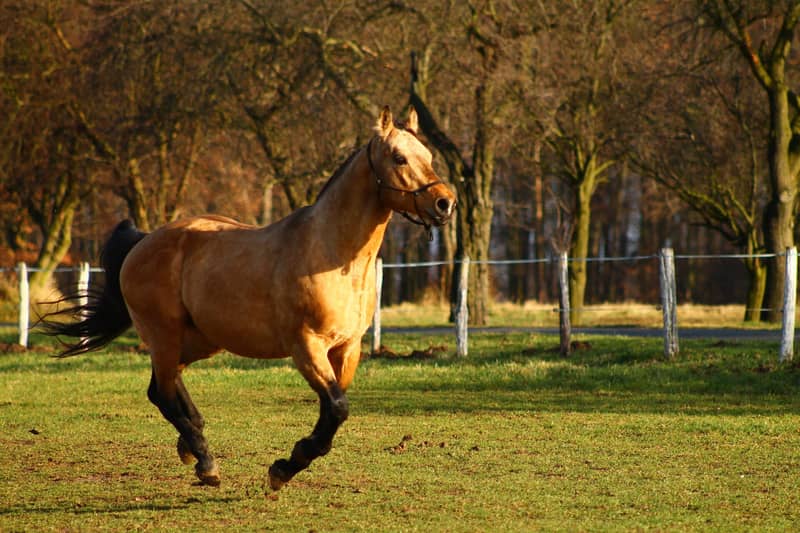
Golden buckskin: the bright, even yellow-gold shade most people picture.
Photo: Raketabill, CC BY-SA 3.0, via Wikimedia Commons
Dark Buckskin
A dark buckskin has a deep tan, brown-gold or bronze body with black points. Some are so dark they are easy to register or sell as bay.
Why do some buckskins look almost brown? A very dark red-brown bay, diluted by one cream copy, still ends up a fairly deep shade. Many dark buckskins also carry sooty hairs (below). The Akhal-Teke Association of America notes that dark buckskins in that breed are often mistaken for bay, yet two of them can produce perlinos and cremellos, which proves they carry cream (ATAA).
If you are unsure whether a horse is a dark buckskin or a bay, a cream DNA test answers it directly.
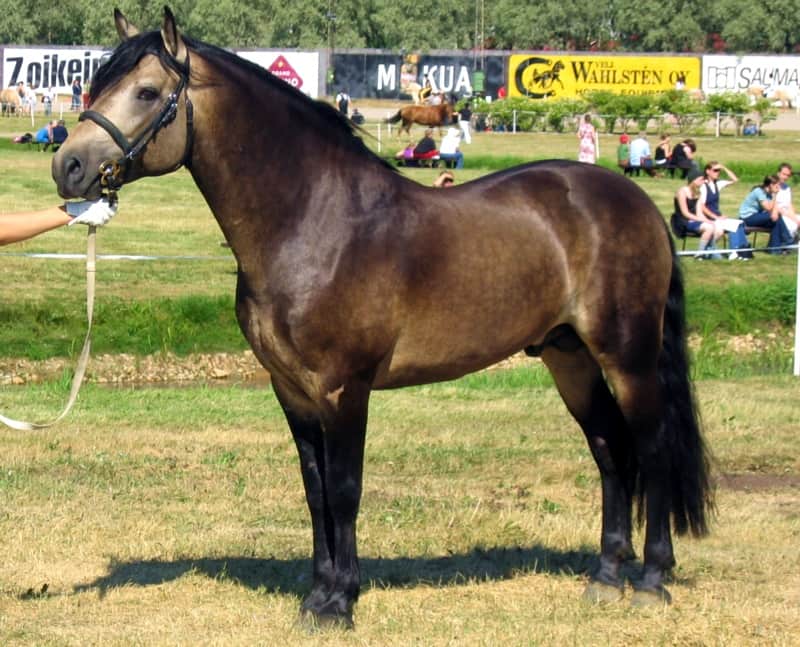
Dark buckskin Connemara stallion. This shade is easy to mistake for bay, but he carries cream: he is a proven buckskin sire.
Photo: Satu Pitkänen, CC BY-SA 3.0, via Wikimedia Commons
Sooty Buckskin
“Sooty” (sometimes “smutty”) describes darker or black-tipped hairs mixed into the coat, usually concentrated along the topline (neck, withers, back and hindquarters) and fading toward the belly. The effect is especially visible on buckskins and palominos. It is thought to be inherited through several genes, but the details are not yet known (overview).
A sooty buckskin can look much darker than a clear-coated one, sometimes with a darker face, a “dappled” effect or a soft, blurry line down the back. That line is countershading, not a dun stripe: a true dun stripe is crisp-edged and runs cleanly from mane to tail.
Sooty buckskin vs dark buckskin: a dark buckskin is darker all over, while a sooty buckskin is darker from the top down, with a lighter belly, flanks and lower body. Many horses are both. The Akhal-Teke Association of America treats “dark buckskin” in that breed as a buckskin carrying the sooty factor (ATAA).
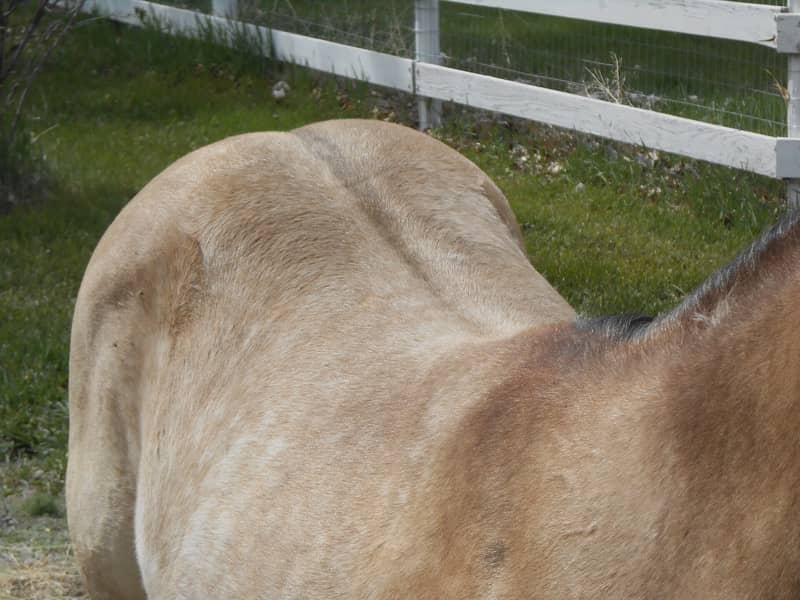
Sooty (countershaded) buckskin: darker hairs across the topline create a soft, blurry line that is not a true dun stripe.
Photo: Montanabw, CC BY-SA 4.0, via Wikimedia Commons
Buckskin Horse With a Blonde Mane
Short answer
A true buckskin has a black mane and tail. A buckskin-looking horse with a blonde, flaxen or silver mane is usually a different or combined color, or a black mane that has been sun-bleached.
Here is what usually explains a light mane on a gold horse:
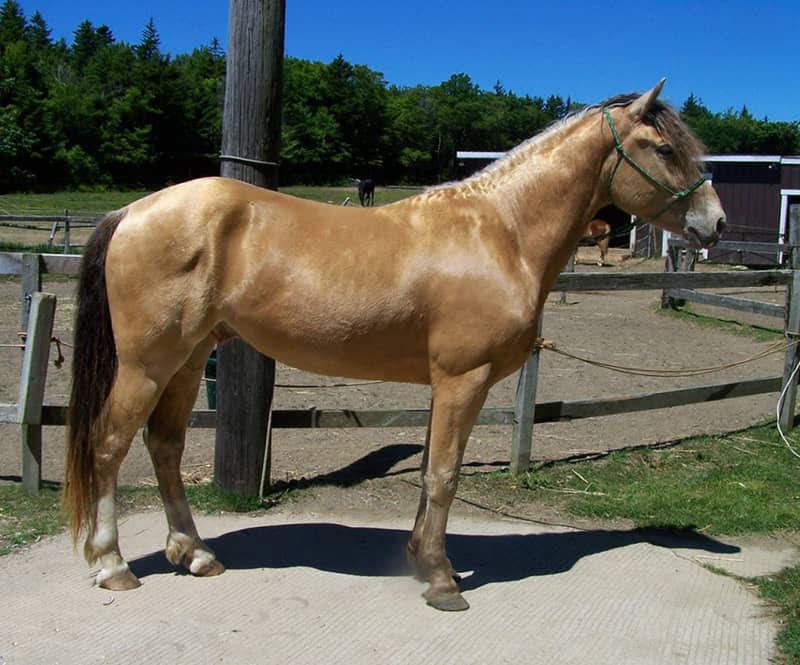
Amber champagne, a common buckskin look-alike: gold body but brown (not black) points, with pinkish freckled skin and light eyes.
Photo: Cook, Brooks, Bellone & Bailey, CC BY-SA 3.0, via Wikimedia Commons
- Sun-bleaching: long hours outdoors can fade the ends of a black mane and tail to rust or reddish-brown. The roots stay black.
- Silver gene: silver lightens black pigment, so it turns black manes and tails flaxen or silver-gray. A bay or buckskin that also carries silver can look like a “buckskin with a blonde mane” (UC Davis VGL).
- Amber champagne: a gold body with brown, not black, points, plus pinkish freckled skin and amber or green eyes. Champagne horses were historically often registered as buckskin (UC Davis VGL).
- Palomino: a gold body with a cream or white mane and tail and no black on the legs. This is a chestnut-based color, not a buckskin.
- Dun “frosting”: some duns and a few buckskins show lighter hairs on the edges of the mane and tail, while the center stays dark.
What Makes a Horse a Buckskin?
Short answer
Bay base coat + one cream dilution allele = buckskin.
You can think of it as a two-step recipe:
- 1Start with the base coat. Every horse has one of three base colors: chestnut (red all over), black (black all over) or bay (red-brown body with black points).
- 2Extension and agouti decide the base. The extension gene decides whether a horse can make black pigment at all; two copies of the recessive e make a chestnut (VGL red factor). If black is possible, the agouti gene decides where it goes. With at least one A, black is restricted to the points and the horse is bay; with a/a, black covers the body and the horse is black (VGL agouti).
- 3Add one cream dilution allele. Cream lightens red pigment. On a bay, that turns the red-brown body gold and leaves the black points black: a buckskin (VGL cream).
| Base color | No cream (N/N) | One cream (N/Cr) | Two cream (Cr/Cr) |
|---|---|---|---|
| Bay (E_ A_) | Bay | Buckskin | Perlino |
| Chestnut (e/e) | Chestnut / sorrel | Palomino | Cremello |
| Black (E_ a/a) | Black | Smoky black | Smoky cream |
Why exactly one copy? Cream is incompletely dominant: one copy dilutes mainly red pigment, while two copies dilute both red and black. A bay with two cream copies is a perlino: an off-white horse with a slightly darker mane and tail, blue eyes and pink skin, not a buckskin (VGL cream; AMHA).
The cream mutation was identified in the SLC45A2 (formerly MATP) gene in 2003 (Mariat et al.).
Buckskin Horse Genetics
You do not need a genetics degree to understand buckskin breeding. Three genes matter most, and cream follows simple, predictable odds.
How Buckskin Color Is Inherited
| Gene (locus) | What it does | What a buckskin needs |
|---|---|---|
| Extension (E/e), also called red factor | Decides whether the horse can make black pigment. Two copies of e (e/e) make a chestnut. | At least one E |
| Agouti (A/a) | Pushes black pigment to the points (mane, tail, lower legs, ear rims). a/a lets black cover the whole body. | At least one A |
| Cream (N/Cr), gene SLC45A2 | One copy dilutes red pigment to gold. Two copies dilute red and black pigment to cream. | Exactly one Cr |
| Dun (D/nd1/nd2), gene TBX3 | A separate dilution that lightens the body and adds primitive markings. | Not required. Buckskin plus dun is a “buckskin dun” or “dunskin”. |
Bay base coat: the horse needs at least one E (extension) and at least one A (agouti). Written in shorthand, a bay is E_ A_, where “_” means either allele.
E locus (extension): E allows black pigment; e/e produces chestnut. A horse that is E/E can never have a chestnut foal, because it always passes on an E (VGL).
Agouti: A restricts black to the mane, tail, lower legs and ear rims. Agouti has no visible effect on chestnuts, so a chestnut or palomino can hide A or a (VGL).
Cream dilution gene: a horse with one cream copy (N/Cr) passes it to about 50% of its foals; a horse with two copies (Cr/Cr) passes cream to every foal (VGL).
One copy vs two copies: one copy makes buckskin (on bay), palomino (on chestnut) or smoky black (on black). Two copies make perlino, cremello or smoky cream, all pale horses with blue eyes and pink skin.
Can Two Buckskin Horses Produce a Buckskin Foal?
Short answer
Yes. When two buckskins (each N/Cr) are bred, each foal has on average a 50% chance of one cream copy, a 25% chance of two copies and a 25% chance of none.
A foal with one cream copy is buckskin if it also inherits a bay base. A foal with two copies will be perlino (or cremello or smoky cream), and a foal with none will be bay (or chestnut or black).
Whether each foal is bay-based depends on the parents’ hidden genes. If both buckskins carry a hidden e or a hidden a, chestnut-based or black-based foals such as palominos, chestnuts, smoky blacks and blacks become possible. If both parents are E/E and A/A, every foal will be bay-based, so the only possibilities are bay, buckskin and perlino.
Can a Buckskin Horse Have a Non-Buckskin Foal?
Short answer
Yes, often. A buckskin carries only one cream copy, so it passes cream to only about half of its foals, and it may carry hidden e or a genes that change the base color.
A buckskin bred to a non-cream bay, black or chestnut has roughly a coin-flip chance of producing a cream foal at all. Depending on the other parent, the non-cream foals may be bay, black or chestnut. The only way to guarantee a cream-diluted foal is to breed to a horse with two cream copies (a cremello, perlino or smoky cream), and even then the foal may be a double dilute rather than a buckskin.
Buckskin Color Genetics Chart
| Parent 1 | Parent 2 | Cream copies per foal | Possible foal colors | What decides it |
|---|---|---|---|---|
| Buckskin | Bay | 50% one, 50% none | Buckskin or bay most often; smoky black or black if both parents carry a; palomino or chestnut if both carry e | Hidden e and a genes in both parents |
| Buckskin | Buckskin | 25% none, 50% one, 25% two | Buckskin, bay, perlino; also smoky black, black, smoky cream, palomino, chestnut or cremello if hidden a or e is present | Yes, two buckskins can have a buckskin foal, but about half the foals (on average) will not be single-cream |
| Buckskin | Palomino | 25% none, 50% one, 25% two | Buckskin, palomino, bay, chestnut, perlino, cremello; black-based colors only if both parents carry a | A palomino is always e/e, so a bay-based foal must get E from the buckskin |
| Buckskin | Black | 50% one, 50% none | Buckskin, bay, smoky black, black; palomino or chestnut only if both carry e | A black is a/a, so the foal is bay-based only if it gets A from the buckskin |
| Buckskin | Chestnut | 50% one, 50% none | Buckskin, bay, palomino, chestnut; smoky black or black if both carry a | The chestnut’s hidden agouti genes |
| Buckskin | Cremello or perlino | 50% one, 50% two (never none) | Buckskin, palomino, smoky black, perlino, cremello, smoky cream | Every foal inherits at least one cream from the double-dilute parent |
For exact odds for a planned pairing, test both parents for extension, agouti and cream. Many labs offer online foal-color calculators once genotypes are known (UC Davis VGL).
How Rare Is a Buckskin Horse?
Short answer
Buckskin horses are not generally considered an extremely rare color, although their frequency varies considerably by breed and population.
Buckskin needs two things at once: a bay base and exactly one cream copy. Bay is one of the most common base colors, but cream is uncommon in many breeds, so buckskins are common in some breeds and scarce or absent in others.
Is a Buckskin Horse Rare?
In breeds where cream is well established, such as Quarter Horses, Mustangs, Morgans, Lusitanos, Akhal-Tekes and many pony breeds, buckskins are a familiar sight. In breeds where cream is rare or was never part of the founding population, buckskins are rare or impossible. A large UC Davis analysis of 11,281 horses found cream in 25 of 28 breeds, with frequencies ranging from about 0.42 in Lusitanos to about 0.013 in Standardbreds, and no cream detected in the Hanoverian, Knabstrupper or Percheron samples (Genes 2022).
One caution: that dataset came from horses submitted for testing, and owners of colorful horses test more often, so it can overstate how common cream is in the whole breed.
| Population | Finding | Source |
|---|---|---|
| 11,281 horses from 28 breeds tested at UC Davis | Cream found in 25 of 28 breeds; not detected in the Hanoverian, Knabstrupper or Percheron samples | Genes 2022 |
| Lusitano (same dataset) | Highest cream allele frequency, about 0.42 | Genes 2022 |
| Standardbred (same dataset) | Lowest detected cream frequency, about 0.013 | Genes 2022 |
| Morgan registrations, 2000–2010 | Cream allele frequency about 0.09, so roughly 17% of Morgans carry at least one cream copy | AMHA 2011 |
| Akhal-Teke | Golden buckskin is described as the breed’s archetypal color | ATAA |
Why Rarity Varies by Breed and Place
- Breed history: if the founding horses of a studbook carried no cream, the breed cannot produce buckskins without outside blood.
- Registry rules: some registries historically restricted or discouraged pale or blue-eyed colors, which also reduced cream carriers. For example, Morgans with double-cream colors could not be registered for a period under the breed’s former “white rule” (AMHA).
- Breeder demand: buckskins are popular in Western markets, so breeders of stock horses often select for them, which raises local frequency.
- Geography: a breed’s color mix differs between countries and regions, depending on which bloodlines were imported and what local buyers prefer.
Are unusual shades rarer? Very pale, very golden or heavily sooty buckskins are less frequently seen than mid-tone ones, but there is no reliable published frequency for individual shades, because shade is not DNA-tested and is described inconsistently.
Buckskin Horse vs Dun
This is the most common buckskin mix-up, and for good reason: a bay dun and a buckskin can both be tan-bodied horses with black points. But they are caused by two different genes. Buckskin comes from cream (VGL); dun comes from a variant affecting the TBX3 gene that lightens the body while leaving a characteristic pattern of darker “primitive markings” (VGL dun; Imsland et al. 2016).
BuckskinA classic golden buckskin Quarter Horse: tan-gold body with black mane, tail and lower legs.
Photo: Sara Landvogt, CC BY-SA 3.0, via Wikimedia Commons
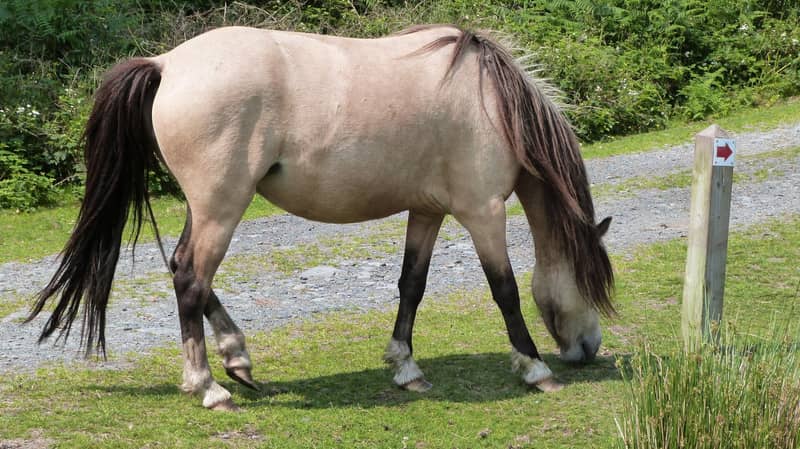 Dun
DunA dun: dusty tan body with a darker head and legs. Every dun also carries a dark dorsal stripe along the spine.
Photo: Peter Broster, CC BY 2.0, via Wikimedia Commons
| Feature | Buckskin | Dun (bay dun) |
|---|---|---|
| Base genetics | Bay + one cream | Bay (or another base) + dun gene |
| Main dilution | Cream | Dun (a different gene, TBX3) |
| Body | Tan, gold, yellow or bronze, often glossy | Tan, yellow, reddish or grayish, often a slightly “dusty” look |
| Head and legs | Head similar to body; legs black | Head and legs usually darker than the body |
| Mane and tail | Usually black | Usually dark, sometimes with lighter edges |
| Dorsal stripe | Not required (sooty shading can make a faint, blurry line) | Always present, crisp-edged, mane to tail |
| Other primitive markings | Not required | Common: leg barring, shoulder stripes, “cobwebbing” on the forehead |
| DNA test | Cream: N/Cr | Dun: D/nd1, D/nd2 or D/D |
How to Tell a Buckskin From a Dun
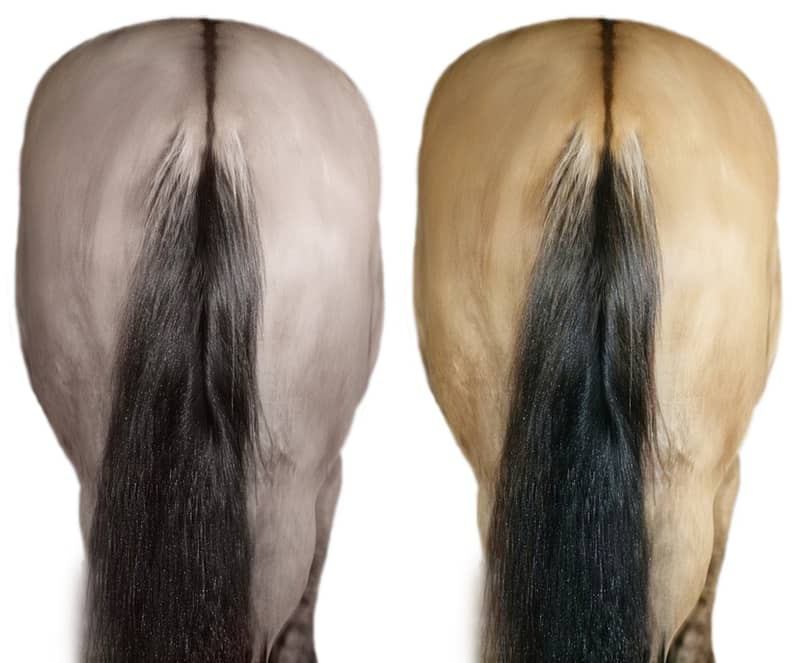
True dun dorsal stripes (grullo left, dun right): sharp-edged and running from mane into tail.
Photo: Arsdelicata, CC BY-SA 3.0, via Wikimedia Commons
- Dorsal stripe: the single most useful clue. Every dun has a dark stripe running along the spine from mane to tail, usually crisp-edged. A buckskin does not need one; if a buckskin has a line, it is usually a soft, blurry sooty shading.
- Leg barring: duns often show faint horizontal “zebra” bars on the backs of the knees or hocks. Buckskins do not.
- Shoulder barring: some duns have a dark transverse stripe across the withers or shoulders.
- Body shading: a dun’s body often looks slightly dusty or matte, with the head and legs noticeably darker. A buckskin’s head is usually close to its body color and its coat often looks glossy.
- Other primitive markings: cobweb-like lines on the forehead, darker ear tips and lighter mane edges are classic dun signs.
One complication: some non-dun horses carry a variant (nd1) that can produce a faint dorsal stripe without diluting the body (VGL dun). If you cannot decide, a dun DNA test is definitive.
Can a Horse Be Both Buckskin and Dun?
Short answer
Yes. Cream and dun are separate genes, so a bay horse can carry one cream copy and the dun gene. This combination is often called a buckskin dun or dunskin.
A dunskin usually looks like a buckskin with extra-pale body color plus dun primitive markings: a dorsal stripe, possible leg barring and a darker head. Terminology gets confusing because some people use “dun” loosely for any tan horse, some older registrations list buckskins as duns (and vice versa), and dun-type color registries accept both colors. When the difference matters for breeding or registration, test for both cream and dun.
Buckskin Horse vs Palomino
Buckskins and palominos are genetic cousins: both carry exactly one cream gene. The difference is the base color underneath. A buckskin is a diluted bay, while a palomino is a diluted chestnut (VGL). Because chestnuts make no black pigment, palominos have no black anywhere.
BuckskinGolden buckskin: the bright, even yellow-gold shade most people picture.
Photo: Raketabill, CC BY-SA 3.0, via Wikimedia Commons
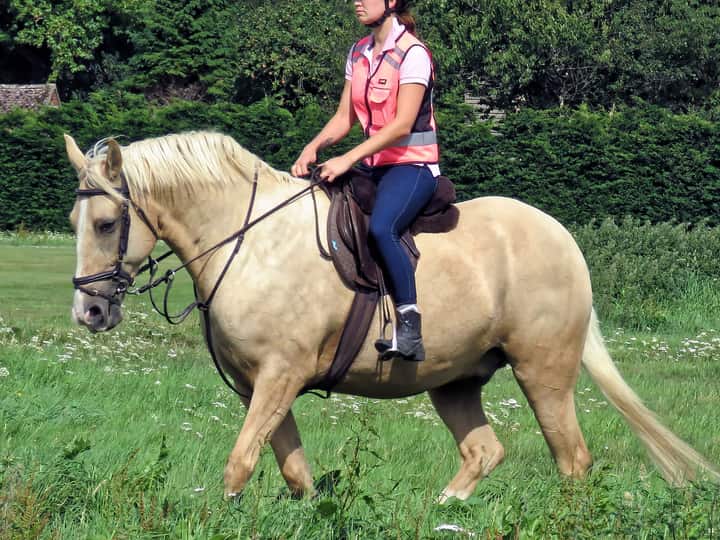 Palomino
A palomino: golden body, but a cream-white mane and tail and no black points.
Photo: Acabashi, CC BY-SA 4.0, via Wikimedia Commons
| Feature | Buckskin | Palomino |
|---|---|---|
| Base color | Bay | Chestnut / sorrel |
| Cream dilution | One copy | One copy |
| Body | Tan to gold | Golden to yellow |
| Mane | Usually black | Usually cream, white or flaxen |
| Tail | Usually black | Usually cream, white or flaxen |
| Lower legs and ear rims | Black | Body-colored (or white markings); no black |
| Black pigment anywhere? | Yes, on the points | No |
| Two cream copies become | Perlino | Cremello |
Easiest Way to Tell Them Apart
Short answer
Look at the mane, tail and lower legs.
- Black points → usually buckskin.
- Light cream or white mane and tail, with no black on the legs → usually palomino.
Watch for exceptions. Very dark, sooty palominos can grow darker hairs in the mane and tail (AMHA), and a buckskin’s black mane can bleach in the sun. When in doubt, check the lower legs and ear rims: black there points to buckskin.
Buckskin vs Bay
What makes a bay different? A bay has the same base genetics as a buckskin (E_ A_) but no cream gene. Its body stays red-brown, anywhere from bright copper to deep mahogany, with black points.
Bay vs buckskin genetics: add one cream copy to a bay and you get a buckskin; add two and you get a perlino. A bay cannot pass on cream because it has none. A buckskin passes cream to about half its foals (VGL).
Why a dark buckskin can resemble a bay: a deep-toned or sooty buckskin can look brown, especially in winter coat or poor light, while a sun-faded light bay can look tan. Compare the body against the black points in daylight. A buckskin’s body looks gold or tan next to the black, while a bay’s looks red-brown. If it still is not clear, a cream test settles it.
Dark buckskinDark buckskin Connemara stallion. This shade is easy to mistake for bay, but he carries cream: he is a proven buckskin sire.
Photo: Satu Pitkänen, CC BY-SA 3.0, via Wikimedia Commons
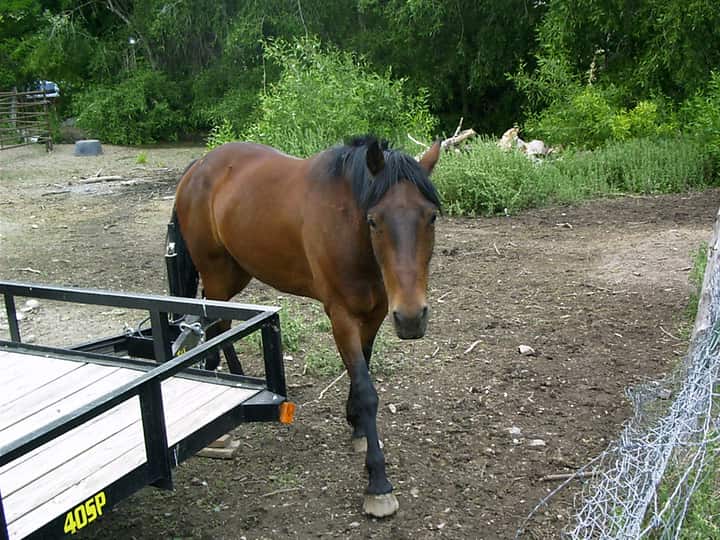 Bay
BayA bay: same black points as a buckskin, but a reddish-brown body with no cream dilution.
Photo: Mwirig, CC BY-SA 4.0, via Wikimedia Commons
| Feature | Buckskin | Bay |
|---|---|---|
| Genetics | E_ A_ with one cream (N/Cr) | E_ A_ with no cream (N/N) |
| Body | Tan, gold, yellow or bronze | Red-brown, from light copper to deep mahogany |
| Mane, tail, lower legs | Black | Black |
| Can pass on cream? | Yes, to about half of foals | No |
| Most common mix-up | A dark or sooty buckskin can look bay | A light, sun-faded bay can look buckskin |
Buckskin vs Roan
What roan means: classic roan is a white patterning trait with white hairs intermixed with colored hairs on the body, while the head, lower legs, mane and tail stay colored (UC Davis VGL). A bay roan, for example, looks like a bay with frosted white hairs through its body.
How roan differs from buckskin: buckskin changes the color of each body hair (dilution); roan adds white hairs among normal-colored ones (pattern). Up close, a buckskin’s body hairs are all gold, while a roan’s are a salt-and-pepper mix. A roan’s head also stays solidly dark, which gives roans a “hooded” look.
Can a buckskin also carry roan? Yes. Roan is a dominant trait that can sit on top of any base color or dilution (VGL coat color), so a buckskin with one roan gene becomes a buckskin roan.
Buckskin roan appearance: a gold body sprinkled with white hairs, a darker gold-to-brown head, and black mane, tail and lower legs. Because the white hairs lighten an already pale body, buckskin roans can look silvery-cream from a distance.
BuckskinWhere to look on a buckskin: numbered points match the legend below.
Photo: Derrick Coetzee, CC0, via Wikimedia Commons
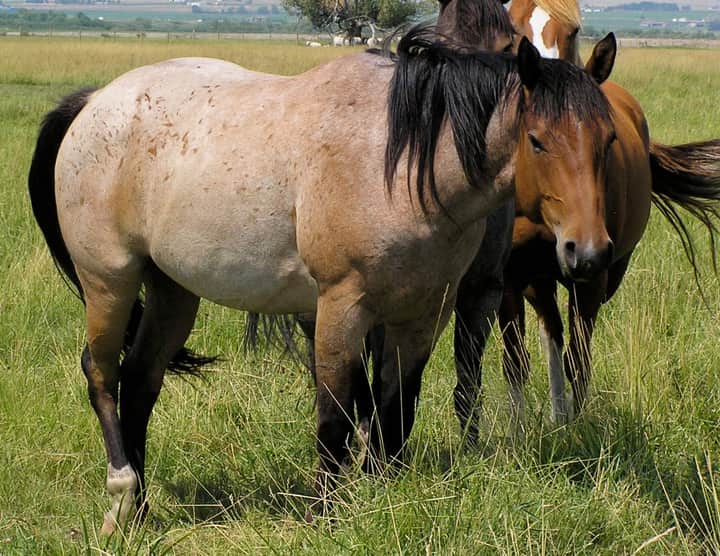 Bay roan
A bay roan: white hairs mixed through the body while the head, legs, mane and tail stay solid.
Photo: Montanabw, CC BY-SA 3.0, via Wikimedia Commons
| Feature | Buckskin | Roan |
|---|---|---|
| What it is | A dilution: every body hair is lightened | A white pattern: white hairs mixed among colored ones |
| Body | Solid gold/tan hairs | Speckled mix of white and colored hairs |
| Head | Similar tone to the body | Solid and noticeably darker than the body |
| Mane, tail, lower legs | Black | Stay fully colored (black on a bay roan) |
| Gene | Cream | Classic roan (dominant) |
| Can they combine? | Yes: a buckskin roan has a gold body flecked with white, a darker head and black points |
Buckskin Horse Breeds
Short answer
Buckskin is a color, so many different breeds can produce buckskin horses, as long as cream exists in the breed’s gene pool.
Presence of cream in the breeds below is supported by the UC Davis 28-breed dataset (Genes 2022), breed-association records and registry color charts. “Common” here means buckskin is a familiar, accepted color in the breed, not that it is the majority color.
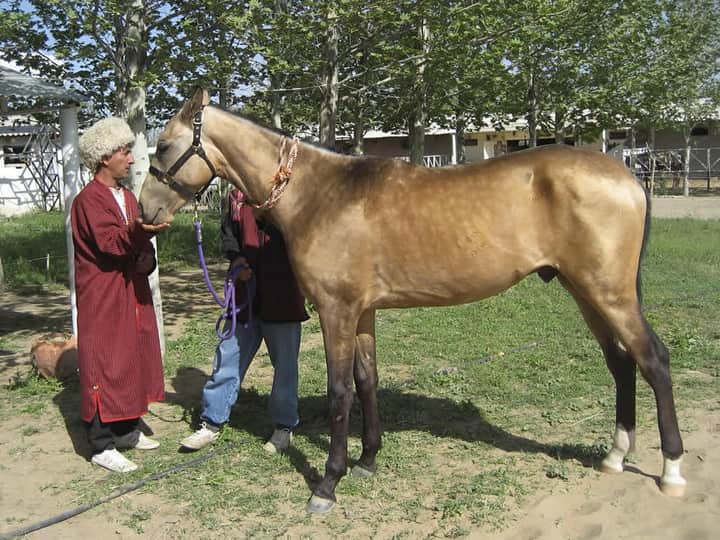
Akhal-Teke: golden buckskin is one of the breed’s archetypal colors, often with a metallic sheen.
Photo: David Stanley, CC BY 2.0, via Wikimedia Commons
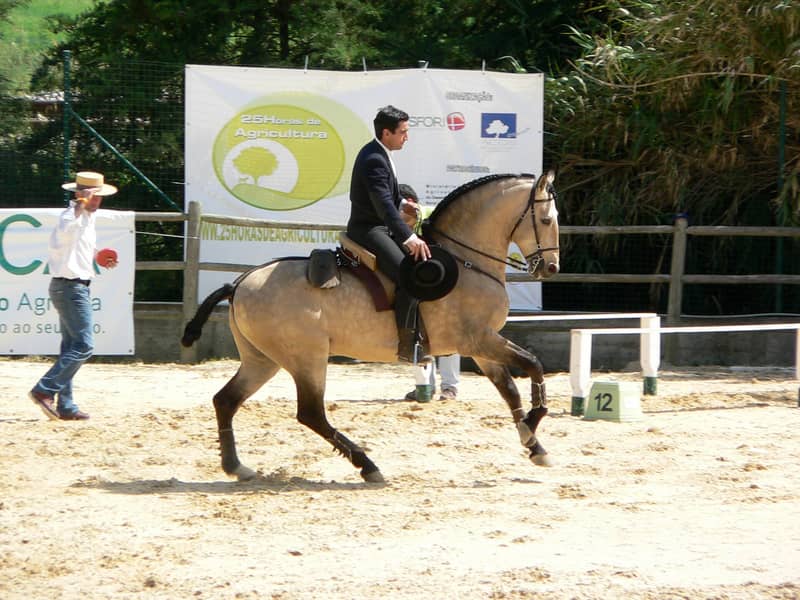
Lusitano: the breed had the highest cream allele frequency in a 2022 UC Davis testing dataset.
Photo: Lbpetersen, CC BY-SA 3.0, via Wikimedia Commons
Dark buckskin Connemara stallion. This shade is easy to mistake for bay, but he carries cream: he is a proven buckskin sire.
Photo: Satu Pitkänen, CC BY-SA 3.0, via Wikimedia Commons
Light buckskin (New Forest pony): pale cream-tan body, but the mane, tail and legs stay dark.
Photo: Paula Jantunen, public domain, via Wikimedia Commons
| Breed | Buckskin common? | Typical use |
|---|---|---|
| American Quarter Horse | Yes | Western riding, ranch work, rodeo and competition |
| Mustang | Yes | Wild and free-roaming herds; adopted riding horses |
| Morgan | Yes | Riding, driving and sport |
| Tennessee Walking Horse | Yes | Gaited trail and pleasure riding |
| Missouri Fox Trotter | Yes | Trail and gaited riding |
| American Paint Horse | Possible (as the base color under a pinto pattern) | Western and sport |
| Appaloosa | Possible (under a spotting pattern) | Western, trail and sport |
| Rocky Mountain Horse | Possible (silver is more typical) | Gaited riding |
| Akhal-Teke | Yes, a signature color | Endurance, sport |
| Lusitano | Yes | Dressage, working equitation |
| Connemara, Welsh and New Forest ponies | Yes | Children’s riding, jumping, driving |
American Quarter Horse
The Quarter Horse is the breed most people associate with buckskins. Buckskin is an established color in the breed, and buckskin Quarter Horses are widely advertised for ranch, rodeo and trail work. Several of the most famous buckskins, including Buttermilk and Wild Card Dun It, were Quarter Horses. You can explore typical Quarter Horse growth with the preset in our animal growth calculator.
Mustang
Wild and adopted Mustangs come in a wide range of colors, and cream was detected in the Mustang samples of the UC Davis study. Mustang herds also carry the dun gene, so many “buckskin” Mustangs are actually duns or dunskins. Check for a dorsal stripe.
Morgan
Morgans are one of the best-documented cream breeds. An American Morgan Horse Association analysis of 2000–2010 registrations estimated a cream allele frequency of about 0.09, meaning roughly 17% of Morgans carry cream (AMHA). Buckskin is one of the ten main color choices on Morgan registrations (AMHA).
Gaited Breeds: Tennessee Walking Horse, Missouri Fox Trotter and Rocky Mountain Horse
Tennessee Walking Horses and Missouri Fox Trotters both carry cream, and buckskins are popular in these trail-oriented gaited breeds. The Rocky Mountain Horse is better known for the silver gene, which produces the breed’s familiar chocolate-bodied, flaxen-maned look; the silver-linked eye condition MCOA is highly prevalent in the breed (Andersson et al. 2013). A true buckskin Rocky Mountain Horse is possible, but many light-maned horses in the breed are silver, not buckskin.
American Paint Horse and Appaloosa
In Paints and Appaloosas, buckskin shows up as the base color underneath a white pattern, giving a “buckskin tobiano” or a buckskin with an Appaloosa blanket. The APHA registration guide lists buckskin among its recognized colors, using the definition quoted at the top of this article (APHA).
Akhal-Teke
The Akhal-Teke is famous for its metallic sheen. The Akhal-Teke Association of America calls the golden buckskin (“bulanaya” in Russian) the archetypal color of the breed, and treats the dark, sooty buckskin as another archetypal color (ATAA).
Akhal-Teke: golden buckskin is one of the breed’s archetypal colors, often with a metallic sheen.
Photo: David Stanley, CC BY 2.0, via Wikimedia Commons
Lusitano and Iberian Horses
Lusitanos had the highest cream allele frequency of all 28 breeds in the UC Davis dataset, at about 0.42 (Genes 2022). Buckskin, palomino and double-cream Lusitanos are all seen, although the breed is still best known for gray and bay.
Lusitano: the breed had the highest cream allele frequency in a 2022 UC Davis testing dataset.
Photo: Lbpetersen, CC BY-SA 3.0, via Wikimedia Commons
Ponies: Connemara, Welsh and New Forest
Buckskin is a traditional pony color. The Connemara ponies used to identify the cream mutation in 2003 included buckskins (Mariat et al.), cream was detected in both the Connemara and Welsh samples of the UC Davis study, and buckskin New Forest ponies are also seen (see the light buckskin photo above).
Buckskin Horse Temperament
Short answer
Buckskin color does not determine temperament.
There is a long tradition of color folklore in the horse world: “chestnut mares are hot”, “buckskins are tough”, and so on. The evidence does not support using color to predict behavior. No published study has shown that buckskin color itself changes personality. The closest research, a survey of 477 horses published in Applied Animal Behaviour Science, compared chestnut and bay horses and found that breed, sex and age influenced owner-reported behavior more than coat color, with no evidence that chestnuts were harder to train (Finn et al. 2016).
Temperament depends far more on breed (a Quarter Horse and an Akhal-Teke are bred for different jobs), individual genetics, training and handling, age and experience, health and pain (a sore horse is often a “difficult” horse) and management such as turnout and diet.
Common misconception: the “tough buckskin” reputation comes from the Old West and ranch horse culture, where buckskin stock horses were common and admired. That reputation reflects the breeds and jobs those horses did, not their color.
Working and riding suitability: a buckskin can be a beginner-safe trail horse or a high-energy performance prospect. Judge the individual horse by its training, a test ride and its history.
What Does a Buckskin Horse Sound Like?
Short answer
A buckskin sounds exactly like any other horse. Coat color has no effect on a horse’s voice, so the neigh below could come from a buckskin, a bay or a palomino.
Horse neigh (whinny)
A loud, high, wavering neigh from a startled horse. Horses also whinny when they are separated from companions or calling to them.
Listen for: the rising, trembling pitch and the long carry. A whinny can be heard across a pasture, which is why horses use it to keep in contact.
Recording: Mixkit, “Scared horse neighing” · Mixkit free license
- Neigh or whinny: the loudest horse call. Horses use it to contact companions they cannot see, and it can signal excitement or alarm. Research on whinnies found that each one carries two separate frequencies: one reflects how aroused the horse is, and the other whether the emotion is positive or negative (Briefer et al. 2015).
- Nicker: a soft, low, rumbling sound made with the mouth closed, often when greeting a familiar person or horse, or when food is coming.
- Snort: a sharp blast of air through the nostrils, often when a horse is alert or suspicious of something new.
- Squeal: a short, high-pitched call during social encounters, such as meeting a new horse.
- Blow: a relaxed, fluttering exhale through the nose, commonly heard when a horse is settling down.
Want to check a recording of your own? Try our animal sound identifier.
What Are Buckskin Horses Used For?
Buckskins do every job their breed does. Because so many buckskins are stock horses, you will see them most often in Western disciplines, but a buckskin Morgan, Lusitano or pony may be doing dressage, jumping or driving.
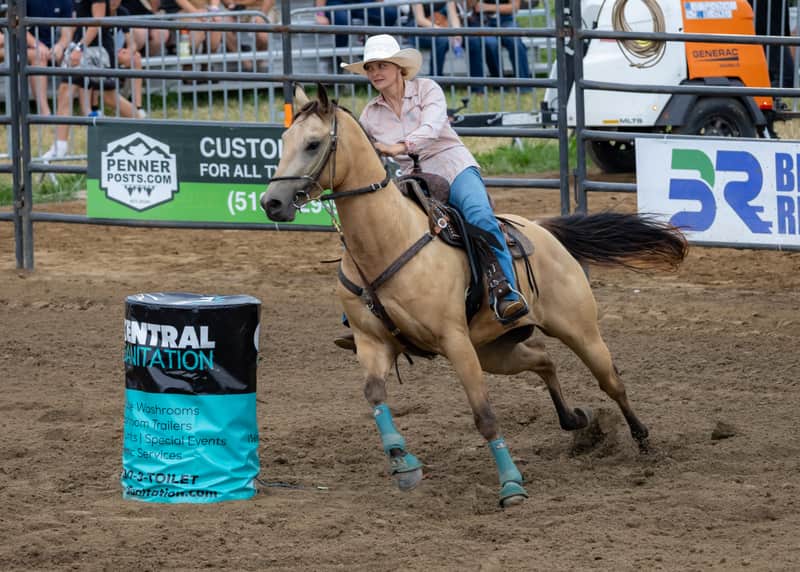
Buckskin barrel racing at a 2025 pro rodeo in Ontario.
Photo: Chris Woodrich, CC BY-SA 4.0, via Wikimedia Commons
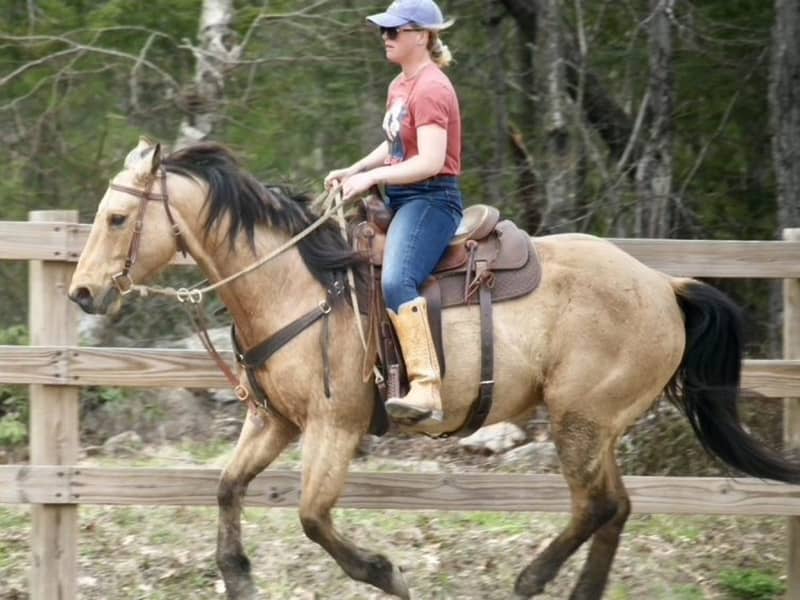
A buckskin Quarter Horse tacked up for the trail.
Photo: LevNoonan, CC BY-SA 4.0, via Wikimedia Commons
- Trail riding: sure-footed stock and gaited buckskins are popular trail partners.
- Ranch work: sorting, roping and doctoring cattle; Quarter Horse and Mustang buckskins dominate here.
- Western riding: Western pleasure, horsemanship, ranch riding and trail classes.
- Barrel racing: fast, agile Quarter Horse buckskins are common in rodeo barrels.
- Reining: spins, sliding stops and patterns; reining-bred buckskins are widely advertised.
- Cutting: cow-sense bloodlines, regardless of color.
- Show classes: halter, all-around and color-breed shows.
- Pleasure riding: relaxed riding at home or on the trail.
- Driving, depending on breed: Morgans, ponies and some warmblood crosses are used in harness.
The horse’s breed, conformation and training, not its color, determine what it is suited for.
Buckskin Horse Care
Buckskins need exactly the same care as any horse of the same breed, age and workload. There is no special buckskin diet, supplement or grooming product required because of coat color. Adult buckskins have dark skin, so they are not generally more sun-sensitive than bays; only white markings with pink skin need extra sun care.
| Area | Guideline | Color-specific? |
|---|---|---|
| Forage | Base the diet on hay or pasture, roughly 1.5–2% of body weight per day as dry matter (Merck) | No |
| Water | Clean water at all times; an idle mature horse drinks about 10–12 gallons a day, much more in heat or work (UNL) | No |
| Salt | Free-choice salt | No |
| Hooves | Trim or shoe every 6–8 weeks in summer and every 6–12 weeks in winter (UMN Extension) | No |
| Grooming | Curry, brush and pick out feet regularly; check skin as you go | No |
| Sun | Pink skin under white face or leg markings can sunburn | Only where there are white markings |
Grooming
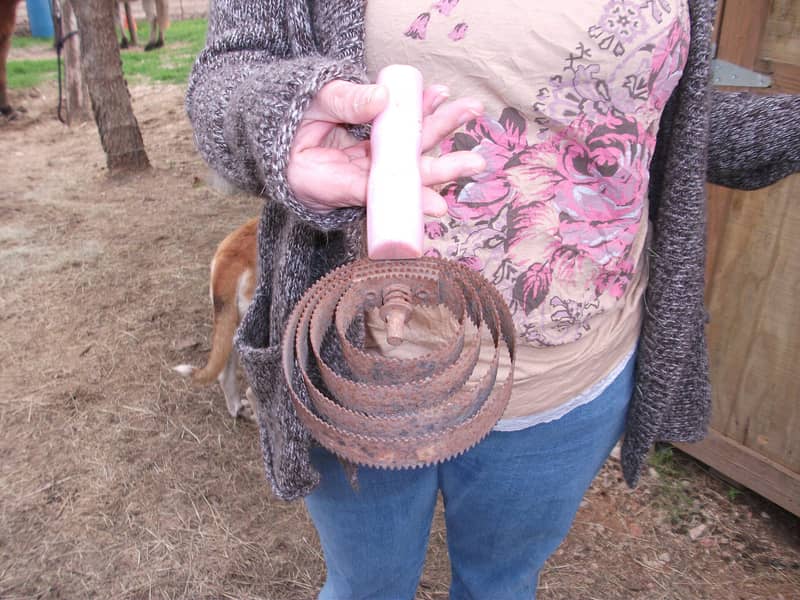
A rubber curry comb loosens dirt and shedding hair before brushing.
Photo: Carolbstevens, CC BY-SA 3.0, via Wikimedia Commons
- Brushing: use a rubber curry comb in circles to lift dirt and loose hair, then a stiff brush and a soft finishing brush. Grooming before riding also lets you spot cuts, heat or swelling.
- Mane and tail: detangle gently by hand or with a wide-tooth comb to keep the black hair from breaking. Some owners use fly sheets or turnout to reduce sun-bleaching, but faded tips are cosmetic, not a health issue.
- Hoof care: pick out hooves daily, check for stones, thrush and cracks, and keep a regular farrier schedule of about every 6–8 weeks in summer and 6–12 weeks in winter (UMN Extension).
- Bathing: occasional baths with horse shampoo are fine; rinse thoroughly. Frequent shampooing can strip natural oils, so rely mainly on grooming.
Nutrition
- Balanced forage: hay or pasture should form the core of the diet, roughly 1.5–2% of body weight per day as dry matter (Merck).
- Appropriate concentrates: add grain or a ration balancer only if forage alone does not meet the horse’s needs for its workload, age or body condition. Ask your vet or an equine nutritionist.
- Fresh water: always available; an idle mature horse drinks about 10–12 gallons a day, and much more in heat or hard work (UNL). Provide free-choice salt.
Exercise
Exercise needs depend on breed, age, workload and fitness, not color. Daily turnout, where the horse can move freely and graze, benefits almost every horse. Build fitness gradually for performance work, and get a veterinary check before increasing workload for older horses. To see how horses develop from foal to adult, see our horse life cycle guide.
Skin and Coat Care
- Sun exposure: protect pink-skinned white markings (such as a blaze or white socks) with shade, fly masks or a vet-approved sunscreen.
- Mud and dirt: clean and dry lower legs regularly; long wet periods can cause skin infections such as “mud fever” (pastern dermatitis).
- Seasonal shedding: heavy grooming in spring helps shed the duller winter coat and reveals the brighter summer gold.
- General skin checks: run your hands over the whole body while grooming and look for lumps, scabs, bites, rubs from tack and hair loss. Ask a vet about anything new or changing.
Buckskin Horse Price
Short answer
There is no single buckskin horse price. In U.S. listings we checked in September 2026, buckskins were advertised from about $3,500 for weanlings and basic riding horses to $25,000 or more for trained, proven ranch and performance horses.
Price depends on the whole horse, not the color. The main factors are:
- Breed and registration: registered horses with papers usually cost more than grade horses.
- Age: weanlings and yearlings cost less upfront but need years of training; prime-age trained horses (roughly 6–14) often command the most.
- Training: a finished, safe riding horse is worth more than an unstarted prospect.
- Competition record: show, rodeo or reining earnings add value.
- Pedigree and bloodlines: well-known sires and dams raise prices.
- Conformation and health: soundness and good build matter for every buyer.
- Location: prices vary by region, and transport costs add up.
- Intended use: a family trail horse and a competitive reiner are different markets.
- Color popularity: striking buckskins can attract more buyer interest, especially in Western markets, but color rarely outweighs training and soundness.
How Much Does a Buckskin Horse Cost?
These are real asking prices from U.S. classified listings in September 2026. They show the range, but they are not appraisals and not what the horses finally sold for.
| Horse | Location | Asking price | Listing |
|---|---|---|---|
| 2026 AQHA buckskin filly, foundation-bred, weanling | Virginia | $3,500 | EquineNow |
| Dappled buckskin Quarter Horse mare, 15 hh, “gentle and ready for a job” | U.S. | $3,500 | EquineNow |
| 9-year-old buckskin Quarter Horse gelding, trained | Indiana | $3,500 | EquineNow |
| 2026 barrel-bred buckskin filly | Montana | $6,500 | EquineNow |
| 2023 AQHA buckskin gelding, broke to ride | Florida | $7,600 | EquineNow |
| 2026 AQHA buckskin filly, reining-bred prospect | Idaho | $8,000 (negotiable) | DreamHorse |
| 5-year-old buckskin Quarter Horse gelding, trail and arena | U.S. | $9,000 | EquineNow |
| Sooty buckskin family ranch horse | U.S. | $17,500 | EquineNow |
| Buckskin ranch and rope horse | U.S. | $22,500 | EquineNow |
| 2022 AQHA buckskin all-around gelding | U.S. | $25,000 | EquineNow |
| Buckskin reining and ranch gelding | Kentucky | $27,500 | EquineNow |
The purchase price is only the start. New Mexico State University Extension estimates annual care costs of roughly $1,350–$3,000 per horse for feed, hoof care and basic healthcare, and more than $6,500 in first-year startup costs such as shelter, fencing and tack, before the price of the horse (NMSU B-715). Boarding, training and emergency veterinary care can raise the total well beyond that.
Why Some Buckskin Horses Cost More
- Proven performance: show, rodeo or ranch records.
- Training: finished horses save buyers years of work and cost.
- Pedigree: in-demand sire lines.
- Breed: some breeds command higher prices overall.
- Age: prime-age horses with experience.
- Registration: papers make a horse eligible for breed shows and breeding programs.
- Show record: placings and points at recognized shows.
- Color genetics: a buckskin stallion or mare DNA-tested for cream (and sometimes homozygous for black) may be priced higher as a color producer.
Buckskin Horse for Sale: How to Buy Well
If you are shopping for a buckskin, the color narrows your search but should not drive your decision. Use these steps to find a horse that suits you.
Where to Find a Buckskin Horse for Sale
- Breed associations: breed registries often run classified listings or breeder directories, and color registries such as the International Buckskin Horse Association connect buckskin owners and breeders.
- Reputable breeders: especially for young horses, a breeder can show you the parents and explain the color genetics.
- Equine marketplaces: online classifieds let you filter by color, breed, price and location.
- Horse rescues and adoption organizations: including Mustang adoption programs; adoption fees are usually lower, and many rescue horses are already started under saddle.
- Local equestrian networks: trainers, farriers, vets, riding clubs and tack stores often hear about good horses before they are advertised.
What to Check Before Buying
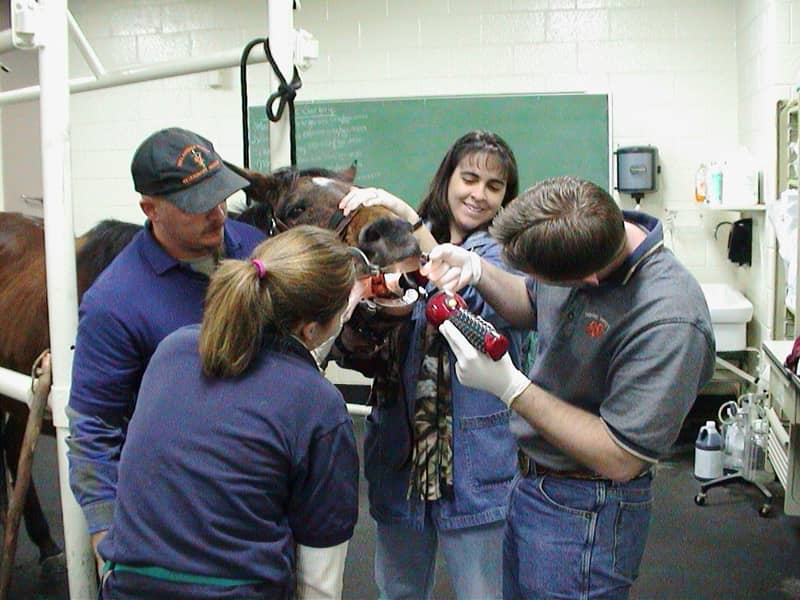
A pre-purchase veterinary exam is the most important step before buying any horse, whatever its color.
Photo: Tim1965, public domain, via Wikimedia Commons
Checklist
0 / 11 checked
A PPE is a snapshot of risk on the day, not a pass/fail guarantee of future soundness; the vet assesses the horse for your intended use (Cornell). Penn State Extension recommends using a vet who has no relationship with the seller (Penn State).
Questions to Ask the Seller
- 1What breed is the horse, and is it registered?
- 2How old is it, and how long have you owned it?
- 3What training does it have, and who trained it?
- 4What disciplines has it done, and does it have a competition record?
- 5Has it had any injuries, lameness, colic or surgeries?
- 6Does it have any vices, such as cribbing, weaving, bucking or trouble loading?
- 7Has it been DNA-tested for color (cream, dun, silver) or genetic diseases relevant to its breed?
- 8Can I arrange a pre-purchase veterinary exam with my own vet?
- 9Can I ride it more than once, or take it on trial?
Famous Buckskin Horses
Each example below has been checked against a published source. We have left out horses whose color or story we could not verify.
Buttermilk
Film and TV · 1941–1972
Dale Evans’s buckskin Quarter Horse gelding, and one of the most recognizable horses of the classic TV Western era. Buttermilk appeared alongside Roy Rogers and Trigger on The Roy Rogers Show.
SourceBuck
TV · Bonanza
Ben Cartwright’s big buckskin on Bonanza. When the series ended, Lorne Greene bought Buck and donated him to a therapeutic riding center, where he taught children with disabilities to ride. INSP reports that James Arness also rode him on Gunsmoke. Reports of his age at death differ, so we do not repeat one.
SourceWild Card Dun It
Competition and film · foaled 2001
A buckskin AQHA stallion who was the 2006 AQHA junior all-around horse, with points in heading, heeling, working cow horse, reining, barrel racing and halter. Robert Duvall chose him as his mount in the 2011 film Seven Days in Utopia.
SourceSpirit (the look-alike)
Animation · DreamWorks, 2002
The star of Spirit: Stallion of the Cimarron is often called a buckskin, and animators studied a real Kiger Mustang stallion named Donner. But the character is drawn with a dark dorsal stripe, a dun trait, so by strict color definitions he reads as a dun or dunskin. He is a good example of how easily the two colors are confused.
SourceFor more on Buck’s later career, see INSP’s profile of the horse also ridden on Gunsmoke.
Buckskin Horse Myths and Misconceptions
Myth: Buckskin is a breed.
Fact: Buckskin describes a coat color. Many breeds, from Quarter Horses to Akhal-Tekes and Connemara ponies, can be buckskin, and color registries accept horses of many breeds.
Myth: Buckskin horses have a specific personality.
Fact: Coat color does not determine temperament. Breed, training, handling, age and the individual horse matter far more (Finn et al. 2016).
Myth: Every golden horse is a buckskin.
Fact: Palominos, duns, amber champagnes, silver bays and light bays can all look similar. A buckskin must have black points and a bay base with one cream gene.
Myth: Buckskins are extremely rare.
Fact: Frequency varies by breed and population. Buckskins are common in breeds like the Quarter Horse and Morgan, and rare or absent in breeds without cream (Genes 2022).
Myth: A buckskin must have a dorsal stripe.
Fact: A crisp dorsal stripe is a dun marker. Buckskins do not need one; the APHA definition specifically says buckskins lack primitive markings (APHA).
Myth: Two buckskins always make a buckskin.
Fact: On average only about half their foals will carry exactly one cream copy; others can be bay, perlino or other colors, depending on hidden genes.
How to Identify a Buckskin Horse
Stand back in soft daylight, then look closely at the points and the back. A buckskin should tick every box below. If you want a second opinion from a photo, our horse identifier by picture can suggest likely breeds and colors, but a DNA test is the only definitive answer.
Buckskin Identification Checklist
Checklist
0 / 6 checked
Rule-outs: blue eyes and pink skin suggest a double-cream color; pink freckled skin and amber eyes suggest champagne; a flaxen or silver mane suggests silver or palomino; white hairs mixed through the body suggest roan.
Buckskin Look-Alikes at a Glance
| Color | Body | Mane and tail | Lower legs | Key tell |
|---|---|---|---|---|
| Buckskin | Tan to gold | Black | Black | Black points, no stripe required |
| Bay dun | Tan, often dusty | Dark | Dark, often barred | Crisp dorsal stripe |
| Palomino | Gold | Cream to white | Body color | No black anywhere |
| Bay | Red-brown | Black | Black | Red, not gold, body |
| Amber champagne | Gold | Brown | Brown | Pinkish freckled skin, amber eyes |
| Silver bay / silver buckskin | Brown or gold | Flaxen to silver-gray | Lightened | Mane lighter than body |
| Perlino | Near-white cream | Slightly darker cream or rust | Cream | Blue eyes, pink skin |
| Bay roan | Red-brown with white hairs | Black | Black | White hairs through body; dark head |
Buckskin Horse FAQs
What makes a horse a buckskin?
+
A buckskin is a bay horse with one copy of the cream dilution gene. The bay base gives black points (mane, tail and lower legs), and one cream copy lightens the red-brown body to tan or gold while leaving the black points largely unchanged.
How rare is a buckskin horse?
+
Buckskin horses are not generally considered an extremely rare color, although their frequency varies considerably by breed and population. They are common in breeds with established cream genetics, such as Quarter Horses, Morgans and Akhal-Tekes, and rare or absent in breeds where cream is uncommon.
What’s the difference between a buckskin and a dun?
+
They are caused by different genes. A buckskin is a bay diluted by the cream gene and does not need primitive markings. A dun is diluted by the dun gene and always has a dark dorsal stripe, often with leg barring, shoulder stripes and a darker head and legs.
Is a buckskin a breed or a color?
+
Buckskin is a coat color, not a breed. Many breeds can produce buckskins, and color registries accept buckskin horses from different breeds.
What breeds can produce buckskin horses?
+
Any breed that carries the cream gene can produce buckskins. Common examples include the American Quarter Horse, Mustang, Morgan, Tennessee Walking Horse, Missouri Fox Trotter, Akhal-Teke, Lusitano and pony breeds such as Connemara and Welsh. Paints and Appaloosas can be buckskin under their white patterns.
What is a dark buckskin horse?
+
A dark buckskin has a deep tan, bronze or brown-gold body with black points. Some are so dark they are mistaken for bay; a cream DNA test confirms the difference. Many dark buckskins also carry sooty hairs.
What is a sooty buckskin?
+
A sooty buckskin has darker or black-tipped hairs mixed into its gold coat, usually concentrated along the topline and fading toward the belly. Sooty shading can create a soft line down the back, but unlike a dun stripe it is blurry rather than crisp. The genetics of sooty are not yet fully understood.
Can buckskin horses have blonde manes?
+
A true buckskin has a black mane and tail, although sun can bleach the tips reddish. A gold horse with a genuinely blonde, flaxen or silver mane is usually a palomino, an amber champagne, or a bay or buckskin that also carries the silver gene.
What’s the difference between a buckskin and a palomino?
+
Both carry one cream gene, but a buckskin is a diluted bay with black mane, tail and lower legs, while a palomino is a diluted chestnut with a cream or white mane and tail and no black points.
Are buckskin horses good riding horses?
+
They can be excellent riding horses, but color is not the reason. Suitability depends on breed, training, temperament, age and soundness. Many buckskins are Quarter Horses and other stock breeds valued for trail, ranch and Western riding.
How much does a buckskin horse cost?
+
There is no single price. U.S. listings checked in September 2026 ranged from about $3,500 for weanlings and basic riding horses to $25,000 or more for trained ranch and performance horses. Breed, age, training, pedigree, show record and health drive the price, and yearly care costs often exceed the purchase price over time.
Can two buckskin horses have a buckskin foal?
+
Yes. Each foal of two buckskins has on average a 50% chance of inheriting one cream copy, a 25% chance of two copies (perlino or another double dilute) and a 25% chance of none (bay, chestnut or black). Whether a single-cream foal is buckskin also depends on the parents’ hidden extension and agouti genes.
Are buckskin horses rare?
+
Not especially. Buckskins are familiar in many Western and pony breeds, but their frequency varies by breed and region. In breeds without the cream gene, such as the Hanoverian and Percheron samples in one large UC Davis study, buckskins are essentially absent.
Can a buckskin also be a dun?
+
Yes. Cream and dun are separate genes, so a bay horse can carry both. The result is called a buckskin dun or dunskin: a buckskin-type horse with dun primitive markings such as a dorsal stripe and leg barring.
Final Summary
- Buckskin is a coat color, not a breed. It is usually recognized by a golden or tan body with black mane, tail, lower legs and ear rims.
- It results from cream dilution acting on a bay-based coat: bay plus one cream copy is buckskin, while two copies give a perlino. Buckskins range from light to golden to dark and sooty.
- Many breeds can produce buckskins, including Quarter Horses, Mustangs, Morgans, gaited breeds, Akhal-Tekes, Lusitanos and ponies. How common they are varies by breed and population.
- A buckskin should be distinguished from a dun (dorsal stripe and primitive markings), a palomino (no black points), a bay (red-brown, no cream) and a roan (white hairs mixed through the body). A DNA test settles any doubt.
- Price and temperament depend primarily on the individual horse: its breed, training, age, health and record, not simply its color.
Sources
Genetics facts come from university genetics laboratories and peer-reviewed studies; care and buying guidance from veterinary manuals and university extension services. Photos are from Wikimedia Commons under the licenses credited in each caption.
- UC Davis Veterinary Genetics Laboratory — Equine coat color genetics
- UC Davis VGL — Cream dilution test
- UC Davis VGL — Agouti (bay/black) test
- UC Davis VGL — Red factor (extension) test
- UC Davis VGL — Dun test
- UC Davis VGL — Silver test
- UC Davis VGL — Champagne test
- UC Davis VGL — Roan zygosity test
- Mariat D, Taourit S, Guérin G (2003). A mutation in the MATP gene causes the cream coat colour in the horse. Genetics Selection Evolution 35:119–133
- Imsland F, et al. (2016). Regulatory mutations in TBX3 disrupt asymmetric hair pigmentation that underlies Dun camouflage color in horses. Nature Genetics 48:152–158
- Genes (2022) 13(9):1641 — Frequency of coat color and white-spotting variants across 28 horse breeds (UC Davis VGL test data)
- American Morgan Horse Association — Gene frequency of cream dilution (L. Brown, 2011)
- The Morgan Horse — “A Touch of Pastel” (dilution genes explained)
- Akhal-Teke Association of America — Breed colors
- American Paint Horse Association — Registration guide (color definitions)
- USDA APHIS NVAP Reference Guide — Equine identification and colors
- International Buckskin Horse Association — About
- Sooty horse (overview of sooty/countershading and its unresolved genetics)
- Andersson LS, et al. (2013). Equine multiple congenital ocular anomalies and Silver coat colour result from the pleiotropic effects of mutant PMEL. PLoS ONE
- American Morgan Horse Association — Color genetics and registration color choices (2010)
- Finn JL, et al. (2016). The relationship between coat colour phenotype and equine behaviour. Applied Animal Behaviour Science 174:66–69
- Briefer EF, et al. (2015). Segregation of information about emotional arousal and valence in horse whinnies. Scientific Reports 5:9989
- Mixkit — Free sound effects license (horse neigh recording)
- Merck Veterinary Manual — Nutritional requirements of horses
- University of Nebraska–Lincoln Extension G1781 — Feeding horses
- University of Minnesota Extension — Caring for your horse’s hooves
- Merck Veterinary Manual — Prepurchase examination of horses
- Merck Veterinary Manual (owner version) — Selecting a horse
- Cornell University College of Veterinary Medicine — Equine pre-purchase exams: what to expect
- Penn State Extension — Pre-purchase exams
- Texas A&M Pet Talk — Purchasing a new horse
- New Mexico State University Extension B-715 — Basic essentials of equine ownership
- Buttermilk (horse)
- INSP — The famous horses of Hollywood: Bonanza
- GoHorseShow — Quarter Horse turns into movie star: Wild Card Dun It
- Spirit: Stallion of the Cimarron
- EquineNow — Buckskin horses for sale (asking prices checked September 2026)
Identify a horse & explore more guides
Upload a photo to get likely breed and color suggestions, follow the horse from foal to adult, or browse the rest of our animal guides.