Palomino Horse: Color, Breeds, Price, Temperament, and Facts
The complete guide to the golden horse with the white mane: what makes a palomino, every shade from light to chocolate, the cream-gene genetics, how rare it is, which breeds produce it, how it compares with buckskins, duns, roans and look-alikes, and what to check on price, care and buying.
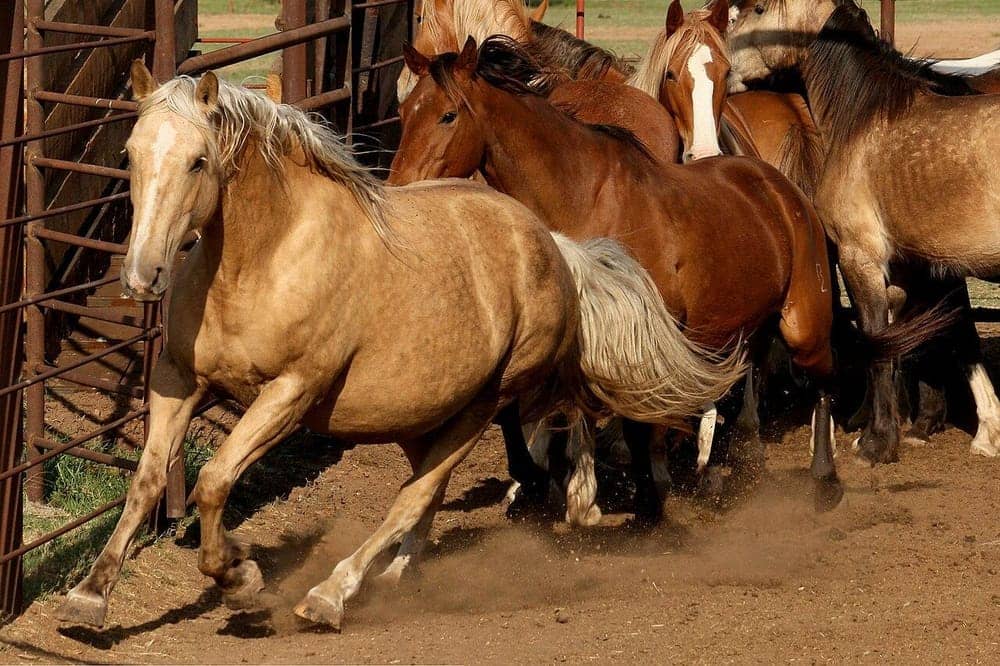
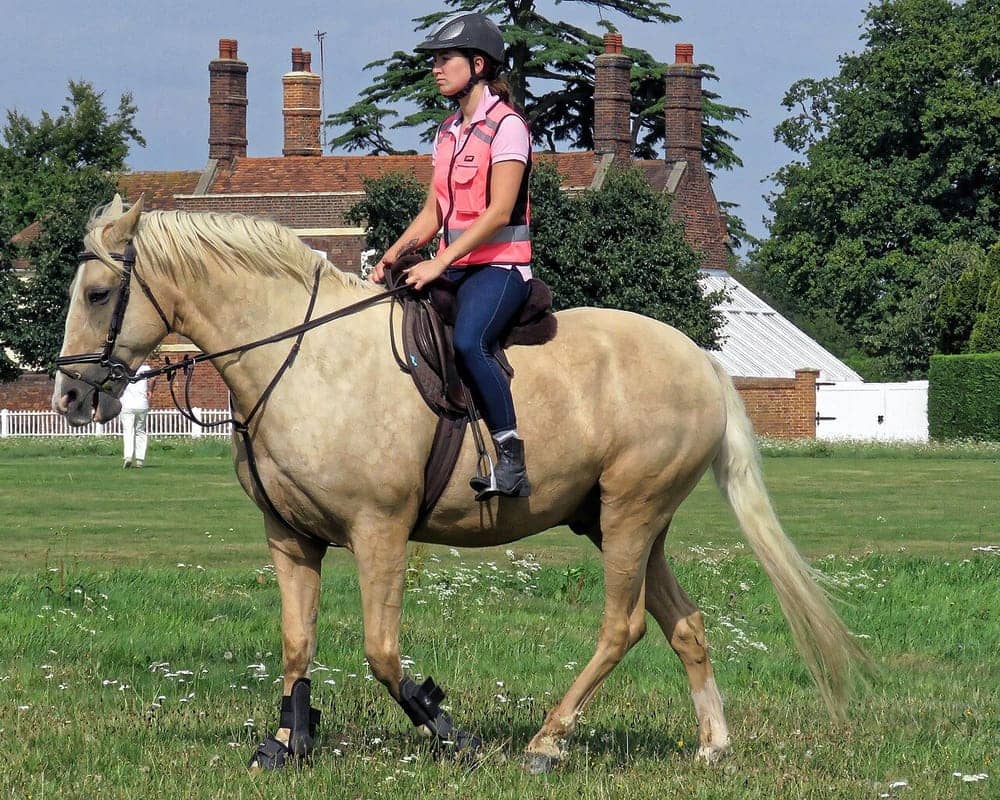
A palomino horse has a golden coat with a white, cream or flaxen mane and tail. The Palomino Horse Breeders of America describes the ideal body color as “approximately the color of a United States gold coin” (PHBA), and shades run from pale cream-gold to a deep, almost chocolate gold.
Palomino is a coat color, not a breed. Genetically, a palomino is a chestnut horse with one copy of the cream dilution gene, which lightens the red body to gold and the mane and tail to near-white (UC Davis VGL). That is why many different breeds can produce palominos, including the American Quarter Horse, Morgan, Tennessee Walking Horse, American Saddlebred, Paint, Missouri Fox Trotter and Half-Arabian horses.
This guide covers what a palomino looks like, every shade, the genetics, how rare the color is, which breeds produce it and how to tell it from look-alikes. It also covers practical questions on temperament, care, lifespan, price and buying. Short version: color affects looks, not personality or health, so choose a palomino the way you would choose any horse.
Palomino Horse: Quick Facts
| Feature | Details |
|---|---|
| Type | Horse coat color, not a breed |
| Typical body color | Golden yellow; ideal is “a United States gold coin”, from light to dark |
| Mane and tail | White, cream or flaxen, usually lighter than the body |
| Genetics | One cream dilution copy on a chestnut base (e/e N/Cr) |
| Skin and eyes | Usually dark skin; brown or hazel eyes |
| Common breeds | American Quarter Horse, Morgan, Tennessee Walking Horse, Saddlebred, Paint, Half-Arabian |
| Height | Depends on breed and individual; PHBA registers horses 14–17 hands |
| Temperament | Depends on breed, training and the individual, not on color |
| Lifespan | Often into the late 20s or early 30s with good care, like other horses |
| Main uses | Riding, showing, ranch work, rodeo, driving, parades and recreation |
| Price | U.S. asking prices checked October 2026: about $3,000 to $45,000 |
| Breeds true? | No: two palominos average 50% palomino foals |
What Is a Palomino Horse?
Short answer
A palomino horse is a horse with a golden coat and a white or cream mane and tail, produced when a chestnut horse inherits one copy of the cream dilution gene.
What makes the golden coat distinctive? A chestnut horse makes only red pigment. One copy of cream dilutes that red to yellow-gold on the body and to near-white in the mane and tail (UC Davis VGL). The result is a gold body framed by a pale mane and tail, with no black anywhere.
Why is palomino a color rather than a breed? A breed has shared ancestry, a studbook and a breed standard. Palomino is a single gene combination that appears in many breeds. It also cannot “breed true”: two palominos produce palomino foals only about half the time (Palomino overview). Color registries such as PHBA record palominos of many breeds, but they do not create a separate breed.
How is a palomino different from an ordinary chestnut? Both have the same red (e/e) base. The palomino also carries one cream copy, which turns the red body gold and the mane and tail white. A chestnut with a naturally flaxen mane can look similar, but its body stays red-toned.
Why are the mane and tail pale? Cream lightens mane and tail hair even more strongly than body hair, so most palominos have a white to cream mane and tail. Some carry a few darker or reddish hairs, which PHBA allows up to 25% (PHBA).
Can palomino horses have different shades of gold? Yes. They range from pale cream-gold to the classic gold-coin shade to a dark, chocolate-like gold. Shade, sooty hairs, season and lighting all change how a palomino looks, as the next section shows.
What Does a Palomino Horse Look Like?
Where to look on a palomino: numbered points match the legend below.
- 1Ears: Gold like the body. No black ear rims, unlike a buckskin.
- 2Eye: Usually brown or hazel in adults; foals may have lighter eyes.
- 3Muzzle skin: Dark gray-black. Pink skin all over suggests a double cream.
- 4Mane: White, cream or flaxen; registries want it mostly white.
- 5Back: No dorsal stripe. A crisp stripe suggests dun genes.
- 6Body: Gold: chestnut red diluted by one cream gene.
- 7Tail: Pale like the mane, sometimes with a few darker hairs.
- 8Legs: Body-colored. Palominos have no black points.
- 9White sock: A white marking; the skin under it is pink.
Photo: Acabashi, CC BY-SA 4.0, via Wikimedia Commons
- Body: gold, from pale cream-gold to deep gold. Some palominos have dapples, especially in summer coat.
- Mane and tail: white, cream or flaxen, usually clearly lighter than the body.
- Legs: the same gold as the body, apart from any white socks or stockings. There are no black points.
- Face: gold like the body, often with a star, stripe or blaze. Face markings are unrelated to the palomino gene.
- Skin: dark gray-black under the coat, visible around the eyes and muzzle. Pink skin all over, with blue eyes, points to a cremello (UC Davis VGL).
- Eyes: usually brown or hazel in adults. Foals may be born with lighter eyes that darken.
What Makes Palomino Horses Special?
Short answer
Palominos stand out for their gold coat and contrasting white mane and tail, a look that has made them favorites in shows, parades, film and photography.
- Distinctive golden coat: few horse colors are as instantly recognizable.
- Contrasting light mane and tail: the pale “frame” makes the gold look brighter.
- Found across many breeds: riders can have the color they love in a stock horse, gaited horse, sport horse or pony.
- Popular in shows and parades: PHBA alone runs hundreds of approved classes, from halter to jumping (PHBA Heritage).
- Film and cultural history: Roy Rogers’s Trigger and TV’s Mister Ed made the palomino the classic “movie star” horse color.
Palomino Horse Color
Palomino color is a family of shades that share one rule: a gold body with a pale mane and tail and no black points. Here is how the shades differ and why the same horse can look different from month to month.
What Color Is a Palomino Horse?
A palomino has a golden-yellow body and a white or cream mane and tail. PHBA’s ideal is a gold-coin body color, and the association describes accepted shades as varying “from light to dark” (PHBA).
Lighting changes the look. Bright sun can make a palomino look almost yellow-white, while shade and indoor light push it toward brown-gold. Phone cameras exaggerate both. Judge the color in soft daylight and look at the legs and skin as well as the body.
Season changes it too. Many palominos look paler and duller in a long winter coat and deeper gold once they shed out in summer (see the photo under “Can a Palomino Horse Change Color?” below).
Types of Palomino Horse Colors
Horse people use several descriptive labels. These are not separate genes: UC Davis notes that the genetics of shade are still only partly understood (VGL).
Golden Palomino Horse
The golden palomino is the classic look: a bright, even gold body, close to the color of a gold coin, with a white mane and tail. It is the shade most people picture and the one color registries describe as ideal.
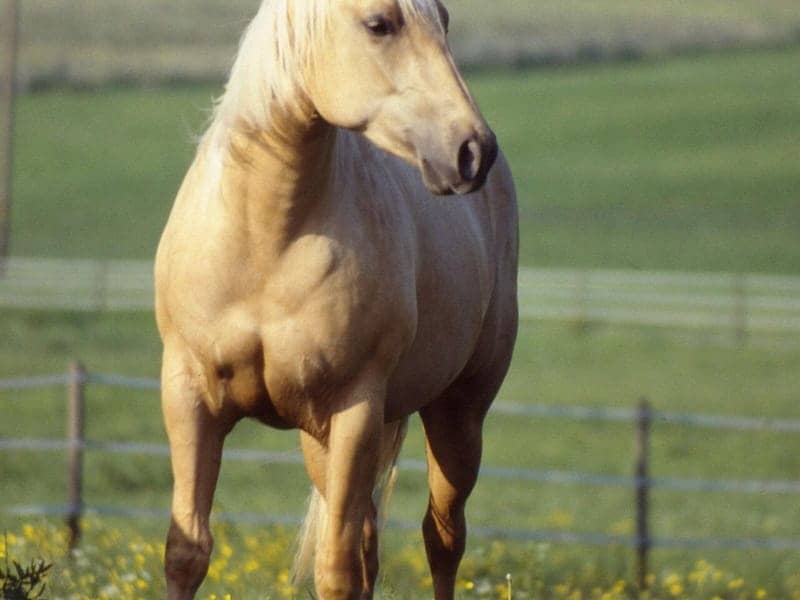
A palomino Quarter Horse: classic gold coat and a pale mane. The breed is Quarter Horse; the color is palomino.
Photo: Rumo, CC BY-SA 2.0, via Wikimedia Commons
Light Palomino Horse
A light palomino has a pale cream or light-gold body. It can look almost white in strong sun.
How to tell it from other cream-colored horses: a light palomino still has dark skin and brown eyes. A cremello has pink skin and blue eyes, and a light gray turns whiter every year. A light palomino with a cream mane and a pale body can also be confused with a light flaxen chestnut, so a cream DNA test is the safest check.
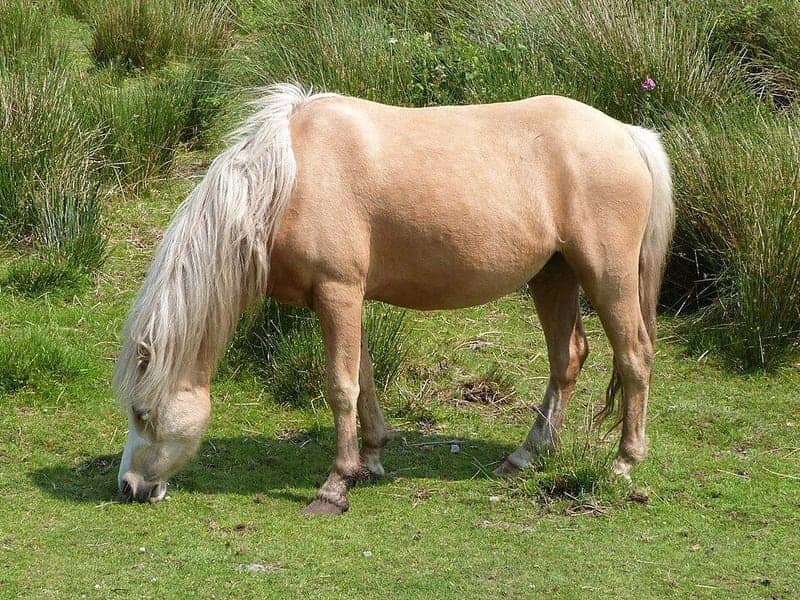
Light palomino: a pale cream-gold body with a white mane and tail. The skin and eyes stay dark.
Photo: Peter Broster, CC BY 2.0, via Wikimedia Commons
Dark Palomino Horse
A dark palomino has a deeper, richer gold body, sometimes with darker “sooty” hairs along the neck, back and hindquarters. Its mane and tail stay pale.
How it differs from a chestnut: a chestnut’s body is red to copper, and its mane and tail are usually the same red or flaxen. A dark palomino’s body is a diluted gold, and the mane and tail are clearly white or cream. Sooty palominos can grow a few darker hairs in the mane and tail (AMHA).
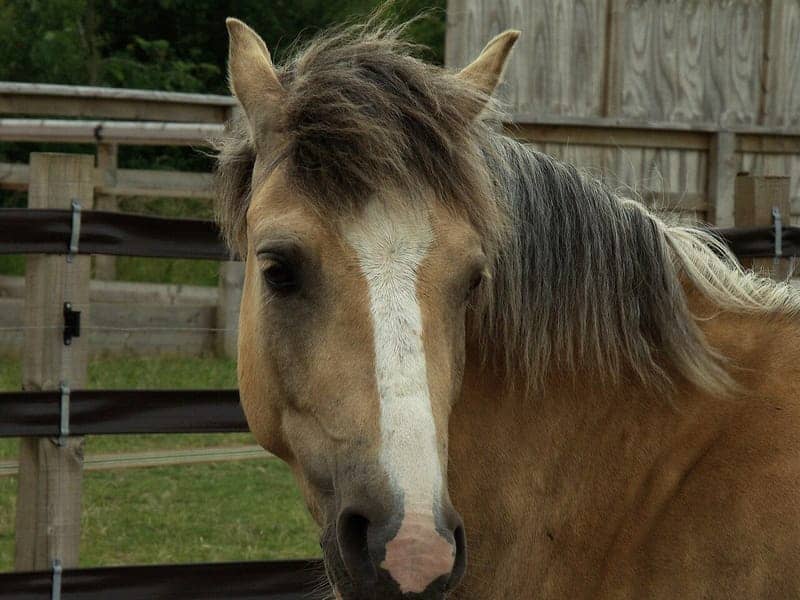
A sooty palomino: darker hairs mixed into the coat give a deeper, browner gold than the classic shade.
Photo: Lil Shepherd, CC BY 2.0, via Wikimedia Commons
Chocolate Palomino Horse
“Chocolate palomino” is an informal name for a very dark palomino whose body looks brown or chocolate while the mane and tail stay light. It is generally explained as a dark (liver) chestnut base plus one cream copy, often with sooty shading, but there is no separate “chocolate” gene, and shade genetics are still poorly understood (VGL).
Why appearance alone is not proof: a black horse with the silver gene (“silver dapple”) can have a chocolate body and flaxen mane, and a liver chestnut with a flaxen mane can look similar too (UC Davis VGL silver). A cream and extension DNA test tells them apart: a true chocolate palomino tests e/e N/Cr.
Palomino With a White Mane and Tail
A bright white mane and tail is the most prized palomino feature, and PHBA requires the mane and tail to be at least 75% white (PHBA). In practice, manes range from snow-white to ivory, cream or flaxen, and many palominos carry a sprinkling of darker or reddish hairs. White face and leg markings vary independently of the palomino gene.
Can a Palomino Horse Change Color?
Short answer
A palomino’s shade can change a lot with season, sun and age, but its genetic color does not. The one real exception is gray, which gradually whitens any horse.
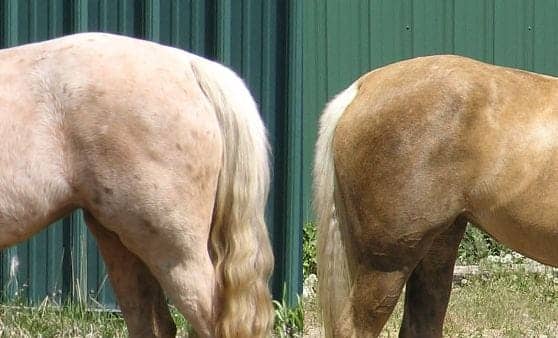
The same palomino in two seasons: the unshed winter coat (left) looks pale, the fully shed summer coat (right) a deeper gold.
Photo: Montanabw, CC BY-SA 3.0, via Wikimedia Commons
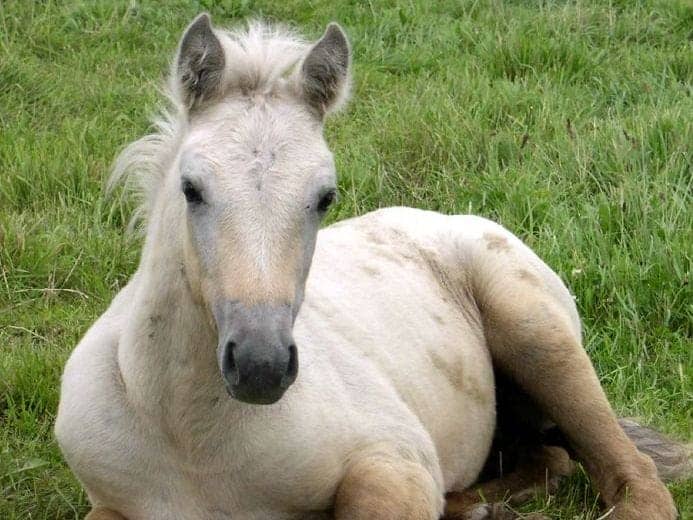
A palomino foal that is turning gray: graying will gradually whiten the coat, even though the horse is palomino underneath.
Photo: Kumana @ Wild Equines, CC BY 2.0, via Wikimedia Commons
- Seasonal coat changes: the winter coat often looks paler or duller, and the summer coat deeper and glossier. Some palominos look darker in summer, others lighter, depending on sootiness.
- Sun bleaching: long hours in strong sun can fade the coat and yellow a white mane. Shade and fly sheets reduce it.
- Foal coat: foals are often born paler or pinkish and reach their adult shade after shedding the foal coat.
- Aging and graying: a palomino that also carries the dominant gray gene will whiten year by year until it looks white (UC Davis VGL gray). Gray white hairs disqualify a horse from regular PHBA registration (PHBA).
None of these shade changes alter the horse’s genes: a palomino stays e/e N/Cr for life, and passes cream to about half of its foals.
Palomino Horse Genetics: What Two Breeds Make a Palomino?
Short answer
No particular pair of breeds makes a palomino. Palomino is a genetic coat color: a horse must inherit a chestnut base (e/e) and exactly one cream gene (N/Cr), whatever its breed.
That is why two horses of different breeds, such as a palomino Quarter Horse and a chestnut Thoroughbred, can produce a palomino foal, while two palominos of the same breed may not.
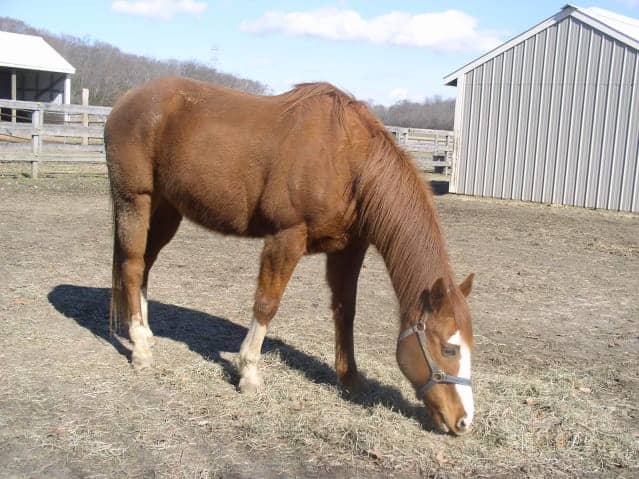
Chestnut (no cream, N/N): red-brown body, mane and tail. This is the base color under every palomino.
Photo: MiLKBONE3, CC BY 2.0, via Wikimedia Commons
A palomino Quarter Horse: classic gold coat and a pale mane. The breed is Quarter Horse; the color is palomino.
Photo: Rumo, CC BY-SA 2.0, via Wikimedia Commons
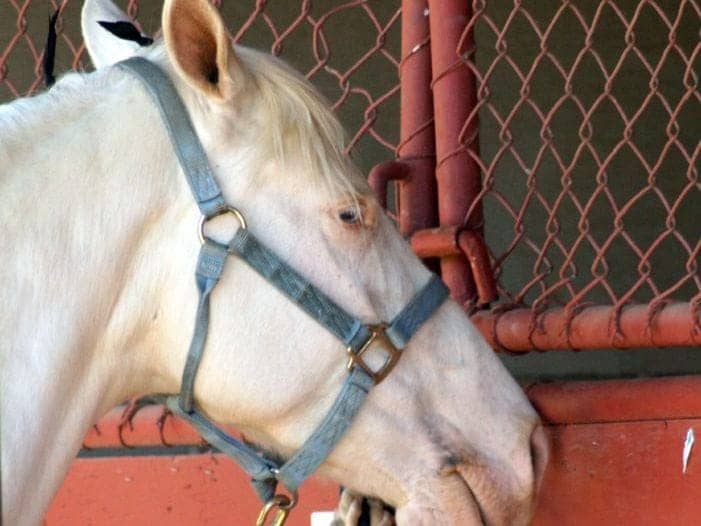
Cremello (two cream copies, Cr/Cr): cream-white coat, pink skin and blue eyes. Not a palomino.
Photo: Just chaos, CC BY 2.0, via Wikimedia Commons
Chestnut Base Coat and the Cream Dilution Gene
- 1Start with a chestnut base. The extension (red factor) gene decides whether a horse can make black pigment. Two copies of the recessive e (e/e) make a chestnut that has only red pigment (VGL red factor).
- 2Add one cream gene. Cream is incompletely dominant. One copy (N/Cr) dilutes red pigment to yellow-gold, turning the chestnut into a palomino (VGL cream).
- 3Two copies go further. A chestnut with two cream copies (Cr/Cr) is a cremello: cream-white with pink skin and blue eyes.
| Base color | No cream (N/N) | One cream (N/Cr) | Two cream (Cr/Cr) |
|---|---|---|---|
| Chestnut (e/e) | Chestnut / sorrel | Palomino | Cremello |
| Bay (E_ A_) | Bay | Buckskin | Perlino |
| Black (E_ a/a) | Black | Smoky black | Smoky cream |
The cream mutation was identified in the SLC45A2 (formerly MATP) gene in 2003 (Mariat et al.).
Why Two Palominos Do Not Guarantee a Palomino Foal
Short answer
Each palomino carries only one cream copy, so two palominos produce on average 25% chestnut, 50% palomino and 25% cremello foals.
Breeders who want a palomino every time cross a chestnut with a cremello: the chestnut always gives e and no cream, and the cremello always gives e and one cream. A study of prize-winning registered palominos found that chestnut × cremello was the most common parent cross, and it is the only cross that guarantees a palomino (Prize-winning palominos study).
| Parent 1 | Parent 2 | Average foal colors | Notes |
|---|---|---|---|
| Palomino | Palomino | 25% chestnut, 50% palomino, 25% cremello | Two palominos never guarantee a palomino |
| Palomino | Chestnut | 50% chestnut, 50% palomino | The classic coin-flip cross |
| Chestnut | Cremello | 100% palomino | The only cross that always produces a palomino |
| Palomino | Cremello | 50% palomino, 50% cremello | Every foal inherits at least one cream |
| Palomino | Bay or black | Palomino, chestnut, buckskin, bay, smoky black or black | A chestnut-based foal needs an e from both parents |
| Palomino | Buckskin | Palomino, buckskin, chestnut, bay, cremello, perlino and others | Depends on the buckskin’s hidden e and a genes |
How Rare Is a Palomino Horse?
Short answer
Palomino is a relatively uncommon coat color in some populations, but it is not universally considered extremely rare. Its frequency depends on the breed and population.
A palomino needs two things at once: a chestnut base and exactly one cream gene. Chestnut is common in many breeds, but cream is uncommon or absent in others, so palominos are familiar in some breeds and impossible in others.
| Population | Finding | Source |
|---|---|---|
| 11,281 horses from 28 breeds tested at UC Davis | Cream found in 25 of 28 breeds; not detected in the Hanoverian, Knabstrupper or Percheron samples | Genes 2022 |
| Same dataset, cream frequency range | From about 0.42 (Lusitano) down to about 0.013 (Standardbred) | Genes 2022 |
| Quarter Horses in the same dataset (5,512 tested) | 1,926 were e/e, so about 35% had the chestnut base a palomino needs | Genes 2022 |
| Morgan registrations, 2000–2010 | Cream allele frequency about 0.09, so roughly 17% of Morgans carry at least one cream copy | AMHA 2011 |
| Purebred Arabians and Haflingers | No cream gene, so no true palominos | Cream gene overview |
Why Palomino Is Common in Some Breeds and Absent in Others
- Breed history: breeds whose founders carried no cream, such as purebred Arabians, Friesians and Haflingers, cannot produce true palominos (Cream gene overview).
- Breeder demand: stock-horse and gaited-horse breeders in North America have long selected for golden horses, which keeps cream common in those breeds.
- Registry rules: some registries once barred blue-eyed double-cream horses, which also reduced cream carriers. Morgans with double-cream colors, for example, could not be registered under the breed’s former “white rule” (AMHA).
- Testing bias: large DNA datasets come from horses owners chose to test, and owners of colorful horses test more often, so they can overstate how common cream is.
Are Chocolate and Unusual Palominos Rarer?
Very dark, chocolate-looking palominos and very pale palominos are seen less often than mid-gold ones, but there is no reliable published frequency for individual shades, because shade is not DNA-tested and is described inconsistently.
Does Rarity Increase a Palomino’s Price?
Color can add buyer interest, especially in Western markets, but training, soundness, age, breed and record drive price far more. A well-trained palomino costs more than an untrained one because of the training, not the gold coat. See the price section for real listings.
Palomino Horse Breeds
Short answer
Many horse breeds can produce palomino horses. The color does not define the breed, size, temperament or abilities of the horse.
Any breed with both chestnut and the cream gene in its gene pool can produce palominos. The table lists the main ones, plus two popular breeds that look palomino but are not.
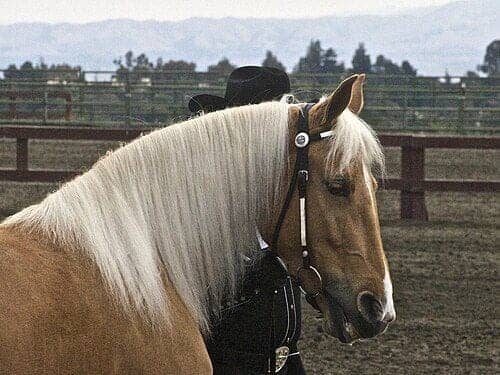
A palomino Tennessee Walking Horse. Cream is well established in this gaited breed.
Photo: Just chaos, CC BY 2.0, via Wikimedia Commons
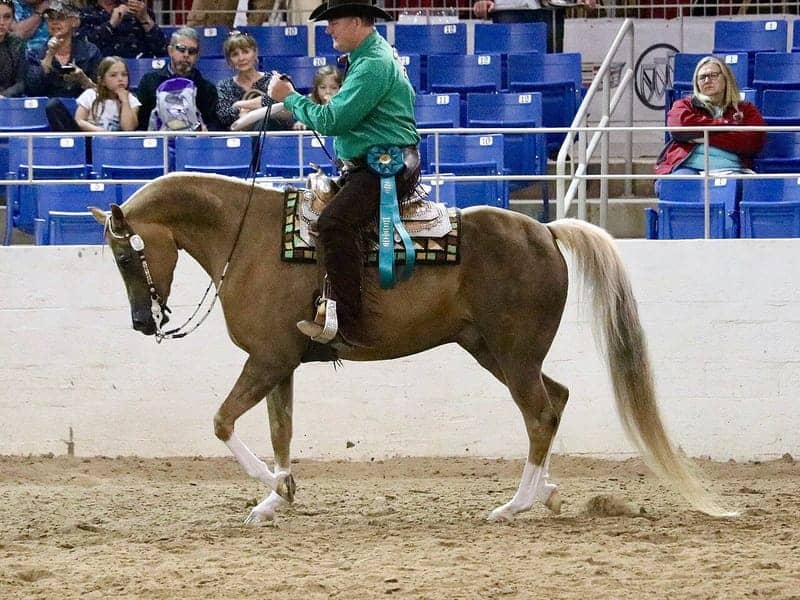
A palomino Half-Arabian in Western pleasure at the Scottsdale Arabian Horse Show. The cream gene came from the non-Arabian parent.
Photo: Montanabw, CC BY-SA 4.0, via Wikimedia Commons
| Breed | Palomino possible? | Common uses |
|---|---|---|
| American Quarter Horse | Yes | Western riding, ranch work, rodeo and competition |
| Morgan | Yes | Riding, driving and sport |
| Tennessee Walking Horse | Yes | Gaited riding, trail riding |
| American Saddlebred | Yes | Show riding, pleasure riding |
| American Paint Horse | Yes (as the base color under a white pattern) | Western riding, showing |
| Appaloosa | Yes (as the base color under a spotting pattern) | Riding, Western disciplines |
| Missouri Fox Trotter | Yes | Trail riding, gaited riding |
| Arabian | Not in purebreds (no cream gene); Half-Arabians and Morabs can be palomino | Endurance, riding, showing |
| Thoroughbred | Yes, but rare; recognized by The Jockey Club | Racing, sport |
| Lusitano and Andalusian | Yes, in lines that carry cream | Dressage, working equitation |
| Ponies (Welsh, Connemara, Shetland and others) | Yes | Children’s riding, driving |
| Haflinger | No: chestnut with flaxen mane; looks palomino | Riding, driving |
Palomino Quarter Horse
A palomino Quarter Horse is an American Quarter Horse with palomino coloring: the breed’s compact, muscular stock-horse build with a gold coat and pale mane and tail. The breed identity comes from its AQHA pedigree; the color is just one gene combination on top.
American Quarter Horse palomino horses are popular because they combine the breed’s calm, versatile working reputation with an eye-catching color. Cream is well established in the breed, and in one large UC Davis dataset about 35% of tested Quarter Horses had the chestnut (e/e) base a palomino needs (Genes 2022). Palomino Quarter Horses fill every job the breed does, from ranch work and reining to barrel racing and family trail riding. To see how a Quarter Horse grows, try the preset in our animal growth calculator.
A palomino Quarter Horse: classic gold coat and a pale mane. The breed is Quarter Horse; the color is palomino.
Photo: Rumo, CC BY-SA 2.0, via Wikimedia Commons
Palomino Paint Horse
Can a Paint Horse be palomino? Yes. In a Paint, palomino is the base color and the Paint pattern (tobiano, overo or tovero) adds white patches on top. The APHA lists palomino among its recognized colors (APHA).
Color vs pattern: the gold comes from cream on chestnut; the white patches come from separate white-spotting genes. A palomino Paint can have small or large white areas, but wherever the coat is colored, it is gold with a pale mane and tail.
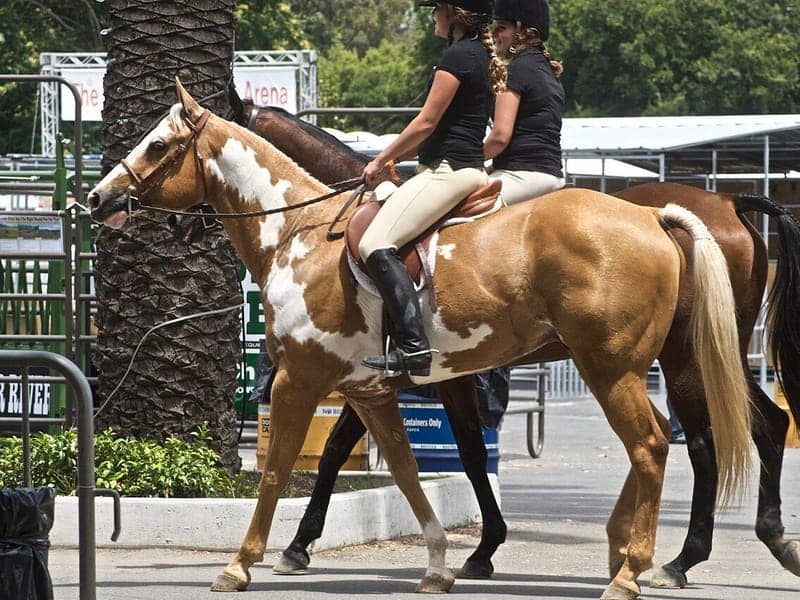
A palomino-and-white Paint: palomino is the base color, and the white patches come from a separate spotting gene.
Photo: Just chaos, CC BY 2.0, via Wikimedia Commons
Palomino Appaloosa Horse
An Appaloosa can be palomino when the leopard-complex spotting pattern sits on a palomino base: a gold horse with a white blanket and spots, or a white horse with gold spots.
Why not every spotted golden horse is palomino: the spots and blanket come from the leopard-complex genes, not cream. A gold-looking Appaloosa might also be chestnut, dun or champagne underneath. Only a DNA test confirms cream. Note that PHBA’s main registry does not accept Appaloosa-type spotting; those horses can go in its separate Palomino Bred registry (PHBA).
Palomino Horse Breed: Is There a Palomino Breed?
Short answer
No. Palomino is a color, not a breed, though some people call it a “color breed” because registries record palominos.
Breed registries record a horse’s pedigree within one breed (AQHA, AMHA, ASHA and so on). Color registries record horses that meet a color standard, often across many breeds. The best known is the Palomino Horse Breeders of America, founded in 1941. Some palomino color registries have even accepted golden Haflingers and Arabians that are genetically flaxen chestnuts (Palomino overview), which shows that “palomino” on paper and palomino in the genes are not always the same.
Palomino Horse vs Similar Horse Colors
Golden horses are easy to mix up. The quickest checks are the mane and tail, the lower legs, the back and the skin. Our buckskin horse guide covers bay-based colors in more depth.
Palomino vs Buckskin Horse
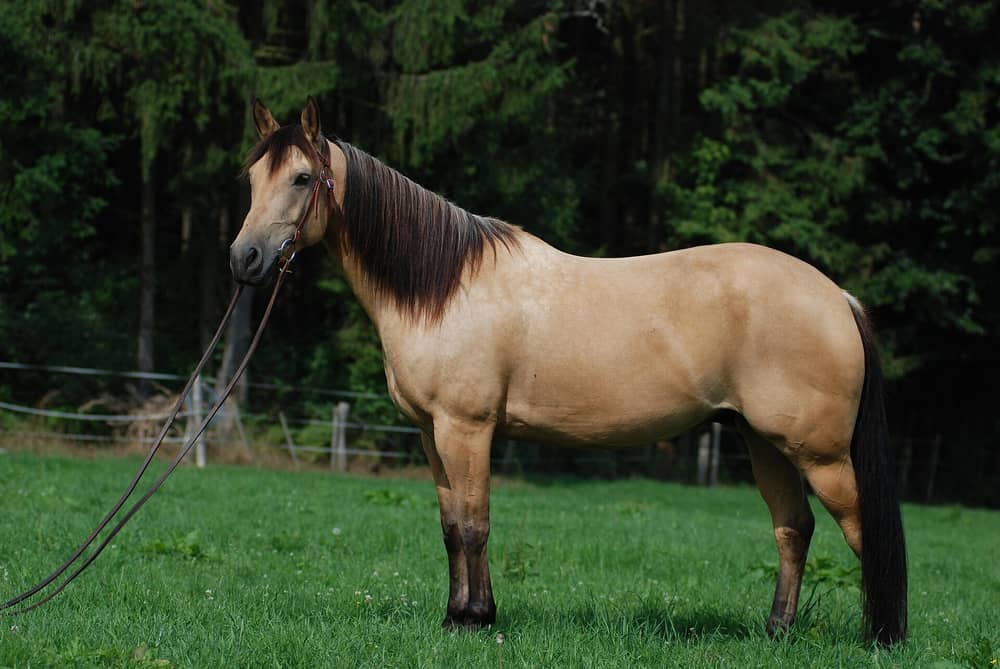
Palominos and buckskins are genetic cousins: both carry exactly one cream gene. The difference is the base underneath. A palomino is a diluted chestnut, so it has no black pigment. A buckskin is a diluted bay, so it keeps a black mane, tail and lower legs (UC Davis VGL).
PalominoA palomino Quarter Horse: classic gold coat and a pale mane. The breed is Quarter Horse; the color is palomino.
Photo: Rumo, CC BY-SA 2.0, via Wikimedia Commons
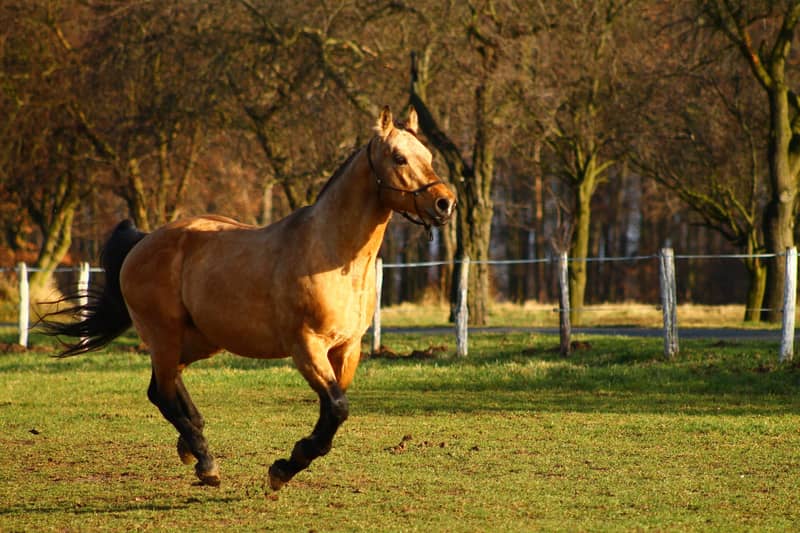 Buckskin
: gold body like a palomino, but with a black mane, tail and lower legs.
Photo: Raketabill, CC BY-SA 3.0, via Wikimedia Commons
| Feature | Palomino | Buckskin |
|---|---|---|
| Base color | Chestnut | Bay |
| Cream dilution | One copy | One copy |
| Body | Golden / yellow | Tan / golden |
| Mane and tail | Usually pale (white, cream, flaxen) | Usually black |
| Lower legs | Body-colored or white, never black-pointed | Usually black-pointed |
| Two cream copies become | Cremello | Perlino |
Palomino vs Buckskin vs Dun
Duns are caused by a different gene (dun, in TBX3) that lightens the body and adds primitive markings: a crisp dorsal stripe, often with leg barring and a shoulder stripe (UC Davis VGL dun). A palomino has none of these, and PHBA rejects horses with a dorsal stripe or zebra stripes (PHBA). A chestnut-based dun (red dun) can look apricot or gold, but its stripe and darker red mane give it away. Read more in buckskin vs dun.
BuckskinBuckskin: gold body like a palomino, but with a black mane, tail and lower legs.
Photo: Raketabill, CC BY-SA 3.0, via Wikimedia Commons
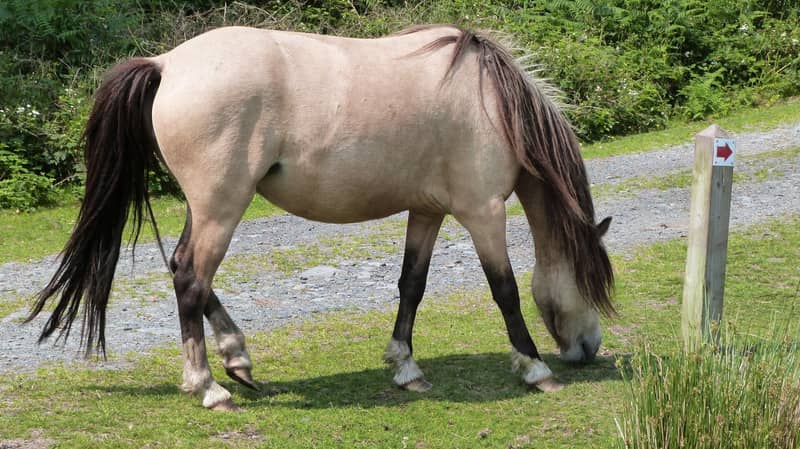 Dun
A dun: tan body with darker head and legs and a dark dorsal stripe along the spine.
Photo: Peter Broster, CC BY 2.0, via Wikimedia Commons
| Feature | Palomino | Buckskin | Dun |
|---|---|---|---|
| Base genetics | Chestnut + one cream | Bay + one cream | Any base + dun gene (TBX3) |
| Mane and tail | Pale | Black | Dark, often with lighter edges |
| Lower legs | Body color | Black | Dark, often barred |
| Dorsal stripe | No (PHBA rejects one) | Not required | Always, crisp from mane to tail |
| Other primitive markings | No | No | Leg bars, shoulder stripe, forehead cobwebbing |
| DNA test | e/e, N/Cr | E_ A_, N/Cr | D/nd1, D/nd2 or D/D |
Palomino vs Pinto Horse
Pinto describes a horse with large patches of white and another color; it is a pattern, not a color. Palomino is a color. A horse can be both: a palomino pinto has gold and white patches. Registries differ: the Pinto Horse Association records pinto-patterned horses of many breeds, while the Paint Horse registry requires Paint, Quarter Horse or Thoroughbred bloodlines.
| Feature | Palomino | Pinto |
|---|---|---|
| What it describes | A coat color (cream on chestnut) | A white spotting pattern on any color |
| Genes | Extension + cream | Tobiano, frame overo, sabino, splash and others |
| Can they combine? | Yes: a palomino pinto (palomino and white) |
Palomino vs Roan Horse
Roan is a white-hair pattern: white hairs mixed evenly through the body, while the head, lower legs, mane and tail stay solid (UC Davis VGL roan). Palomino is a dilution that lightens every body hair. Up close, a palomino’s body hairs are all gold; a roan’s are a salt-and-pepper mix. Yes, a palomino can also be roan, because roan is a dominant gene that can sit on any color.
| Feature | Palomino | Roan |
|---|---|---|
| What it is | A dilution: every body hair is lightened | A pattern: white hairs mixed among colored ones |
| Body | Solid gold hairs | Speckled mix of white and colored hairs |
| Head and legs | Same tone as the body (or white markings) | Stay solid and darker than the body |
| Gene | Cream | Classic roan (dominant) |
| Can they combine? | Yes: a palomino roan (“yellow roan”) |
Palomino Roan Horse
A palomino roan (sometimes called a “yellow roan”) has a gold body frosted with white hairs, a solid gold head and gold lower legs. Because white hairs lighten an already pale coat, palomino roans can look silvery-cream from a distance and are sometimes mistaken for light palominos or grays.
How to tell roaning from other white: roan hairs are spread evenly over the body and the head stays solid; gray starts on the head and spreads with age; sun bleaching fades the tips of hairs rather than adding white ones; and white markings are solid white patches with pink skin underneath. PHBA asks owners to note roan patches on the registration application (PHBA).
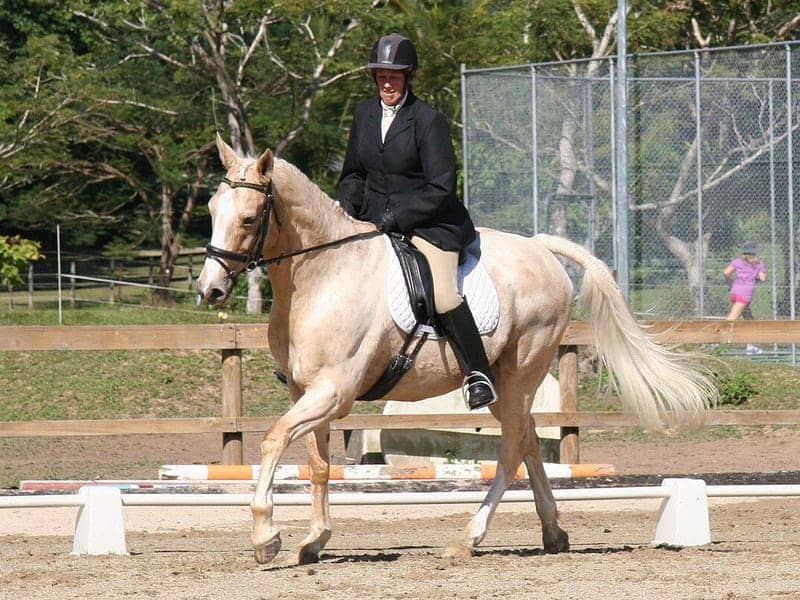
A palomino roan (“yellow roan”) at a dressage show: white hairs frost the gold body while the head stays solid.
Photo: FNEG, CC BY-SA 2.0, via Wikimedia Commons
Palomino vs Bay Horse
A bay has a red-brown body with black points (mane, tail, lower legs and ear rims) and no cream. A palomino has a gold body, a pale mane and tail and no black at all. They differ at two genes: a palomino is e/e with one cream; a bay is E_ A_ with no cream. Read buckskin vs bay for the bay-based side of the family.
PalominoLight palomino: a pale cream-gold body with a white mane and tail. The skin and eyes stay dark.
Photo: Peter Broster, CC BY 2.0, via Wikimedia Commons
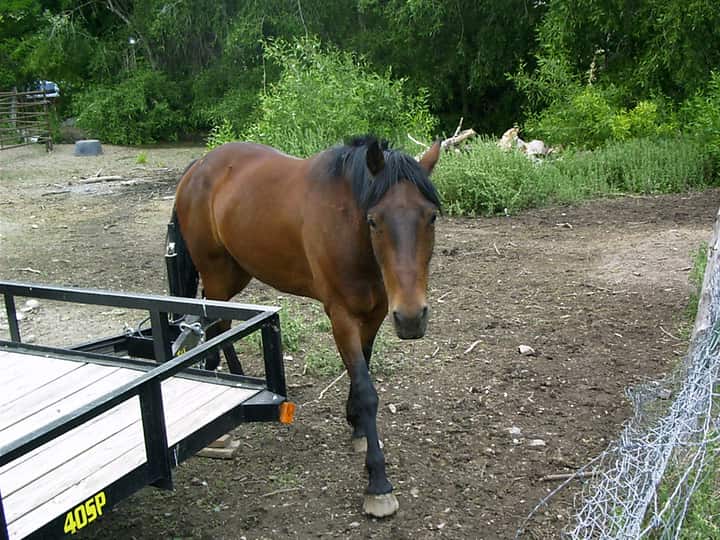 Bay
A bay: red-brown body with black points and no cream dilution.
Photo: Mwirig, CC BY-SA 4.0, via Wikimedia Commons
| Feature | Palomino | Bay |
|---|---|---|
| Body | Gold | Red-brown, copper to mahogany |
| Mane and tail | Pale | Black |
| Dark points | None | Black lower legs and ear rims |
| Genetics | e/e with one cream | E_ A_ with no cream |
Palomino vs Chestnut Horse
Every palomino is a chestnut underneath. One cream copy turns the red body gold and the mane and tail white. A flaxen chestnut, like most Haflingers, has a naturally pale mane and tail but no cream, so its body keeps a red or copper tone. Haflingers and purebred Arabians may look palomino, but neither breed carries cream (Palomino overview).
ChestnutChestnut (no cream, N/N): red-brown body, mane and tail. This is the base color under every palomino.
Photo: MiLKBONE3, CC BY 2.0, via Wikimedia Commons
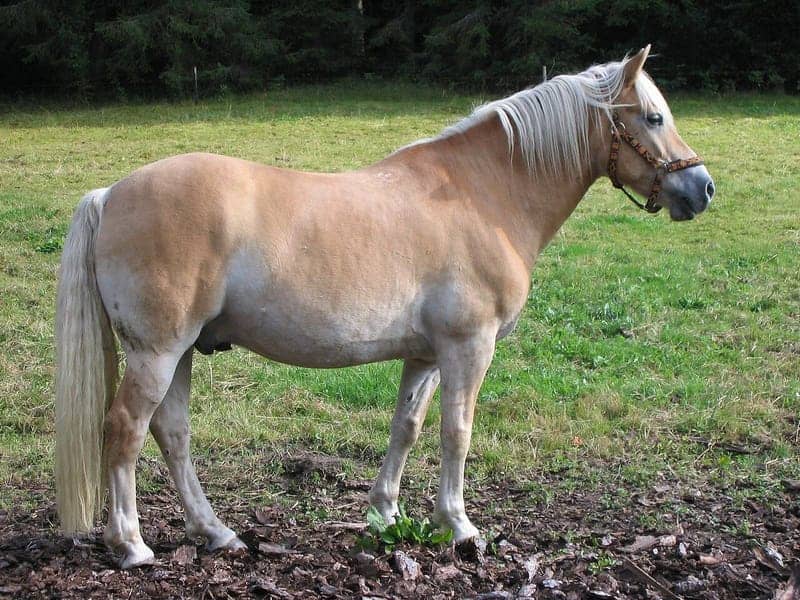 Flaxen chestnut
A Haflinger: often mistaken for a palomino, but genetically a chestnut with a flaxen mane. The breed carries no cream gene.
Photo: Flominator, CC BY-SA 3.0, via Wikimedia Commons
| Feature | Palomino | Chestnut |
|---|---|---|
| Base coat | Chestnut (e/e) | Chestnut (e/e) |
| Cream dilution | One copy | None |
| Body | Gold, cream-gold or dark gold | Red, copper, sorrel or liver |
| Mane and tail | White to cream | Same as body, or flaxen |
| Can pass on cream? | Yes, to about half of foals | No |
Palomino Look-Alikes at a Glance
Champagne horses are the trickiest look-alike: a gold champagne (chestnut + champagne gene) has a shimmering gold body and pale mane, but pinkish, freckled skin and amber or green eyes (UC Davis VGL champagne). Cremellos, flaxen chestnuts, silver dapples and graying horses round out the list.
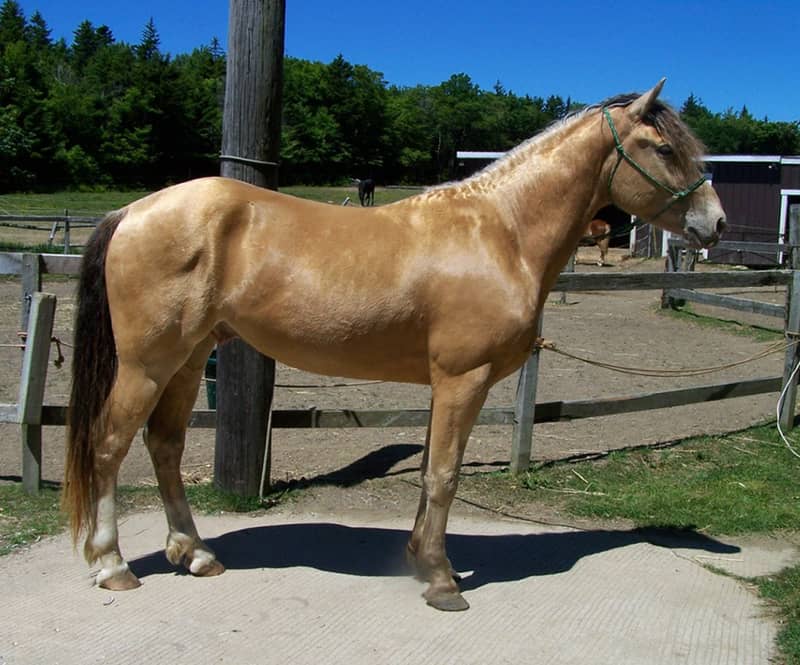
Champagne horses can look palomino-like, but have pinkish freckled skin and amber or green eyes.
Photo: Cook, Brooks, Bellone & Bailey, CC BY-SA 3.0, via Wikimedia Commons
| Color | Body | Mane and tail | Skin and eyes | Key tell |
|---|---|---|---|---|
| Palomino | Gold | White to cream | Dark skin, brown eyes | No black anywhere |
| Flaxen chestnut (e.g. Haflinger) | Red-gold to copper | Flaxen | Dark skin, brown eyes | Body has a red tone; no cream gene |
| Cremello | Cream-white | Cream-white | Pink skin, blue eyes | Two cream copies |
| Gold champagne | Gold with a metallic sheen | Gold to flaxen | Pinkish freckled skin, amber eyes | Freckled skin around eyes and muzzle |
| Buckskin | Tan to gold | Black | Dark skin, brown eyes | Black points |
| Dun (red dun) | Tan to apricot | Darker red | Dark skin | Dorsal stripe and leg bars |
| Silver dapple (silver black) | Chocolate | Flaxen to silver | Dark skin | Looks like a “chocolate palomino” but is black-based |
| Gray (turning) | Gold with white hairs | Pale | Dark skin | Whitens more every year |
Want a second opinion from a photo? Our horse identifier by picture can suggest likely breeds and colors, but a DNA test is the only definitive answer.
Painted Palomino Horse and Spotted Palomino Horse
“Painted palomino” and “spotted palomino” are everyday descriptions, not registered breeds. They describe a palomino base color combined with a white-spotting or leopard pattern.
What Is a Painted Palomino Horse?
A painted palomino is a palomino horse with a Paint- or pinto-type white pattern. A palomino tobiano usually has white crossing the back and white legs with a gold head. A palomino overo usually has white on the belly and sides, with a mostly gold back. Splash and sabino patterns add yet more variety.
Color description vs registered breed: “painted palomino” describes how the horse looks. A Paint Horse is a breed with Paint, Quarter Horse or Thoroughbred bloodlines (APHA), while a pinto may be any breed with the pattern.
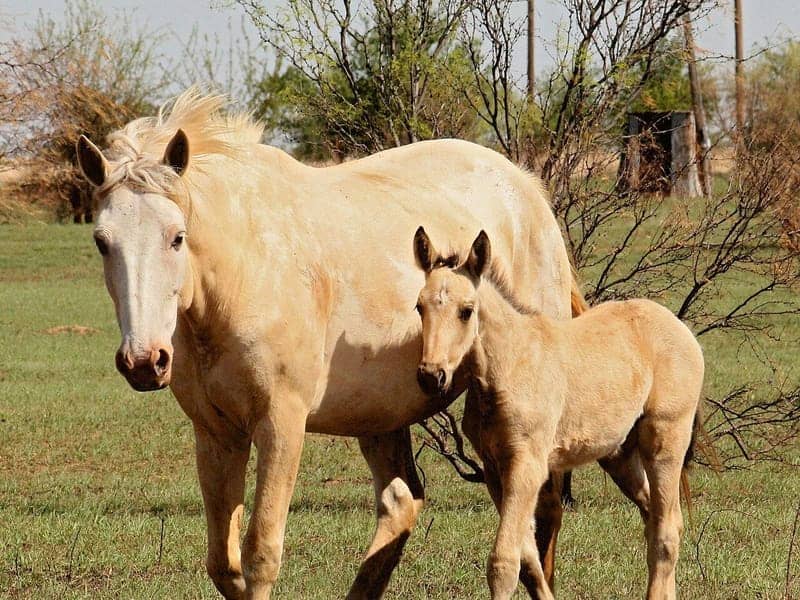
A palomino overo Paint mare with her dun foal: a reminder that a palomino parent does not guarantee a palomino foal.
Photo: Betty Wills (Atsme), CC BY-SA 4.0, via Wikimedia Commons
What Is a Spotted Palomino Horse?
Can a palomino have spots? Yes, in three different ways:
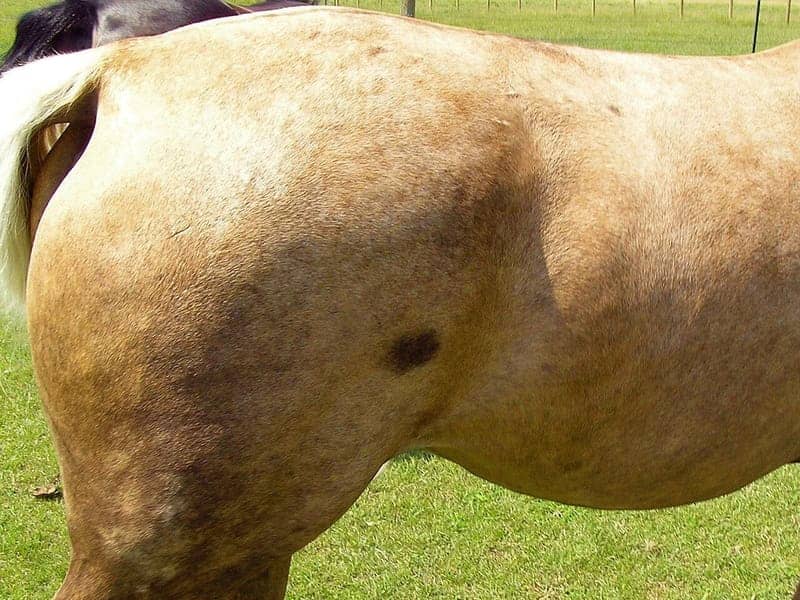
A Bend-Or spot on a palomino’s flank: a small dark patch on a chestnut-based coat, not an Appaloosa pattern.
Photo: Montanabw, CC BY-SA 3.0, via Wikimedia Commons
- Appaloosa (leopard-complex) patterns: a blanket or leopard pattern on a palomino base. This is the “palomino Appaloosa” described in the breeds section.
- White spotting patterns: Paint and pinto patterns give large white patches rather than small spots.
- Bend-Or spots: small, dark reddish or brown spots that sometimes appear on chestnut-based coats, including palominos. They are named after Bend Or, a 19th-century Thoroughbred, and are not an Appaloosa trait (Bend Or spots).
Because these spots have different genetic causes, not every spotted golden horse has the same genetic makeup. A gold leopard Appaloosa might not carry cream at all.
Can a Palomino Have White Patches?
Short answer
Yes. White spotting genes work independently of cream, so a palomino can have anything from a white blaze and socks to large Paint-style patches.
One caveat for registration: PHBA limits white markings to the face and lower legs (with small allowances elsewhere) and does not accept Paint, pinto or Appaloosa spotting in its regular registry. Spotted horses with a PHBA-registered parent can be recorded in its Palomino Bred registry instead (PHBA).
Palomino Horse Height and Size
Short answer
There is no single palomino height, because palomino is a color found in breeds of every size. Many palomino riding horses stand roughly 14 to 16 hands, and PHBA registers horses from 14 to 17 hands at maturity (PHBA).
How horse height is measured: height is measured in hands from the ground to the highest point of the withers (the bony ridge at the base of the neck), with the horse standing square on level ground. One hand equals 4 inches (10.16 cm). The number after the point is extra inches, so 14.2 hh means 14 hands 2 inches, or 58 inches.
Why size varies: a palomino pony, a palomino Quarter Horse and a palomino Saddlebred are completely different sizes. For example, palomino Quarter Horse geldings in the October 2026 listings we checked stood 14.2 to 15.1 hands. Weight and build also follow the breed: a stock horse is compact and muscular, a Saddlebred taller and more upright, and a pony much smaller.
| Hands (hh) | Inches | Centimeters |
|---|---|---|
| 14.0 | 56 | 142 |
| 14.2 | 58 | 147 |
| 15.0 | 60 | 152 |
| 15.2 | 62 | 157 |
| 16.0 | 64 | 163 |
| 16.2 | 66 | 168 |
| 17.0 | 68 | 173 |
Palomino Horse Temperament
Short answer
Palomino color does not determine temperament. A palomino’s personality depends on its breed, training, handling, age and individual nature.
There is plenty of color folklore in the horse world, but no published study shows that palomino color changes behavior. The closest research, a survey of 477 horses in Applied Animal Behaviour Science, compared chestnuts and bays and found that breed, sex and age influenced owner-reported behavior more than coat color (Finn et al. 2016).
Personality differences between breeds matter far more. A palomino Quarter Horse bred for ranch work, a palomino Saddlebred bred for the show ring and a palomino pony will behave differently because of their breeding and jobs, not their gold coat.
Are palominos good for beginners? Some are excellent beginner horses and some are not, exactly like horses of any other color. A beginner horse should be older, well trained, calm in new places and sound.
What to Evaluate When Choosing a Riding Horse
Checklist
0 / 6 checked
What Are Palomino Horses Used For?
Palominos do every job their breed does. PHBA alone offers more than 900 approved show classes, ranging from halter to jumping, horsemanship to driving, cutting to saddle seat, and pole bending to reining and barrel racing (PHBA Heritage).
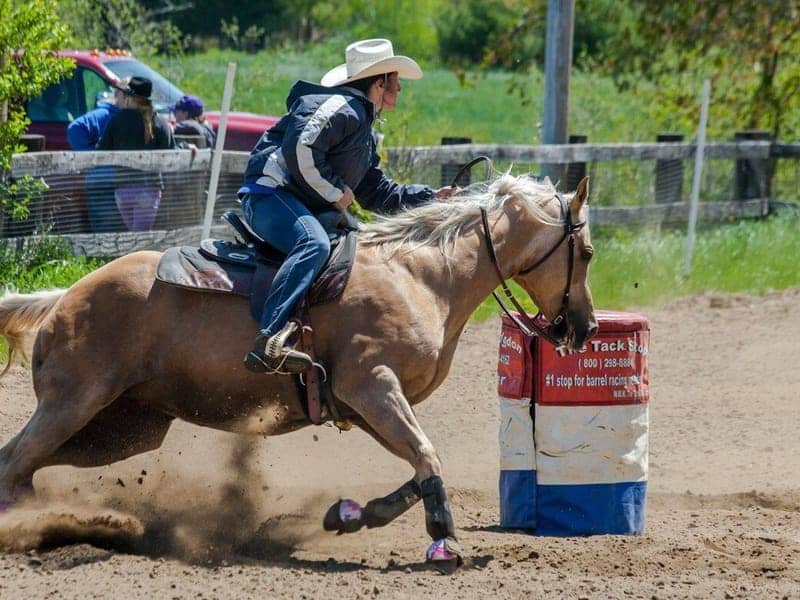
A palomino barrel racing at a rodeo.
Photo: Paul VanDerWerf, CC BY 2.0, via Wikimedia Commons
A palomino Half-Arabian in Western pleasure at the Scottsdale Arabian Horse Show. The cream gene came from the non-Arabian parent.
Photo: Montanabw, CC BY-SA 4.0, via Wikimedia Commons
- Trail riding: calm stock-horse and gaited palominos make popular trail partners.
- Western pleasure: a classic palomino show class, where the color’s flash is an asset.
- Ranch work: sorting, roping and moving cattle, mostly on palomino Quarter Horses.
- Barrel racing and other speed events: pole bending and barrels on athletic stock horses.
- English riding and jumping: where breed and training suit, for example palomino warmblood crosses, Thoroughbreds and ponies.
- Horse shows: halter, all-around and color-breed shows such as the PHBA World Championship Show.
- Driving: Morgans, Saddlebreds and ponies in harness.
- Recreational riding: relaxed riding at home or with friends.
- Film, photography and exhibitions: parades, drill teams, film and advertising, where the gold coat photographs beautifully.
Suitability depends on the individual horse’s conformation, health, training and breed, not simply its color.
Palomino Horse Lifespan
Short answer
A palomino lives as long as any horse of its breed and care level: domestic horses often live into their late 20s and early 30s (UF IFAS Extension). Palomino color itself does not affect lifespan.
Horses are living longer than they used to thanks to better nutrition, dental and veterinary care. Kentucky Equine Research estimates that about 17% of U.S. horses are over 20 years old (KER). The most famous palomino, Trigger, lived to 30 (Trigger).
Factors That Affect Longevity
- Breed and size: ponies often live longer than large horses.
- Nutrition and body condition: neither too thin nor overweight; obesity raises the risk of metabolic disease.
- Preventive veterinary care: vaccinations, parasite control and regular check-ups.
- Dental care: older horses lose grinding ability, so regular dental exams keep them eating well.
- Hoof care and exercise: regular farrier work and daily movement keep joints and hooves healthy.
- Living conditions: safe turnout, shelter and companions.
How to Support Healthy Aging
The American Association of Equine Practitioners recommends a total management plan for older horses built on nutrition, care and exercise, with regular veterinary oversight (AAEP). Switch to senior feeds if chewing becomes difficult, schedule dental checks at least yearly, and keep an older horse moving with gentle work or turnout. For the full journey from foal to senior, see our horse life cycle guide.
Palomino Horse Care Requirements
Palominos need the same care as any horse of the same breed, age and workload. There is no special palomino diet or supplement. The only real differences are cosmetic: a pale mane and tail show stains, and a gold coat can fade in strong sun.
| Area | Guideline | Color-specific? |
|---|---|---|
| Forage | Base the diet on hay or pasture, roughly 1.5–2% of body weight per day as dry matter (Merck) | No |
| Water | Clean water at all times; an idle mature horse drinks about 10–12 gallons a day, more in heat or work (UNL) | No |
| Salt and minerals | Free-choice salt; balance vitamins and minerals to the forage | No |
| Hooves | Trim or shoe every 6–8 weeks in summer and every 6–12 weeks in winter (UMN Extension) | No |
| Grooming | Curry, brush and pick out feet regularly | Light mane and tail show stains more |
| Sun | Shade or a fly sheet can reduce coat fading; protect pink skin under white markings | Partly |
Grooming a Palomino Horse
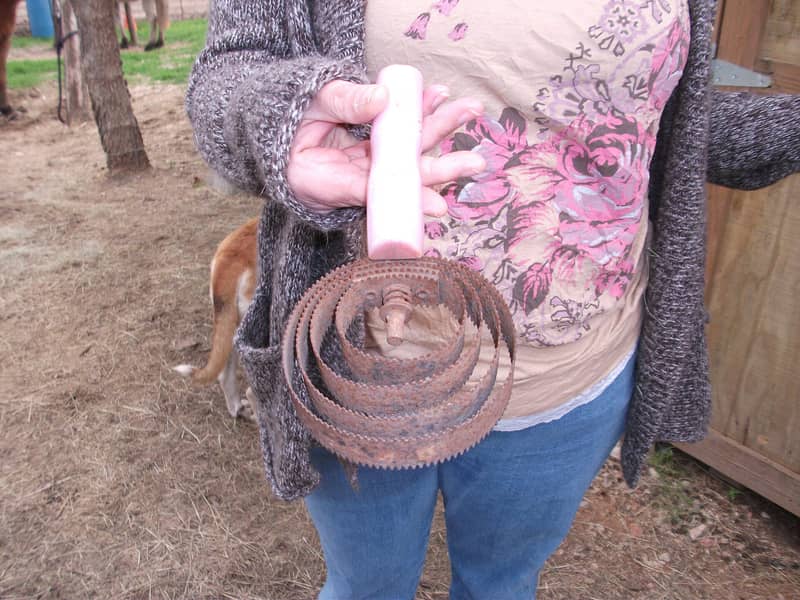
A rubber curry comb loosens dirt and shedding hair before brushing.
Photo: Carolbstevens, CC BY-SA 3.0, via Wikimedia Commons
- Regular brushing: use a rubber curry comb in circles, then a stiff brush and a soft finishing brush. Grooming also lets you spot cuts, heat or swelling.
- Mane and tail care: detangle gently by hand or with a wide-tooth comb, and use a detangler to reduce breakage of the pale hair.
- Removing dirt and stains: spot-clean manure and grass stains quickly with water and a gentle equine shampoo before they set.
- Bathing when appropriate: occasional baths are fine in warm weather; rinse thoroughly. Frequent shampooing strips natural oils, so rely mainly on grooming.
- Coat care during shedding: extra currying in spring speeds up the shed and reveals the brighter summer gold.
Keeping a Golden Coat Clean
- Mud and stains: keep turnout areas well drained and clean lower legs regularly; long wet periods can cause skin infections such as “mud fever” (pastern dermatitis).
- Gentle equine shampoos: choose products made for horses; color-enhancing shampoos for light horses are fine used as directed.
- Avoid harsh whitening chemicals: never use household bleach or similar products on the mane or tail.
- Sun exposure and fading: shade, stabling during the hottest hours or a light fly sheet can reduce fading. Pink skin under white markings may need a vet-approved sunscreen.
Feeding and Nutrition
- Quality forage: hay or pasture forms the core of the diet, roughly 1.5–2% of body weight per day as dry matter (Merck).
- Fresh water: always available; an idle mature horse drinks about 10–12 gallons a day (UNL).
- Balanced minerals and vitamins: provide free-choice salt and a ration balancer if forage alone falls short.
- Feed matched to workload and body condition: add concentrates only if the horse needs more energy than forage provides.
- Professional guidance: ask your veterinarian or an equine nutritionist for horses with special needs, such as seniors or easy keepers.
Exercise and Turnout
- Daily movement: turnout where the horse can walk and graze benefits almost every horse.
- Appropriate workload: build fitness gradually and match work to age and condition.
- Safe pasture and fencing: check fences, footing and pasture plants regularly.
- Social interaction: horses are herd animals and do best with equine company.
Health and Preventive Care
- Routine veterinary examinations: at least yearly, more often for seniors.
- Vaccinations and parasite control: follow a plan from your vet based on region and fecal egg counts.
- Dental care: routine dental exams and floating as needed.
- Hoof trimming and farrier visits: about every 6–8 weeks in summer and 6–12 weeks in winter (UMN Extension).
- Skin checks and injury monitoring: run your hands over the horse while grooming and check pink-skinned areas for sunburn.
Palomino Horse Price
Short answer
There is no single palomino horse price. In U.S. listings we checked in October 2026, palominos were advertised from about $3,000 for a trained gelding or $3,500 for a weanling up to $40,000–$45,000 for top-bred stallions and proven all-around horses.
Prices vary widely by country and market. These figures are U.S. dollar asking prices from public listings, not appraisals or final sale prices.
What Is the Price Range for a Palomino Horse?
Factors that affect price:
- Breed: registered stock and sport breeds usually cost more than grade horses.
- Age: weanlings cost less upfront but need years of training; prime-age trained horses often command the most.
- Training and riding discipline: a finished, safe riding horse is worth more than an unstarted prospect.
- Pedigree and registration: well-known bloodlines and papers (AQHA, PHBA and others) add value.
- Health and soundness: a clean pre-purchase exam supports the price.
- Competition record: show, rodeo or reining results raise value.
- Coat-color demand: a striking gold color can attract more buyers.
- Seller and location: regional markets and transport costs matter.
| Horse | Location | Asking price | Listing |
|---|---|---|---|
| 7-year-old palomino Quarter Horse gelding, 14.2 hh, ranch and trail experience | U.S. | $3,000 | EquineNow |
| 2026 AQHA palomino colt, foundation-bred weanling | Virginia | $3,500 | EquineNow |
| 2026 AQHA palomino filly, foundation/ranch-bred | Iowa | $4,500 | EquineNow |
| Palomino Quarter Horse gelding, 14.2 hh, Western and trail | U.S. | $5,000 | EquineNow |
| 2026 AQHA/PHBA palomino filly, halter-bred | Texas | $6,500 | EquineNow |
| Palomino Quarter Horse gelding, 15.1 hh | U.S. | $12,000 | EquineNow |
| 2024 AQHA palomino stallion by a PHBA Hall of Fame sire | South Dakota | $40,000 | Performance Horse Central |
| 2021 AQHA all-around palomino gelding, 15 hh, family and show horse | Texas | $45,000 | EquineNow |
The purchase price is only the start. New Mexico State University Extension estimates annual care costs of roughly $1,350–$3,000 per horse for feed, hoof care and basic healthcare, plus more than $6,500 in first-year startup costs such as shelter, fencing and tack (NMSU B-715). Boarding, training and emergency care can add much more.
Why Are Some Palomino Horses More Expensive?
- Proven performance: wins and earnings in reining, cutting, barrels or all-around classes.
- Specialized training: a finished reiner or ranch horse represents years of professional work.
- Strong pedigree: the $40,000 stallion in the table is by a PHBA Hall of Fame sire.
- Breed popularity: in-demand breeds and bloodlines cost more overall.
- Show records: points and placings at recognized shows.
- Desirable conformation: correct, athletic build for the intended job.
Does Palomino Color Increase a Horse’s Value?
Color can raise buyer demand, and some sellers list palominos at a premium. But training, health, breed and ability usually matter more. A cremello or a DNA-tested palomino breeding animal may be priced higher as a color producer, because buyers know what it can pass on. For a riding horse, pay for the horse’s skills and soundness, not the gold.
Palomino Horse for Sale: What to Check Before Buying
Searching for “palomino horse for sale” narrows your options by color, but the same buying rules apply as for any horse.
Where to Find Palomino Horses for Sale
- Reputable breeders: especially for young horses, a breeder can show you the parents and explain the color genetics.
- Equine marketplaces: online classifieds let you filter by color, breed, price and location.
- Breed associations: breed registries and the PHBA can point you to breeders and affiliate clubs.
- Local equestrian communities: trainers, farriers, vets and riding clubs often hear about good horses before they are advertised.
- Rescue and adoption organizations: adoption fees are usually lower, and many rescue horses are already started under saddle.
What to Check Before Buying
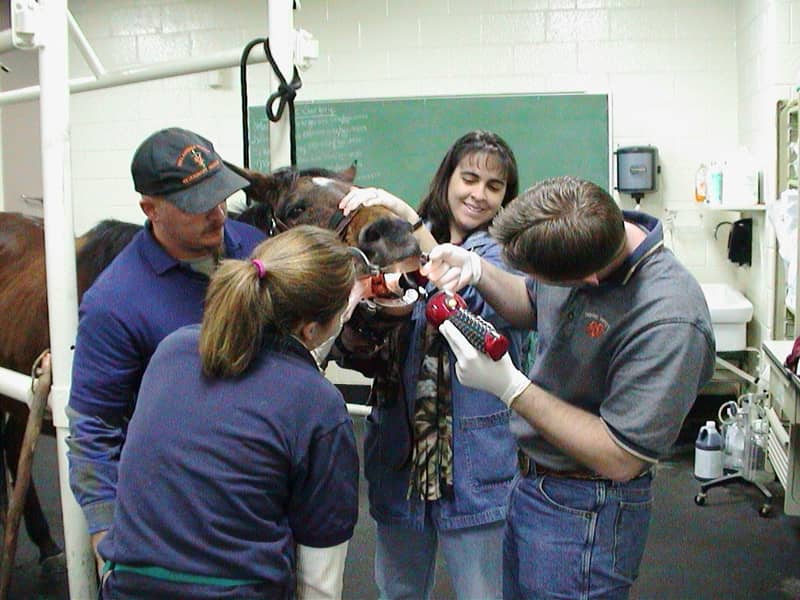
An independent pre-purchase veterinary exam matters far more than coat color when buying a horse.
Photo: Tim1965, public domain, via Wikimedia Commons
Checklist
0 / 8 checked
A pre-purchase exam is a snapshot of risk on the day, not a guarantee; the vet assesses the horse for your intended use (Cornell). Penn State Extension recommends a vet with no relationship to the seller (Penn State).
Questions to Ask a Seller
- 1What breed is the horse, and is it registered (and with which associations)?
- 2How old is it, and how long have you owned it?
- 3What training does it have, and who trained it?
- 4Has it competed, and does it have a show or performance record?
- 5Does it have any previous injuries, lameness, colic or surgeries?
- 6Has it been DNA-tested for color (cream, extension) or genetic diseases relevant to its breed?
- 7Can I arrange a pre-purchase veterinary examination with my own vet?
- 8Can I ride it more than once, or take it on trial?
Palomino Horse Origin and History
The history of the palomino color is different from the history of any breed. Golden horses appear in art and stories from many cultures, and the cream gene is spread across breeds from Central Asia to the Americas. Where the color first arose is unknown. Even the Palomino Horse Association says its place of origin “probably never will be conclusively determined” (PHA).
Golden Horses in Spanish Tradition
Popular accounts link the palomino to Spain. The best-known story says Queen Isabella kept around a hundred golden horses and sent a palomino stallion and five mares to New Spain (Mexico), from which the color spread to Texas and California (PHA). Another says a conquistador named Juan de Palomino gave the color its name. Neither story is backed by solid documentary evidence, so treat them as tradition.
Where the name comes from: “palomino” is a Spanish word and surname, often explained as meaning a young dove or pigeon (from paloma), after the birds’ pale golden color (Palomino overview). A golden grape variety shares the name too.
Palominos in North America, Film and Shows
In the American West, golden horses descended from Spanish stock became prized ranch and parade horses. In the 1930s and 1940s horse enthusiasts in California began organizing palomino registries, and the Palomino Horse Breeders of America was incorporated in Los Angeles County on June 25, 1941 (PHBA).
Hollywood turned the color into a star. Trigger (foaled as Golden Cloud, 1934–1965), Roy Rogers’s palomino stallion, starred in dozens of Westerns and, according to people close to Rogers, learned 150 trick cues (Trigger). Mister Ed, the talking horse of the 1961–1966 TV comedy, was played by Bamboo Harvester, a palomino American Saddlebred × part-Arabian gelding (Bamboo Harvester).
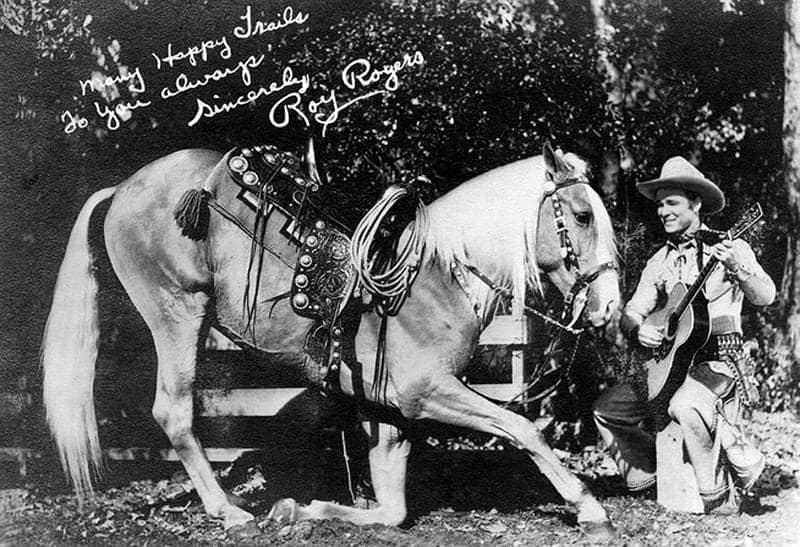
Roy Rogers and Trigger, “the smartest horse in the movies” and the most famous palomino of all.
Photo: publicity photo, public domain, via Wikimedia Commons
Modern Breeding and Registries
Today palominos are bred within many breed registries and recorded by color registries such as PHBA and the Palomino Horse Association. DNA testing, available since the cream mutation was identified in 2003, lets breeders confirm cream status and plan crosses such as chestnut × cremello for guaranteed palomino foals (Mariat et al.).
Palomino Horse Names
Looking for palomino horse names? These ideas suit a golden horse. Choose a name that fits the horse’s personality and appearance, is easy to call across a field, and does not sound like a common command such as “whoa”.
Golden and Sun-Inspired Names
- Sunny
- Goldie
- Sol
- Sunshine
- Marigold
- Nugget
- Dorado
- Solstice
Elegant Names
- Amber
- Aurelia
- Honey
- Dawn
- Saffron
- Champagne
- Gilded Lady
- Topaz
Male Palomino Horse Names
- Apollo
- Blaze
- Copper
- Leo
- Sterling
- Midas
- Trigger
- Butterscotch
Female Palomino Horse Names
- Daisy
- Goldie
- Willow
- Belle
- Aurora
- Buttercup
- Sunny Rose
- Clementine
Names for Dark or Chocolate Palominos
- Mocha
- Toffee
- Caramel
- Maple
- Cocoa
- Bourbon
- Hazel
- Fudge
Palomino Horse Breeders of America
Short answer
The Palomino Horse Breeders of America (PHBA) is the best-known palomino color registry. It was formed in 1941, is based in Tulsa, Oklahoma, and registers golden horses of recognized breeds that meet its color, skin, eye, marking and height rules (PHBA).
What the organization does: PHBA keeps registration records, runs a show and points program with youth, amateur and open divisions, and holds an annual World Championship Horse Show. Its records cover more than 88,000 horses (PHBA Heritage).
Registration and eligibility basics: most horses must already be registered with a PHBA-recognized breed association, including AQHA, APHA, the Appaloosa Horse Club, ASHA, AMHA, the Arabian Horse Association, The Jockey Club and several gaited and warmblood registries. Horses that are not can sometimes qualify through documented parentage or, for some horses, on color and conformation alone (PHBA rules).
| Requirement | PHBA rule |
|---|---|
| Body color | Approximately the color of a U.S. gold coin (rule 503) |
| Not accepted on the body | Dorsal stripe, zebra leg or withers stripes, Paint/Pinto/Appaloosa spotting, cremello/perlino traits, or gray white hairs (rule 503) |
| Skin | Dark (gray, black, brown or mottled) around the nose, eyes, under the tail and between the hind legs (rule 504) |
| Eyes | Black, brown, blue or hazel; blue or partly blue eyes must be on the breed papers (rule 505) |
| Mane and tail | At least 75% white, no more than 25% dark or off-colored hair, not artificially whitened (rule 506) |
| White markings | Limited to the face and lower legs, with small allowances elsewhere (rule 512) |
| Height and type | 14–17 hands at maturity, light riding type, no pony or draft characteristics (rule 502) |
| Breed papers | Registered with a recognized breed association, or eligible through other documented routes (rules 521–548) |
How to Verify a Palomino’s Registration
- 1Ask the seller for the original PHBA certificate and the breed-association papers.
- 2Check that the name, registration number, color, markings and age match the horse in front of you.
- 3Contact PHBA (and the breed association) to confirm the registration and current ownership before you pay.
Color Registration vs Breed Registration
A breed registration (for example AQHA) records pedigree and breed identity. A PHBA registration records that the horse meets the palomino color standard. Many palominos hold both. Horses of palomino breeding that cannot meet the color rules, such as Paint- or Appaloosa-patterned horses, can be recorded in PHBA’s separate Palomino Bred registry if a parent is PHBA-registered (PHBA).
Rules change: PHBA updates its handbook regularly (the current edition covers 2026–2027). Always check the latest requirements directly with the organization (PHBA Handbook).
Interesting Palomino Horse Facts
- 1Palomino describes a coat color, not a distinct breed. Many breeds can be palomino.
- 2The classic coat is golden with a pale mane and tail, ideally the color of a gold coin.
- 3Palomino is cream dilution on a chestnut base: e/e plus one cream gene.
- 4Several horse breeds can produce palominos, from Quarter Horses and Morgans to Saddlebreds, Tennessee Walking Horses and ponies.
- 5Purebred Arabians and Haflingers cannot be true palominos, because neither breed carries cream.
- 6Palomino Quarter Horses are one of the most recognizable examples of the color.
- 7A palomino can also have white spotting patterns, such as a palomino tobiano Paint.
- 8Coat appearance can vary with lighting and season, and some palominos look paler in winter coat.
- 9Two palomino parents do not guarantee a palomino foal: on average only half their foals are palomino.
- 10Chestnut × cremello is the only cross that always produces a palomino.
- 11A palomino’s temperament depends on the individual and its training, not its color.
- 12Trigger, Roy Rogers’s palomino, lived to 30 and was billed as “the smartest horse in the movies”.
Frequently Asked Questions About Palomino Horses
How rare is a palomino horse?
+
Palomino is a relatively uncommon coat color in some populations, but it is not universally considered extremely rare. It is familiar in breeds where cream is established, such as Quarter Horses, Morgans, Tennessee Walking Horses and Saddlebreds, and impossible in breeds with no cream gene, such as purebred Arabians and Haflingers.
What is special about palomino horses?
+
Their striking gold coat and contrasting white or cream mane and tail. The color appears across many breeds and has a long history in shows, parades and film, made famous by horses such as Trigger and Mister Ed.
What two breeds make a palomino?
+
No particular pair of breeds makes a palomino. Palomino is a genetic color: a horse of any breed becomes palomino when it inherits a chestnut base and exactly one cream gene. Crossing a chestnut with a cremello always produces a palomino, whatever the breeds.
What is the price range for a palomino horse?
+
In U.S. listings checked in October 2026, palominos were advertised from about $3,000 to $45,000. Weanlings and basic riding horses sat at the low end, and top-bred stallions and proven all-around horses at the high end. Training, age, breed, pedigree, soundness and record drive the price more than color.
What is the temperament of a palomino horse?
+
There is no palomino temperament. Coat color does not determine personality; breed, training, handling, age and the individual horse do. Judge each horse with a test ride and a look at its history.
What is the average lifespan of a palomino horse?
+
The same as other horses of its breed: domestic horses often live into their late 20s and early 30s with good nutrition, dental, hoof and veterinary care. The color itself does not affect lifespan.
What are the uses of a palomino horse?
+
Palominos are used for trail riding, Western pleasure, ranch work, barrel racing, reining, English riding and jumping, driving, horse shows, parades, film and recreational riding. What a horse can do depends on its breed, conformation and training.
What are the care requirements for a palomino horse?
+
The same as any horse: quality forage, fresh water, salt and balanced minerals, daily movement, regular hoof care, dental care, vaccinations, parasite control and grooming. The pale mane and tail show stains more, and the coat can fade in strong sun.
Is a palomino a horse breed?
+
No. Palomino is a coat color. Color registries such as the Palomino Horse Breeders of America record palominos of many breeds, but the color does not breed true, so it cannot form a breed of its own.
What colors can a palomino horse be?
+
Every palomino has a gold body and a pale mane and tail, but the gold ranges from light cream-gold through the classic golden shade to dark and chocolate-looking palominos, often influenced by sooty shading, season and sun.
Can a palomino horse have spots?
+
Yes. A palomino can carry an Appaloosa (leopard-complex) pattern, Paint or pinto white patches, or small dark Bend-Or spots. These come from different genes than the palomino color itself.
Can a palomino horse be roan?
+
Yes. Roan is a separate dominant gene that adds white hairs to the body while the head and legs stay solid. A palomino with roan is called a palomino roan or yellow roan.
What is a chocolate palomino horse?
+
An informal name for a very dark palomino with a brown or chocolate-looking body and a light mane and tail, usually explained as a dark chestnut base with one cream gene and sooty shading. Silver dapples and flaxen liver chestnuts can look similar, so a DNA test is the only proof.
How tall is a palomino horse?
+
It depends on the breed. Many palomino riding horses are roughly 14 to 16 hands (56 to 64 inches), and the Palomino Horse Breeders of America registers horses from 14 to 17 hands at maturity. Palomino ponies are smaller.
Can a palomino horse be a Paint Horse?
+
Yes. A Paint Horse can have a palomino base color with tobiano, overo or other white patterns on top. The American Paint Horse Association recognizes palomino as a color.
What breeds can produce palomino horses?
+
Any breed with both chestnut and the cream gene, including the American Quarter Horse, Morgan, Tennessee Walking Horse, American Saddlebred, Paint, Appaloosa, Missouri Fox Trotter, Thoroughbred (rarely), Lusitano, many pony breeds and Half-Arabians. Purebred Arabians and Haflingers cannot.
Is a palomino the same as a buckskin?
+
No. Both carry one cream gene, but a palomino is a diluted chestnut with a pale mane and tail and no black, while a buckskin is a diluted bay with a black mane, tail and lower legs.
Final Summary
- Palomino is a coat color, not a breed: a gold body with a white or cream mane and tail and no black points.
- It results from one cream gene on a chestnut base. Two palominos average only 50% palomino foals; chestnut × cremello always produces one.
- Many breeds can be palomino, including Quarter Horses, Morgans, Tennessee Walking Horses, Saddlebreds, Paints and Half-Arabians. Purebred Arabians and Haflingers cannot.
- Tell a palomino from a buckskin (black points), dun (dorsal stripe), chestnut (red body), cremello (pink skin, blue eyes) and champagne (freckled skin). A DNA test settles any doubt.
- Temperament, lifespan, care and price depend on the individual horse: its breed, training, health and record, not its golden coat.
Sources
Genetics facts come from university genetics laboratories and peer-reviewed studies; care and buying guidance from veterinary manuals and university extension services. Photos are from Wikimedia Commons under the licenses credited in each caption.
- UC Davis Veterinary Genetics Laboratory — Equine coat color genetics
- UC Davis VGL — Cream dilution test
- UC Davis VGL — Red factor (extension) test
- UC Davis VGL — Dun test
- UC Davis VGL — Silver test
- UC Davis VGL — Champagne test
- UC Davis VGL — Roan zygosity test
- UC Davis VGL — Gray test
- Mariat D, Taourit S, Guérin G (2003). A mutation in the MATP gene causes the cream coat colour in the horse. Genetics Selection Evolution 35:119–133
- Genes (2022) 13(9):1641 — Breed distribution and allele frequencies of coat color variants across 28 horse breeds (UC Davis VGL test data)
- The relationship between parental coat colour and prize-winning Palominos (open-access study, PMC)
- American Morgan Horse Association — Gene frequency of cream dilution (L. Brown, 2011)
- The Morgan Horse — “A Touch of Pastel” (dilution genes explained)
- Arabian Horse World — “What color is your horse?” Part 3 (color genes in Half-Arabians)
- Cream gene (overview of breeds with and without cream)
- Palomino (overview, color registries and look-alike breeds)
- Bend Or spots (overview)
- Palomino Horse Breeders of America — Registration rules
- Palomino Horse Breeders of America — New to PHBA? (registration and Palomino Bred)
- Palomino Horse Breeders of America — History of PHBA
- Palomino Horse Breeders of America — About PHBA
- Palomino Horse Breeders of America — 2026–2027 Handbook
- Palomino Horse Breeders Heritage Foundation — Formation of PHBA
- Palomino Horse Association — History (traditional origin stories)
- American Paint Horse Association — The breed (lineage rules and recognized colors)
- Finn JL, et al. (2016). The relationship between coat colour phenotype and equine behaviour. Applied Animal Behaviour Science 174:66–69
- University of Florida IFAS Extension AN253 — Caring for the older horse
- Kentucky Equine Research — Taking care of the senior horse
- American Association of Equine Practitioners — 10 tips for caring for the older horse
- Merck Veterinary Manual — Nutritional requirements of horses
- University of Nebraska–Lincoln Extension G1781 — Feeding horses
- University of Minnesota Extension — Caring for your horse’s hooves
- Merck Veterinary Manual — Prepurchase examination of horses
- Cornell University College of Veterinary Medicine — Equine pre-purchase exams: what to expect
- Penn State Extension — Pre-purchase exams
- Texas A&M Pet Talk — Purchasing a new horse
- New Mexico State University Extension B-715 — Basic essentials of equine ownership
- Trigger (horse)
- Bamboo Harvester (Mister Ed)
- EquineNow — Palomino horses for sale (asking prices checked October 2026)
Related Articles
Buckskin Horse: Color, Genetics & Breeds
The palomino’s bay-based cousin: gold body, black points. Shades, genetics, buckskin vs dun and buying tips.
Read articleHorse Identifier by Picture
Upload a photo to get likely breed and coat-color suggestions for any horse.
Read articleHorse Life Cycle
Follow a horse from foal to senior: growth stages, weaning, training age and lifespan.
Read articleIdentify a horse & explore more guides
Upload a photo to get likely breed and color suggestions, follow the horse from foal to adult, or browse the rest of our animal guides.



