How Many Nuts Can a Squirrel Fit in Its Mouth?
The short answer surprises most people: a grey or fox squirrel carries just one nut at a time. Here is why tree squirrels never stuff their cheeks, what research shows about peanuts and hazelnuts, and which members of the squirrel family really can.
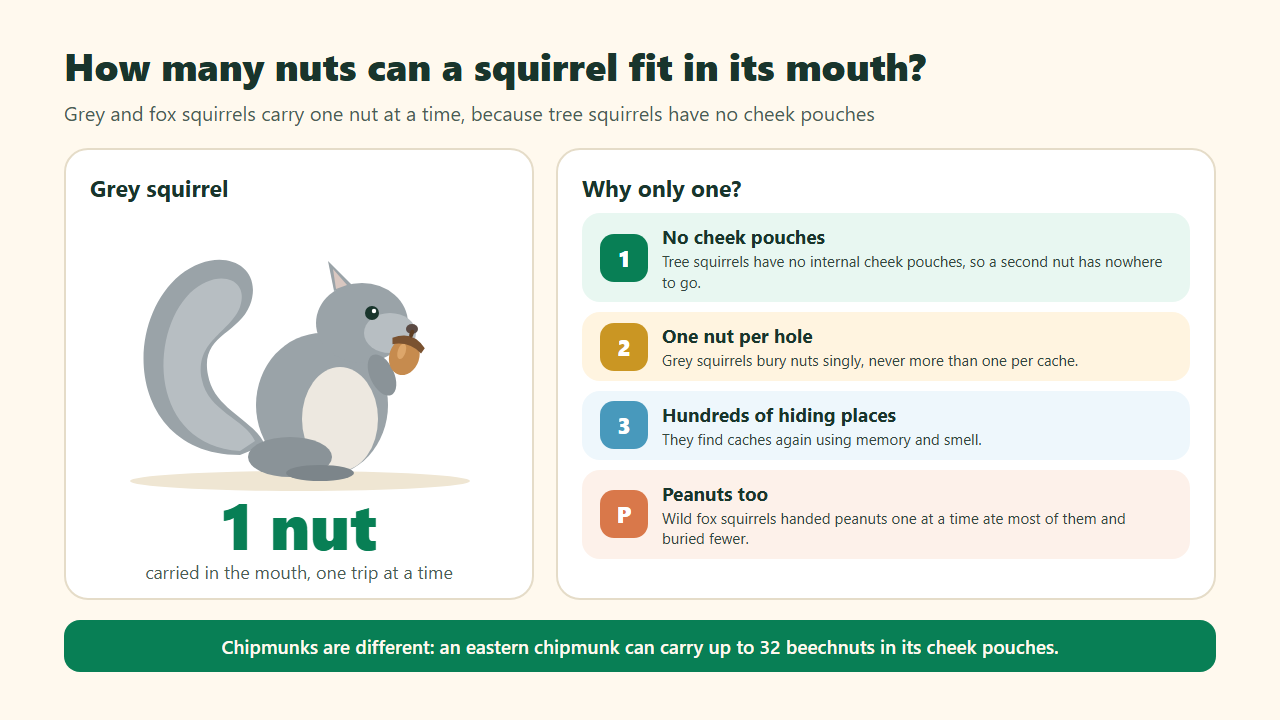
Quick answer
One. Tree squirrels such as the grey squirrel and fox squirrel carry a single nut at a time, held in their mouth. Unlike chipmunks and ground squirrels, tree squirrels have no internal cheek pouches to pack food into (Orange County Vector Control).
Carrying one nut suits the way they store food. Grey squirrels bury nuts singly, never more than one per cache, and end up with food hidden in hundreds of different places (UC Berkeley).
If you meant the stripy animal with bulging cheeks, that is a chipmunk, a small ground-dwelling member of the squirrel family. An eastern chipmunk has been recorded carrying 32 beechnuts in one trip. See how many nuts a chipmunk can fit in its mouth.
Why a Squirrel Can Only Carry One Nut
Some members of the squirrel family, such as ground squirrels, have internal cheek pouches they use to carry food back to their nests. Tree squirrels have no internal cheek pouches (Orange County Vector Control). Without pouches there is nowhere to store a second nut while carrying the first, so a grey or fox squirrel carries one nut in its mouth.
You can see this in research on wild fox squirrels. Before deciding whether to eat or bury a nut, a squirrel turns it in its paws and mouth, then “head flicks”, rapidly shaking its head while holding the nut in its mouth, which researchers think helps it judge the nut’s weight and quality. When it buries the nut, it tamps it into the ground with its front teeth (Delgado et al., PLOS ONE).
One Nut, One Hole: How Squirrels Store Food
Grey squirrels are scatter hoarders. Instead of keeping one big pile, they bury food in many separate caches and find them later using both memory and smell (Animal Diversity Web).
A UC Berkeley study describes grey squirrels burying nuts singly, never more than one per cache, so a single thief cannot take everything; the cost is that the squirrel has to remember hundreds of hiding places (UC Berkeley). In a classic experiment, squirrels given hazelnuts one at a time spent an average of about 2.3 minutes caching each nut, and later found their own caches more often than other squirrels’ caches (Jacobs & Liman, 1991).
Carrying one nut at a time is therefore not a limitation for a tree squirrel. It matches a strategy built around many small, separate hiding places.
How Many Peanuts Can a Squirrel Fit in Its Mouth?
The same rule applies: one peanut at a time. In a study of wild fox squirrels on the UC Berkeley campus, researchers handed each squirrel 15 nuts in the shell, one at a time, alternating peanuts and hazelnuts (Delgado et al., PLOS ONE).
The squirrels treated the two nuts very differently. They always ate more peanuts than they buried, while they buried almost every hazelnut in autumn. They also carried hazelnuts about twice as long before stopping, suggesting they took the more valuable nut farther away.
What wild fox squirrels did with nuts handed to them one at a time (Delgado et al., 2014)
| Measure | Peanuts in the shell | Hazelnuts in the shell |
|---|---|---|
| Weight of each nut used | 2.0–3.0 g | 2.5–3.5 g |
| Eaten or buried in autumn | Mostly eaten (59%) | 99% buried |
| Eaten or buried in summer | Mostly eaten (78%) | 76% buried |
| Average time spent carrying before eating or digging | About 17 seconds | About 34 seconds |
| How researchers describe the nut | Lower value, highly perishable, soft porous shell | High calorie, heavy shell, less perishable |
Which Squirrels Can Stuff Their Cheeks?
The squirrel family includes more than tree squirrels. The Missouri Department of Conservation notes that chipmunks, woodchucks and ground squirrels have pockets of skin in their mouths called cheek pouches that can be packed full of nuts and seeds (Missouri Department of Conservation).
The eastern chipmunk is the record holder most people picture. It can carry as many as 32 husked beechnuts in its two cheek pouches at once (SUNY ESF). Read the full breakdown in how many nuts a chipmunk can fit in its mouth.
Which members of the squirrel family have cheek pouches
| Animal | Cheek pouches? | How it carries nuts |
|---|---|---|
| Grey squirrel, fox squirrel and other tree squirrels | No | One at a time, in the mouth |
| Eastern chipmunk | Yes, on both sides of the mouth | Many at once, packed into the pouches |
| Ground squirrels | Yes | Carried in the pouches back to the nest |
| Woodchuck (groundhog) | Yes | Pouches can be packed with food |
Should You Feed Squirrels Nuts?
Watching a squirrel carry off a nut is fun, but feeding wild animals is not risk-free. Check the advice above and any local rules first. Where feeding is appropriate, The Wildlife Trusts suggest putting out small amounts every few days, offering a variety of nuts and seeds rather than peanuts alone, removing uneaten food before restocking and cleaning feeders regularly (The Wildlife Trusts).
Frequently asked questions
Do squirrels have cheek pouches?+
Tree squirrels, including grey, fox and red squirrels, do not have internal cheek pouches. Some relatives in the squirrel family do, including chipmunks, ground squirrels and woodchucks.
Can a squirrel carry two nuts at once?+
Tree squirrels normally carry one nut at a time in their mouth. They have no cheek pouches, and they bury nuts one per hole, so there is little reason to carry more than one.
How many peanuts can a squirrel carry?+
One at a time. In a study of wild fox squirrels, each peanut was carried off individually, and the squirrels were more likely to eat peanuts than bury them.
Why do squirrels bury nuts one at a time?+
Grey and fox squirrels are scatter hoarders. Spreading nuts across hundreds of separate holes means another animal that finds one cache only gets one nut. Squirrels find their caches again using memory and smell.
What animal looks like a squirrel and stuffs its cheeks?+
That is usually a chipmunk. Chipmunks are small, striped, ground-dwelling members of the squirrel family with cheek pouches that can hold dozens of seeds or nuts.
How This Guide Was Prepared
This guide was researched and written by the AnimalIDFinder editorial team using wildlife agency publications, university resources and peer-reviewed studies, all linked below. Numbers from experiments describe what the studied squirrels did and may differ for other squirrels and settings.
Last reviewed against sources: November 2026.
Related wildlife questions
Sources
Wildlife agency, university and peer-reviewed sources used in this guide:
- Orange County Mosquito and Vector Control District — Squirrels fact sheet (PDF)
- Animal Diversity Web (University of Michigan) — Sciurus carolinensis, eastern gray squirrel
- UC Berkeley — Squirreling it away: how gray squirrels remember where they hid their nuts (1997)
- Delgado, Nicholas, Petrie & Jacobs (2014) — Fox squirrels match food assessment and cache effort to value and scarcity, PLOS ONE
- Jacobs & Liman (1991) — Grey squirrels remember the locations of buried nuts, Animal Behaviour (PDF)
- Missouri Department of Conservation — Nut Jobs: seven kinds of squirrels
- Animal Diversity Web (University of Michigan) — Tamias striatus, eastern chipmunk
- SUNY College of Environmental Science and Forestry — Eastern chipmunk
- USDA APHIS Wildlife Services — Don’t feed the wildlife
- The Wildlife Trusts — Helping red squirrels in your garden
Identify animals & explore guides
Spotted a squirrel or chipmunk and not sure which? Try the photo identifier, browse the mammals encyclopedia, or return to the guides hub.