Harpy Eagle Identification: Size, Wingspan, Diet, Habitat, Talons, and Facts
Everything about the rainforest eagle that hunts sloths and monkeys: how big it really is, how much females and males weigh, why its wingspan is shorter than you might expect, how large its talons are, where it lives, how it breeds and why it is Vulnerable, with every number traced to a source.
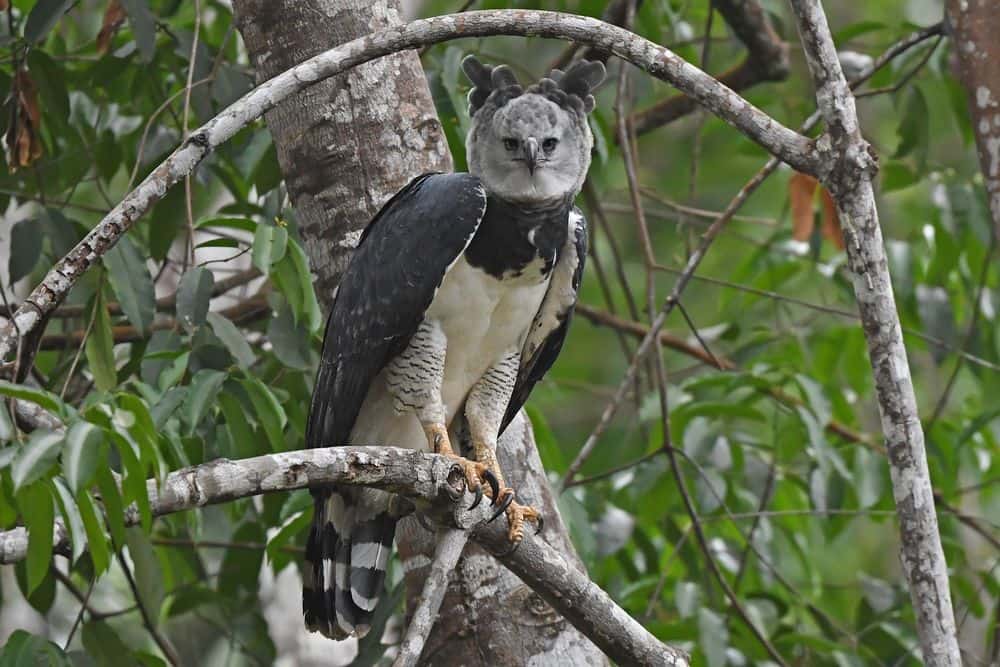
The harpy eagle (Harpia harpyja) is a large tropical forest eagle of Central and South America, and one of the most powerful birds of prey on Earth. It is famous for its huge feet and talons, its pale gray head with a split crest, and a diet built around sloths and monkeys caught in the rainforest canopy (The Peregrine Fund).
Researchers who study it describe it as one of Earth’s largest eagles (Miranda et al. 2021). But “largest” depends on what you measure. Female harpies are among the heaviest eagles alive, yet their wingspan is surprisingly modest for their weight, because short, broad wings work better inside a forest than long soaring wings.
This guide covers the questions people actually search for: how big a harpy eagle is next to a person and next to other eagles, female vs male weight, wingspan, talon size, diet, habitat and range, lifespan, breeding and conservation status. Where reputable sources disagree, we show the range and explain why.
Harpy Eagle Quick Facts
| Feature | Harpy eagle |
|---|---|
| Scientific name | Harpia harpyja (the only species in the genus Harpia) |
| Common names | Harpy eagle, American harpy eagle; gavião-real in Brazil; águila harpía in Spanish |
| Type | Bird of prey (eagle) |
| Family | Accipitridae (hawks, eagles and kites) |
| Habitat | Lowland tropical rainforest, usually below 900 m |
| Range | Southern Mexico through Central America to northern Argentina; most common in the Brazilian Amazon |
| Diet | Mostly tree-dwelling mammals, especially sloths and monkeys |
| Length | 89–105 cm (35–41 in), bill tip to tail tip |
| Wingspan | Up to about 2 m (6.5 ft) |
| Weight | Females 6.3–9 kg (14–20 lb); males 3.8–5.4 kg (8.5–12 lb) |
| Rear talon | About 7.6–10 cm (3–4 in); some sources cite up to 13 cm |
| Lifespan | Estimated 25–35 years (see the lifespan section for caveats) |
| Conservation status | Vulnerable (IUCN Red List, 2021); population decreasing; CITES Appendix I |
| Main threats | Forest loss and degradation, shooting and poaching |
What Is a Harpy Eagle?
Short answer
A harpy eagle is a very large, powerful eagle of Neotropical rainforests. It belongs to the hawk and eagle family Accipitridae, is the only member of the genus Harpia, and hunts mainly tree-dwelling mammals such as sloths and monkeys.
The harpy eagle lives in lowland tropical forest from southern Mexico to northern Argentina, usually below about 900 m elevation (BirdLife International). Adults are slate-black above and white below, with a broad black band across the chest, a pale gray head and a split crest. Males and females look alike, but females are much larger.
Carl Linnaeus described the species in 1758 under the name Vultur harpyja; it was later moved into its own genus, Harpia (overview). Its closest relatives are the crested eagle of the same forests and the Papuan eagle of New Guinea, which is why it is sometimes called the American harpy eagle.
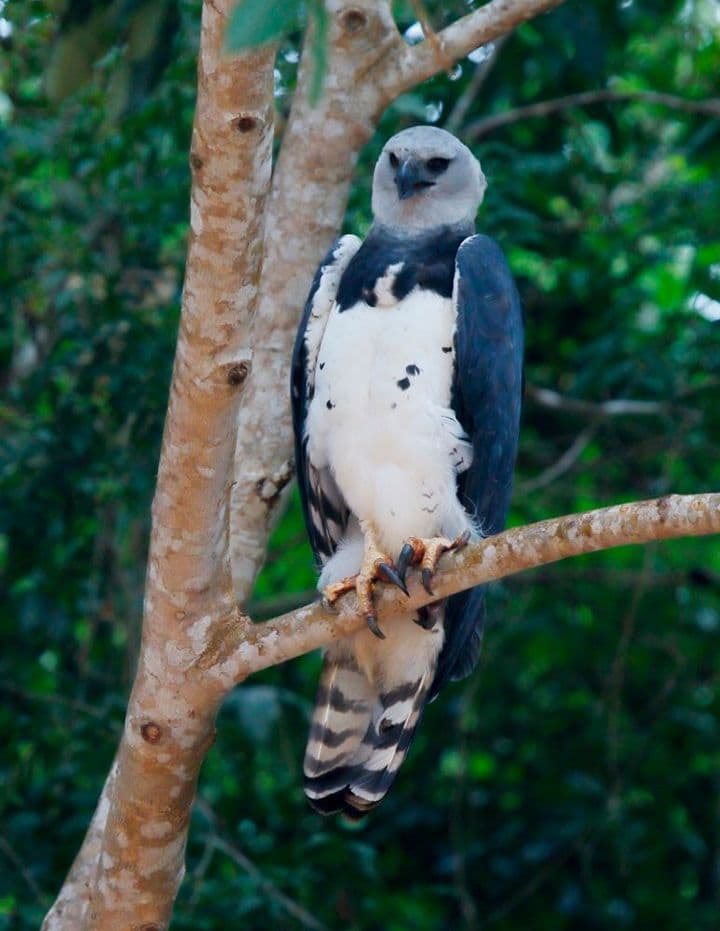
A free-living adult in Carajás National Forest, Pará, Brazil. The Brazilian Amazon is the species’ stronghold.
Photo: Hector Bottai, CC BY-SA 4.0, via Wikimedia Commons
Why Is the Harpy Eagle So Famous?
- Size and power: it is regularly ranked among the world’s largest and most powerful eagles (The Peregrine Fund).
- Enormous talons: its rear talons are about 3–4 inches long, comparable to a grizzly bear’s claws, according to The Peregrine Fund.
- A canopy hunter: it specializes in catching sloths and monkeys among the trees, prey that few other birds can tackle.
- A striking face: the raised crest and owl-like facial disc make it instantly recognizable.
- A national symbol: it is the national bird of Panama (The Peregrine Fund).
- Rarely seen: it lives at low density in remote forest, so even many people living within its range have never seen one.
Harpy Eagle Size
Short answer
A harpy eagle measures about 89–105 cm (35–41 in) from bill tip to tail tip, roughly 1 m. Females are larger than males. Its wingspan reaches about 2 m (6.5 ft).
Those figures come from San Diego Zoo Wildlife Alliance, which lists the harpy’s size as 89–105 cm with the female larger than the male (San Diego Zoo). The Peregrine Fund gives a body length of 3 to 3.5 ft (about 1 m) and a wingspan of up to 6.5 ft (2 m) (The Peregrine Fund).
Want to see how fast a big raptor grows from hatchling to adult size? Our animal growth calculator estimates growth curves and adult weight for birds of prey such as the bald eagle, peregrine falcon and red-tailed hawk, along with many mammals and pets.
How Big Is a Harpy Eagle?
Picture a bird roughly a meter long, with legs as thick as a small child’s wrist (San Diego Zoo). What makes it look so massive is its bulk: a heavy chest, very thick legs and huge feet on a body that is compact rather than lanky.
| Measurement | What is measured | Harpy eagle figure |
|---|---|---|
| Total length | Bill tip to tail tip, with the bird laid flat or stretched | 89–105 cm (San Diego Zoo) |
| “Height” | Usually just total length relabeled; a perched bird stands shorter because the body tilts and the tail hangs down | Often quoted as 89–105 cm or “about 1 m” |
| Wingspan | Wingtip to wingtip with wings fully spread | Up to about 2 m (The Peregrine Fund) |
| Weight | Body mass; varies by sex, season, crop contents and captivity | F 6.3–9 kg, M 3.8–5.4 kg |
| Talon length | Usually the rear (hallux) claw, measured along the curve or in a straight line | 7.6–10 cm, up to ~13 cm in some sources |
Harpy Eagle Height: What the Numbers Mean
Many fact sheets list a harpy eagle’s “height” as 89–105 cm. That number is really total length, measured from the bill tip to the tail tip. Nobody measures a wild eagle standing on a perch with a ruler.
A perched harpy usually looks a little shorter than its total length, because its body leans forward and its long tail hangs below the branch. Sources differ for three main reasons: females are much bigger than males, captive birds can be heavier and better fed than wild ones, and some sources quote a single bird or round to “about 1 m”.
Harpy Eagle Size Compared With a Human
Stood on end next to an adult, a large female harpy’s full length (about 1 m) would reach roughly waist height, so the bird is far shorter than the person. With its wings open, though, the eagle is wider than most people are tall: “From wing tip to wing tip, they are longer than many full-grown humans are tall,” says The Peregrine Fund.
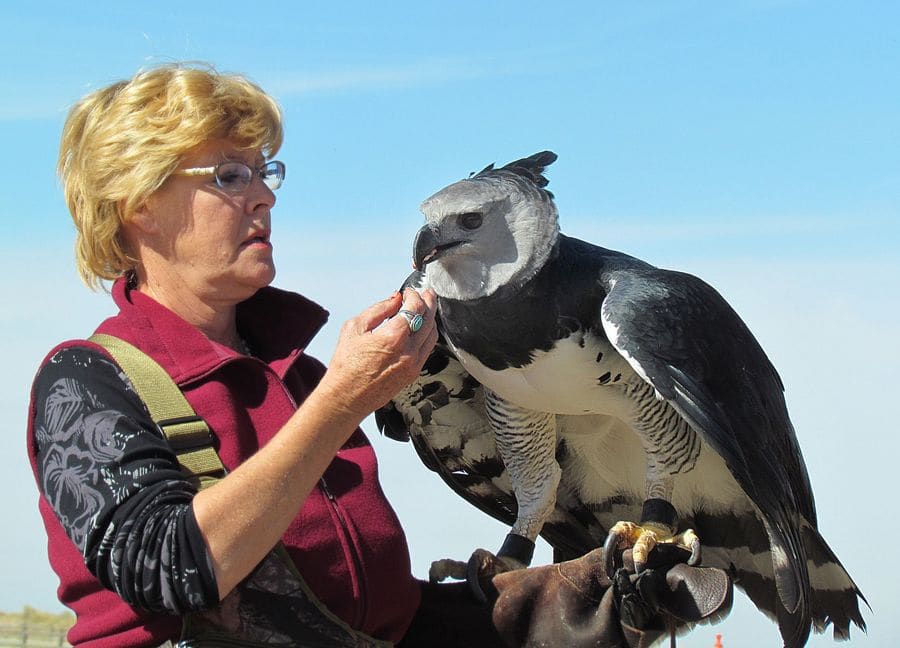
Real-world scale: a trained harpy eagle on a falconer’s glove. The bird’s body is roughly as long as the handler’s forearm and upper body.
Photo: Jitze Couperus, CC BY 2.0, via Wikimedia Commons
Harpy Eagle Size Compared With Other Eagles
Compared with other big eagles, the harpy is heavier and longer than bald and golden eagles, but its wingspan is no wider. It is similar in length and weight to the Steller’s sea eagle and the Philippine eagle, and much bigger than the African crowned eagle.
Sources: San Diego Zoo (harpy, Steller’s), The Peregrine Fund (Philippine, crowned), Cornell Lab All About Birds (bald, golden). Ranges overlap heavily, so there is no clear “longest eagle”.
Full side-by-side tables follow in the comparison sections below: harpy vs bald eagle, vs golden eagle, vs Steller’s sea eagle and vs crowned eagle.
Harpy Eagle Weight
Short answer
Female harpy eagles weigh about 6.3–9 kg (14–20 lb); males weigh about 3.8–5.4 kg (8.5–12 lb). A female can weigh up to twice as much as her mate.
These are the ranges given by San Diego Zoo. The Peregrine Fund gives an overall range of 9–20 lb (4–9 kg) and notes that “a female can weigh up to two times more than her mate” (The Peregrine Fund). Unusually heavy figures quoted online usually come from captive birds, which are not representative of wild eagles.
Female vs Male Harpy Eagle Weight
| Feature | Female | Male |
|---|---|---|
| Weight | 6.3–9 kg (14–20 lb) | 3.8–5.4 kg (8.5–12 lb) |
| Relative size | Can weigh up to twice as much as her mate | Noticeably smaller and lighter |
| Talons | Larger; often-quoted average rear talon ~12.3 cm | Smaller; often-quoted average ~8.6 cm |
| Typical prey | Tends to take larger prey such as sloths and monkeys | Tends to take more, smaller and faster prey |
| Nesting role | Does most incubation and stays close to the nest for months | Hunts for the female and chick |
| Plumage | Same pattern as the male | Same pattern as the female |
The talon averages in the table are widely repeated compiled figures (overview). Treat them as approximate: see the talon section for why talon measurements vary. Prey differences between the sexes come from San Diego Zoo.
Why Are Female Harpy Eagles Heavier?
Females being larger than males is normal in birds of prey, and it is especially pronounced in harpy eagles. Biologists have proposed several explanations, and they are not mutually exclusive:
- Different prey: the larger female tends to take sloths and monkeys, while the smaller, more agile male takes more, smaller prey. Together the pair can use a wider range of food (San Diego Zoo).
- Nest duties: the female does most of the incubation and stays at or near the nest until the chick is about four months old, while the male hunts for the family (The Peregrine Fund). A bigger female is better at guarding the nest and enduring long fasts.
- Egg production: producing large eggs and fueling a long breeding attempt favors a bigger body.
Scientists still debate how much each factor matters, so treat these as leading hypotheses rather than settled facts.
Harpy Eagle Wingspan
Short answer
A harpy eagle’s wingspan reaches about 2 m (6.5 ft). That is impressive in absolute terms, but short for such a heavy eagle: its wings are broad and rounded rather than long.
Both The Peregrine Fund and San Diego Zoo put the wingspan at up to about 2 m. Compiled field and museum measurements are often quoted as roughly 1.76–2.24 m (overview).
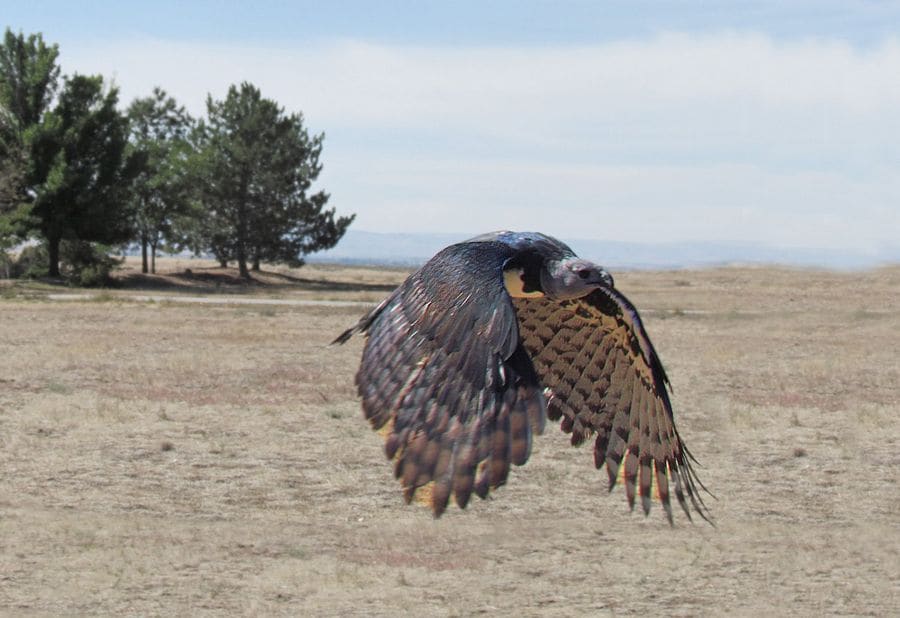
Broad, rounded wings: built for short bursts and quick turns between trees rather than long soaring flights.
Photo: Jitze Couperus, CC BY 2.0, via Wikimedia Commons
Male vs Female Wingspan
Because females are larger overall, their wings are larger too. However, reputable sources rarely publish separate wingspan ranges for each sex, so we do not invent precise male and female figures. If you see exact sex-specific wingspans online, check whether they come from a measured sample or are simply estimates.
Why Is the Wingspan Relatively Short for Its Body Size?
Harpy eagles hunt inside the forest, among trunks, vines and branches. The Peregrine Fund explains that they “are not built for true soaring”: they have “relatively short wings and long tails that act like a rudder on a boat to steer through dense vegetation” and travel slowly from tree to tree (The Peregrine Fund).
Short, broad wings give lift and quick acceleration in tight spaces, and San Diego Zoo notes they let the harpy fly almost straight up to attack from below (San Diego Zoo). Long, narrow wings like those of open-country eagles would be efficient for soaring but awkward under the canopy. That is why a bald eagle weighing far less can have a wingspan as wide as a harpy’s.
Harpy Eagle Appearance
Short answer
Adults have a pale gray head with a split crest, a black chest band, white underparts, slate-black upperparts, a long banded tail, thick barred legs and huge yellow feet with black talons. Males and females share the same plumage.
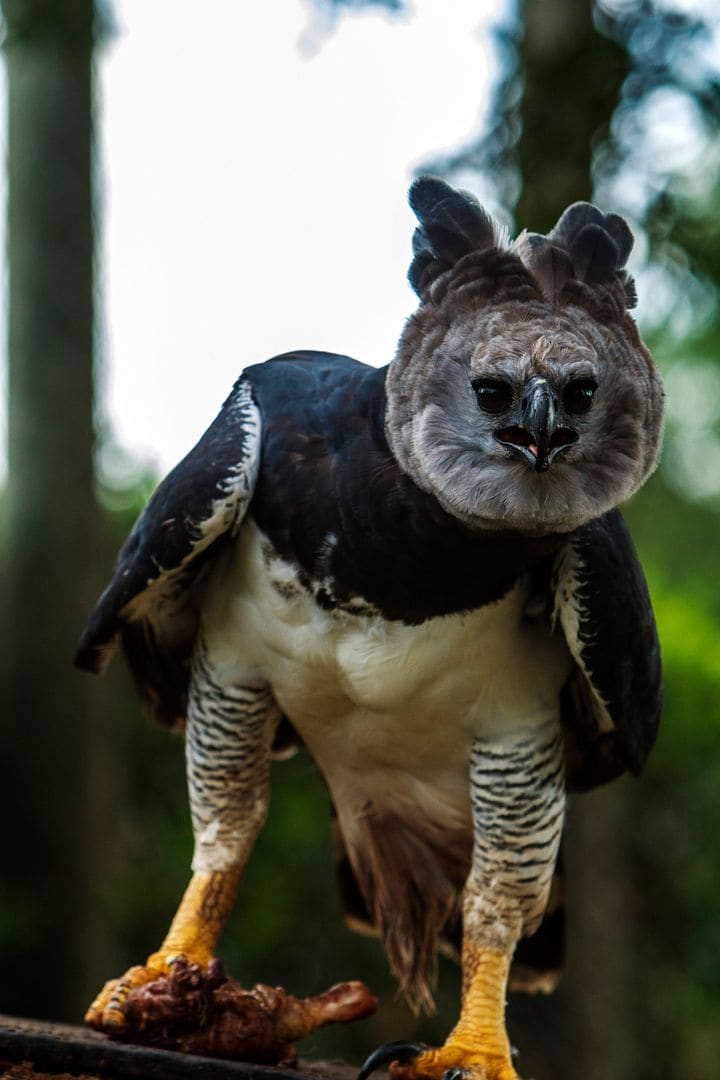
Harpy eagle identification points: each number on the photo matches the legend.
- 1Crest: Long, split crest feathers that can be raised or flattened.
- 2Facial disc: A ring of gray feathers around the face, thought to help funnel sound.
- 3Eye: Dark and forward-facing, set in a pale gray face.
- 4Bill: Black, deep and strongly hooked.
- 5Breast band: A broad black band across the upper chest of adults.
- 6Upperparts: Slate-black to dark gray back and wings.
- 7Underparts: White belly below the black band.
- 8Legs: Thick, feathered legs with fine black barring.
- 9Toes: Bare, yellow and very thick.
- 10Talons: Long, curved black claws; the rear one is the largest.
Photo: Jonathan Wilkins, CC BY-SA 3.0, via Wikimedia Commons
Adult Harpy Eagle Field Marks
Head
Pale to dark gray head with dark eyes and a heavy, strongly hooked black bill. Gray feathers around the face form a facial disc, a trait the harpy shares with owls. The Peregrine Fund notes the disc can be raised to help direct sound to the ears (The Peregrine Fund).
Crest
A crest of long, dark feathers splits into two tufts and can be raised or lowered at will. San Diego Zoo describes it fanning out when the bird feels threatened (San Diego Zoo).
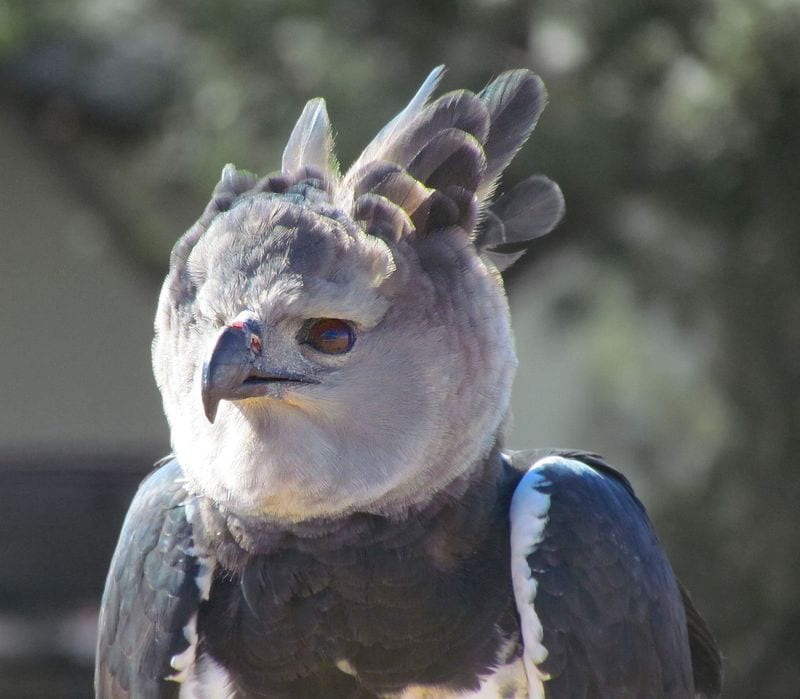
The crest raised: long, split crest feathers stand up above the gray facial disc.
Photo: Jitze Couperus, CC BY 2.0, via Wikimedia Commons
Body
A broad black band crosses the upper chest. Below it, the belly is white. The back is slate-black to dark gray.
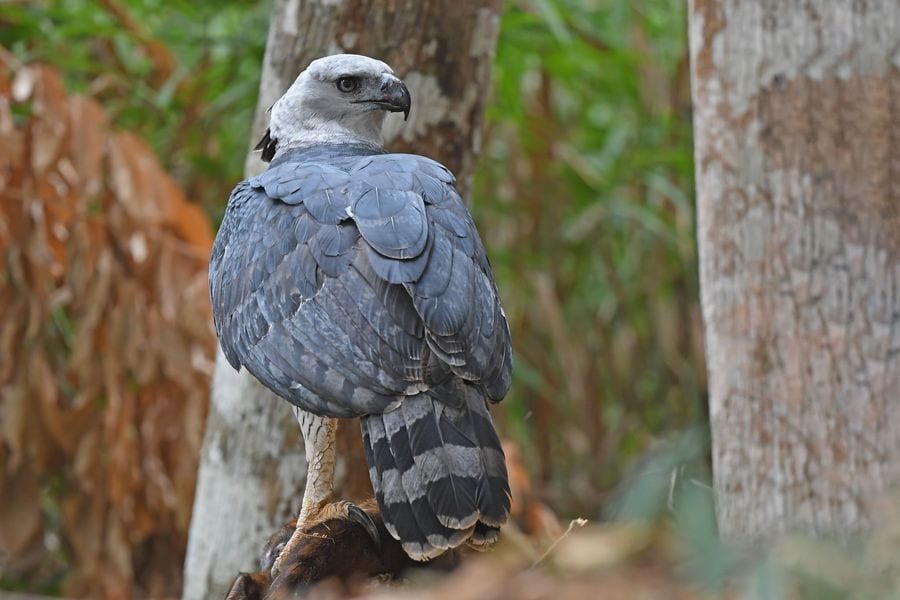
From behind: slate-gray to black upperparts and a long, broadly banded tail. Wild bird, Pará, Brazil.
Photo: Christoph Moning, CC BY 4.0, via Wikimedia Commons
Wings and Tail
Broad, rounded, dark wings. Underneath they show barring, visible in flight. The long tail is gray with broad dark bands.
Legs
Extremely thick, feathered legs with fine black barring, described by San Diego Zoo as “as thick as a small child’s wrist” (San Diego Zoo).
Feet and Talons
Bare, thick yellow toes end in long, curved black talons. The rear talon (hallux) is the largest and the main killing tool.
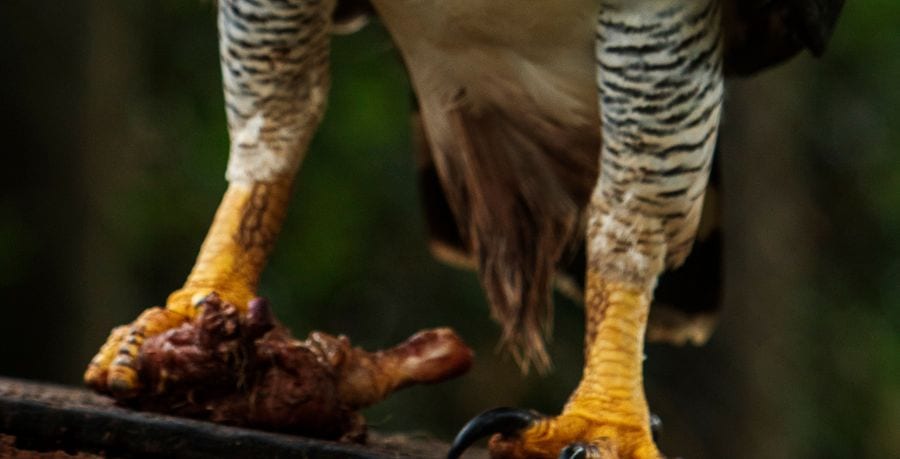
Legs and feet: densely feathered, barred legs above thick yellow toes and long, curved black talons.
Photo: Jonathan Wilkins, CC BY-SA 3.0, via Wikimedia Commons
Juvenile vs Adult Plumage
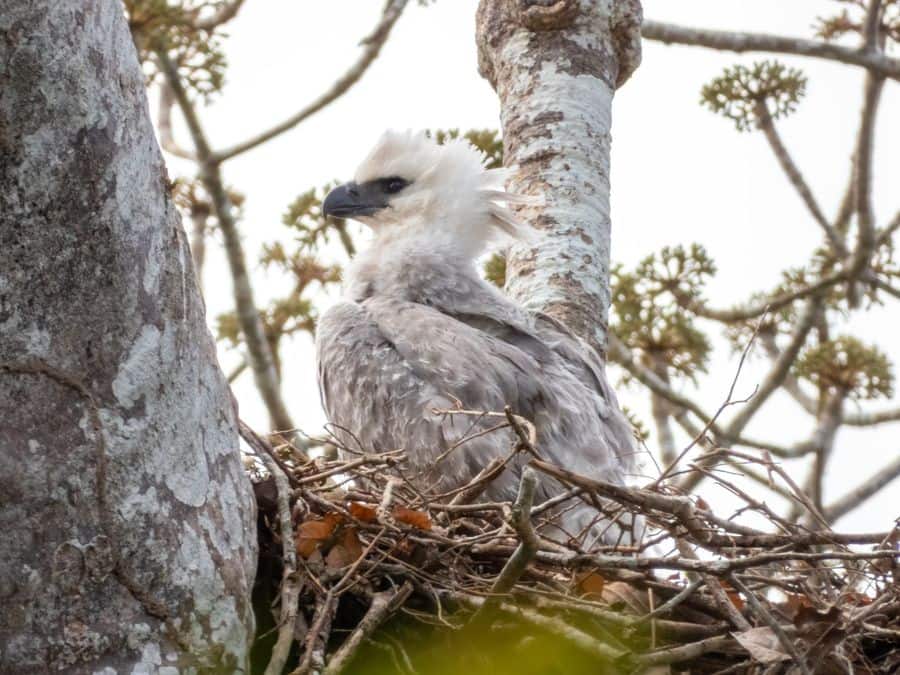
Young harpy eagles look very different from adults. The Peregrine Fund describes a young bird’s feathers as almost all white and light gray, growing in a little darker after each molt for the first five years until adult colors appear (The Peregrine Fund). San Diego Zoo says full adult coloring is not reached until at least the third year (San Diego Zoo). Pale juveniles are the birds most often confused with juvenile crested eagles.
 Young bird
A pale young harpy eagle on a stick nest in Panama. Young birds are mostly white and light gray and darken with each molt.
Photo: Jason Alexander, CC BY 4.0, via Wikimedia Commons
AdultA free-living adult in Carajás National Forest, Pará, Brazil. The Brazilian Amazon is the species’ stronghold.
Photo: Hector Bottai, CC BY-SA 4.0, via Wikimedia Commons
Harpy Eagle Talons
Short answer
A harpy eagle’s rear talons are about 7.6–10 cm (3–4 in) long, according to The Peregrine Fund, roughly the size of a grizzly bear’s claws. Some zoo and university sources cite up to 12.5–13 cm (about 5 in). Females have larger talons than males.
Legs and feet: densely feathered, barred legs above thick yellow toes and long, curved black talons.
Photo: Jonathan Wilkins, CC BY-SA 3.0, via Wikimedia Commons
How Big Are Harpy Eagle Talons?
- The Peregrine Fund: rear talons “about 3–4 inches long”, comparable to a grizzly bear’s claws (The Peregrine Fund).
- San Diego Zoo: curved back talons “larger than grizzly bear claws at 5 inches (13 centimeters) long” (San Diego Zoo).
- Animal Diversity Web: talons “can be up to 12.5 cm long” (ADW).
- Often-quoted averages: about 8.6 cm for males and 12.3 cm for females (overview).
Why Talon Measurements Differ
- Along the curve or straight? Measuring around the outside curve of a claw gives a larger number than a straight line from base to tip.
- Which claw? Most figures refer to the rear (hallux) talon, the biggest one, but not every source says so.
- Female or male? Females are much larger, so a female’s talon can be several centimeters longer than a male’s.
- Upper limit or typical value? “Up to 13 cm” describes the biggest birds, not an average eagle.
How Powerful Are the Talons?
Harpy talons are built to grip and immobilize heavy, struggling prey in the canopy, such as sloths and monkeys that can bite and claw back (The Peregrine Fund). Their thick toes and legs give them a very strong grip.
You will see grip-force numbers quoted online, but we could not find a peer-reviewed measurement of a wild harpy eagle’s grip. So we do not publish a pressure figure or claim the harpy has the “strongest grip” of any bird.
Talons Compared With a Human Hand
An adult’s hand, from wrist crease to fingertip, has a median length of about 18.0 cm in women and 19.3 cm in men, according to the 2012 U.S. Army anthropometric survey (ANSUR II). A typical harpy rear talon of 7.6–10 cm is therefore roughly two-fifths to half the length of an adult hand, and about as long as the width of a bank card (85.6 mm, ISO/IEC 7810).
Talons Compared With Other Eagles
Harpy talons are routinely described as larger than those of bald and golden eagles, which hunt smaller or very different prey. Few studies publish standardized, measured talon lengths for many eagle species side by side, so we do not give exact figures for the other eagles. The forest monkey-hunters (harpy, Philippine and crowned eagles) all have very powerful legs and feet for their size, because their prey is heavy and fights back (The Peregrine Fund: crowned eagle).
What Do Harpy Eagles Eat?
Short answer
Harpy eagles eat mostly medium-sized, tree-dwelling mammals, above all sloths and monkeys. They also take porcupines, opossums, kinkajous, coatis, agoutis, armadillos, birds such as macaws, and reptiles such as iguanas. A literature review counted 102 known prey species.
Diet varies from place to place. In a study of five nests near Parintins in the Brazilian Amazon, sloths made up 78% of prey items and 85% of prey biomass, while primates made up 11% (Aguiar-Silva et al. 2014). At a nest in primary forest in Suriname, sloths were 39% of prey and primates 34.5% (Miranda 2018). The same review raised the number of known prey species to 102.
In the heavily deforested southern Amazon, harpy eagles kept eating mainly canopy animals even where forest was disappearing. They could not switch to open-country prey (Miranda et al. 2021).
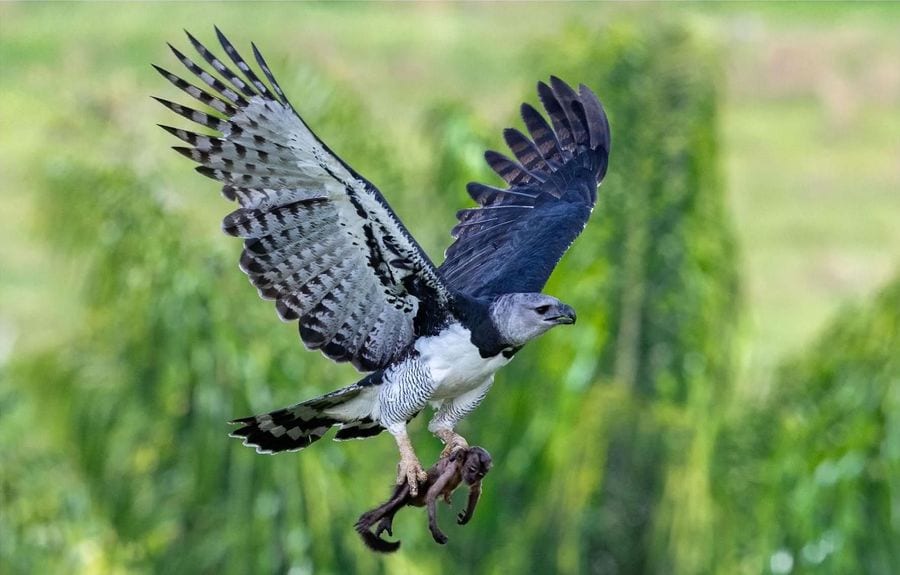
A harpy eagle arriving at its nest with a brown capuchin monkey, one of the primates it hunts in the canopy.
Photo: Jiang Chunsheng, CC BY 4.0, via Wikimedia Commons
Do Harpy Eagles Eat Sloths?
Yes. Sloths are the staple prey in many studies. Both three-toed and two-toed sloths are taken, plucked from branches in the canopy. The Peregrine Fund mentions “8-pound sloths” on the menu (The Peregrine Fund).
Do Harpy Eagles Eat Monkeys?
Yes. Howler, capuchin, titi and saki monkeys are regular prey (Aguiar-Silva et al. 2014). Monkeys are a bigger part of the diet in some primary forests, such as central Suriname (Miranda 2018). Monkeys can bite and scratch, so hunting them carries real risk for the eagle.
How Much Can a Harpy Eagle Carry?
Prey brought to nests near Parintins weighed an estimated 0.3–6.5 kg, averaging about 2.6 kg (Aguiar-Silva et al. 2014). San Diego Zoo notes the harpy can snatch monkeys and sloths of up to about 7.7 kg (17 lb), but heavier prey is taken to a stump or low branch and partly eaten first because it is too heavy to fly whole to the nest (San Diego Zoo).
So the honest answer is that a harpy eagle can carry prey weighing a sizeable fraction of its own body weight over short distances, but there is no single verified “maximum lift” figure.
How Do Harpy Eagles Hunt?
Short answer
Harpy eagles are mainly sit-and-wait hunters. They perch quietly high in the forest, watch and listen for prey, then launch a short, powerful attack through the branches and seize the animal with their feet.
- 1Perch and wait. The harpy sits still in a tall tree, sometimes for hours. San Diego Zoo describes perches of up to 23 hours (San Diego Zoo).
- 2Watch and listen. It scans with keen eyesight and uses its hearing, helped by the facial disc, to pinpoint prey in the dim forest (The Peregrine Fund).
- 3Move quietly. If nothing shows up, it moves from tree to tree below the canopy rather than soaring above it.
- 4Attack. It drops or dashes through the branches. San Diego Zoo reports chase speeds of up to about 80 km/h (50 mph).
- 5Seize and subdue. Its feet close around the prey, and the long talons and powerful legs hold it still.
- 6Carry or feed on the spot. It carries manageable prey to a perch or nest; heavy prey is partly eaten first. One kill can feed it for several days (The Peregrine Fund).
Why Their Hunting Is So Effective
- Ambush, not chase: waiting silently saves energy and surprises prey.
- Built for clutter: short, broad wings and a long tail let it maneuver between trees.
- Grip strength: thick legs and huge talons let it hold heavy, struggling animals.
- Patience: it does not need to eat every day and can go a week or more without food (The Peregrine Fund).
Harpy Eagle Prey Table
| Prey group | Examples | What studies found |
|---|---|---|
| Sloths | Brown-throated three-toed sloth, Linnaeus’s two-toed sloth | 78% of prey items at five nests near Parintins, Brazil; 39% at a nest in Suriname |
| Monkeys | Howler, capuchin, titi and saki monkeys | 11% at Parintins; 34.5% in primary forest in Suriname |
| Other tree mammals | Porcupines, kinkajous, opossums, coatis | Regular secondary prey |
| Ground mammals | Agoutis, armadillos, peccaries, young deer | Taken when available |
| Birds | Macaws, parrots, occasionally vultures | Small share of the diet |
| Reptiles | Iguanas, snakes | Occasional |
| Livestock and pets | Poultry and small stock | Rare; no evidence of livestock predation in the Parintins study |
Sources: Aguiar-Silva et al. 2014, Miranda 2018, The Peregrine Fund, San Diego Zoo, ADW.
Harpy Eagle Habitat
Short answer
Harpy eagles live in large areas of lowland tropical rainforest, typically below 900 m, where there are giant trees for nesting and plenty of canopy prey. They can use some human-altered forest, but not landscapes that have lost most of their trees.
BirdLife International describes the habitat as lowland tropical forest, typically below 900 m but locally up to 2,000 m, with nests usually below 310 m (BirdLife International). Harpies are most likely to be found where forest cover is at least 70%, and they do not usually cross forest gaps wider than about 500 m.
Where Do Harpy Eagles Live?
They live in the tropical forests of Central and South America. The Peregrine Fund notes they prefer large expanses of pristine forest, but can survive in some human-altered habitats “as long as there is enough to eat, they have tall trees to nest in, and people don’t harm them” (The Peregrine Fund). If you are curious about the Amazon’s other wildlife, see animals of the Amazon rainforest.
Harpy Eagle Habitat Requirements
- Giant nest trees: emergent trees such as kapok (Ceiba pentandra); in the Amazon they appear to nest in only about 28 tree species, many of them prized for timber (BirdLife International).
- Enough forest: pairs could not raise young to independence where more than half the surrounding forest had been cleared, and no nests were found where over 70% was gone (Miranda et al. 2021).
- Abundant canopy prey: sloths, monkeys and other tree-dwelling mammals.
- Large territories: studies report roughly 10–79 km² per breeding pair, depending on the region (BirdLife International).
- Freedom from persecution: shooting can wipe out local populations even where forest remains.
Harpy Eagle Range by Region and Country
| Region | Countries | Status today |
|---|---|---|
| Mexico | Southern Mexico | Very scarce; largely lost from its former northern range |
| Central America | Guatemala, Belize, Honduras, Nicaragua, Costa Rica, Panama | Rare and patchy; strongest population in eastern Panama (Darién); very scarce in Costa Rica |
| Locally extinct | El Salvador | Considered extinct there |
| Northern South America | Colombia, Venezuela, Guyana, Suriname, French Guiana | Present in large forests; French Guiana estimate 1,000–2,000 mature birds |
| Andean foothills and west Amazon | Ecuador, Peru, Bolivia | Present in lowland forest; Peru estimate 5,000–10,000 individuals |
| Brazil | Amazon and remnant Atlantic Forest | Most common in Amazonia; rare in the Atlantic Forest |
| Southern edge | Paraguay, north-east Argentina (Misiones) | Rare; likely extirpated from several Argentine provinces |
Country list, local extinctions and national estimates from BirdLife International; Darién stronghold from The Peregrine Fund.
Are Harpy Eagles Found in India?
Short answer
No. Wild harpy eagles live only in Central and South America (from southern Mexico to northern Argentina). There are no wild harpy eagles in India, Africa, Europe or anywhere else in Asia.
Species People Confuse With Harpy Eagles
| Species | Where | How to tell it from a harpy |
|---|---|---|
| Crested eagle (Morphnus guianensis) | Same forests, Mexico to Argentina | Smaller and slimmer (about 3 kg); crest ends in a single point; much thinner legs. Juveniles of both species look alike. |
| African crowned eagle | Sub-Saharan Africa | Lives on another continent; heavily barred underparts; much lighter |
| Philippine eagle | Philippines only | Shaggy, lion-like crest; deep blue-gray bill; lives in Asia |
| Juvenile harpy eagle | Same range | Pale whitish-gray all over; lacks the adult’s solid black breast band |
The Peregrine Fund notes that juvenile crested eagles are sometimes mistaken for juvenile harpy eagles, since both share habitat and even nest trees (The Peregrine Fund: crested eagle).
Harpy Eagle Range
Short answer
The harpy eagle’s range runs from southern Mexico through Central America to northern Argentina. Today it is most common in the Brazilian Amazon and patchy or locally extinct across much of Central America and Brazil’s Atlantic Forest.
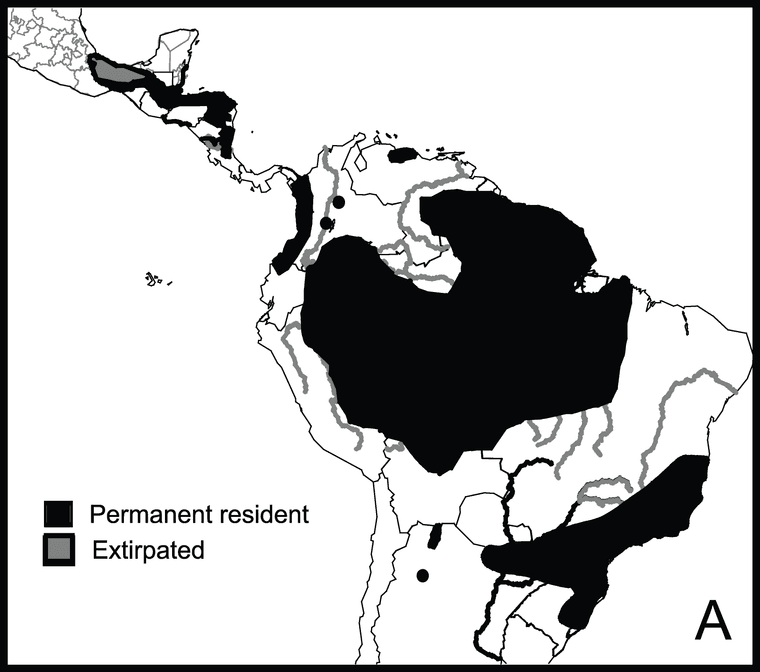
Harpy eagle distribution as mapped by Lerner et al. (2009): black = permanent resident, gray = extirpated. Local losses have continued since this map was published.
Map: Lerner, Johnson, Lindsay, Kiff & Mindell, CC BY 2.5, via Wikimedia Commons
Central America
Harpy eagles have disappeared from much of central and northern Central America. They are considered extinct in El Salvador and are very scarce in Mexico and Costa Rica (BirdLife International). The largest known breeding population in Central America is in Panama near the Colombian border, and only one nesting pair had been observed in Belize at the time of The Peregrine Fund’s account (The Peregrine Fund).
South America
The species occurs in Colombia, Venezuela, the Guianas, Ecuador, Peru, Bolivia, Brazil, Paraguay and north-east Argentina. It is thought to be extinct in parts of Bolivia and in parts of Venezuela north of the Orinoco, and in Argentina it has likely disappeared from several provinces (BirdLife International).
Where Are Harpy Eagles Most Common?
In Brazil’s Amazon. BirdLife describes the species as most common in Amazonia and rare in the Atlantic Forest. Large, unbroken forests in the Guianas, Peru and Panama’s Darién also hold important populations. To check recent sightings, use the eBird harpy eagle map.
Harpy Eagle Behavior
Short answer
Harpy eagles are solitary or paired, active by day, territorial and largely silent. They spend long periods perched, move through the forest rather than soaring above it, and pairs may stay together for life.
A Day in the Life
Harpies are diurnal (active in the daytime) and spend much of their time perched high in trees. When hunting they sometimes drop below the canopy to search (The Peregrine Fund). They do not hunt every day: one large kill can feed a bird for several days.
Territory
Each pair uses a large area of forest: from about 10–20 km² in parts of Panama to 45–79 km² in Venezuela (BirdLife International). Harpies are non-migratory and hunt the same established range continuously (San Diego Zoo).
Are Harpy Eagles Friendly to Humans?
Short answer
Harpy eagles are not “friendly”; they are wild predators. They are not known to prey on people and generally avoid humans, but they can defend nests, and their talons can cause serious injury. Never approach one.
In Panama, The Peregrine Fund ran an education campaign teaching people that harpy eagles “aren’t dangerous” and should be protected, because many were being shot out of fear or curiosity (The Peregrine Fund). Not being dangerous to people is not the same as being tame. Admire them from a distance.
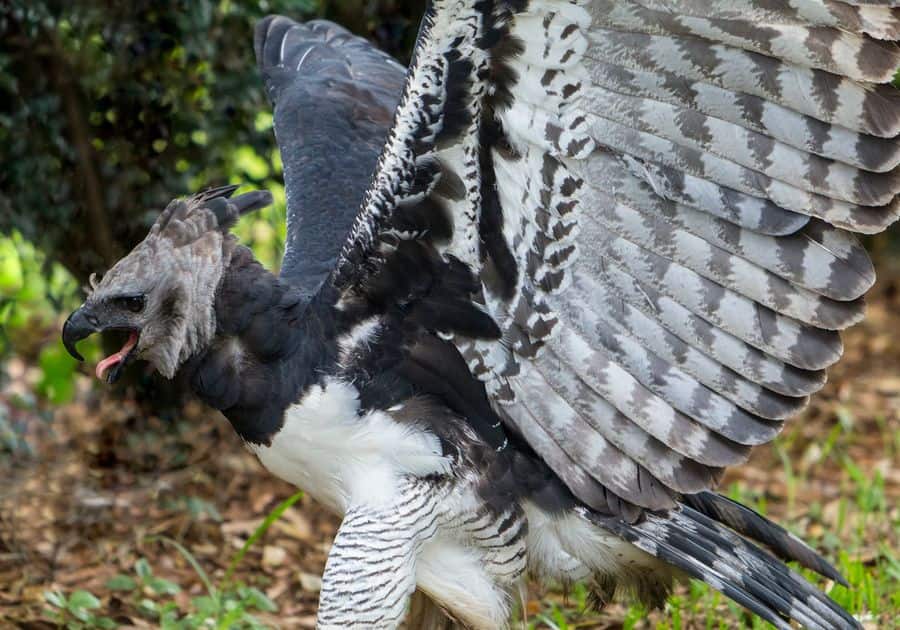
A harpy eagle lifting its wings in a defensive display, a clear signal to keep your distance.
Photo: Jonathan Wilkins, CC BY-SA 3.0, via Wikimedia Commons
Harpy Eagle Lifespan
Short answer
Harpy eagles are estimated to live about 25–35 years. Reliable lifespan data for wild birds are scarce, so there is no guaranteed maximum age.
San Diego Zoo lists a life span of 25 to 35 years and says harpies can breed from about 5 to 30 years of age and beyond (San Diego Zoo). Animal Diversity Web gives the same 25–35-year estimate “if they remain healthy”, noting that disease and injury sharply reduce survival by making it harder to hunt (ADW).
Wild harpies face risks that captive birds do not, including injuries from prey, starvation in degraded forest and shooting. BirdLife uses a generation length of 20 years for Red List calculations (BirdLife International). That is an average age of breeding adults, not a lifespan.
| Context | Figure | How reliable? |
|---|---|---|
| General estimate | 25–35 years | Widely quoted by zoos and educational sources; not based on long-term tracking of many wild birds |
| Pair bond | A pair could stay together 25–30 years | Peregrine Fund estimate, consistent with a long life |
| Breeding years | From about 5 to 30 years of age and beyond | San Diego Zoo, based on captive experience |
| Generation length | 20 years | A demographic average used for Red List assessments, not a maximum age |
| Wild maximum | Unknown | No reliable published maximum for wild birds |
Harpy Eagle Reproduction
Short answer
Harpy eagles breed slowly. A pair builds a huge stick nest in a giant tree, lays one or two eggs, raises only one chick, and usually breeds only every two to three years because the young bird depends on its parents for a year or more.
A pale young harpy eagle on a stick nest in Panama. Young birds are mostly white and light gray and darken with each molt.
Photo: Jason Alexander, CC BY 4.0, via Wikimedia Commons
Breeding Season
Timing varies across this huge range. One account ties the start of breeding to the onset of the rainy season, around April or May (ADW), but local seasons differ, so no single calendar applies everywhere.
Nest
Nests are built in some of the tallest trees in the forest, where the main branches spread, at around 40 m (130 ft). The pair can lay down more than 300 branches, creating a nest up to about 1.8 m (6 ft) across and more than 30 cm deep (The Peregrine Fund). San Diego Zoo describes nests 27–43 m above the ground, about 1.5 m across and 1.2 m thick, often in kapok trees (San Diego Zoo). Nests are often reused for years.
Eggs and Incubation
The female lays one or two large white eggs and does most of the incubation, which lasts about 55 days (The Peregrine Fund); San Diego Zoo gives 53–56 days. Usually only one egg produces a chick: once the first chick hatches, the second egg is typically neglected. Scientists think it serves as a “backup” in case the first egg fails.
Chicks and Dependence
A newly hatched chick fits in the palm of a person’s hand, yet it reaches adult size in about five or six months, when it fledges (The Peregrine Fund). The young bird stays dependent on its parents for one to two years, begging for food that is delivered less and less often until it learns to hunt.
Breeding Interval
Because of that long dependence, a pair generally raises young about every two years (The Peregrine Fund); other sources say every two to three years. Such a slow rate is one reason harpy populations recover poorly after losses.
| Stage | Typical timing | Notes |
|---|---|---|
| Nest building or repair | Before laying | Pair brings 300+ branches; nests are reused for years |
| Eggs | 1–2 eggs | Usually only one chick is raised |
| Incubation | About 53–56 days | Mostly by the female |
| Nestling | 0–5 or 6 months | Female stays near the nest for about 4 months; male hunts |
| Fledging | About 5–7 months | First flights are short and clumsy |
| Dependence | Until 1–2 years old | Parents keep feeding the young bird, less and less often |
| Next breeding attempt | Every 2–3 years | Pairs usually do not lay while still caring for a youngster |
| Adulthood | About 4–6 years | Plumage darkens with each molt until adult colors appear |
Harpy Eagle Conservation Status
Short answer
The harpy eagle is listed as Vulnerable on the IUCN Red List (2021), with a decreasing population estimated at 100,000–250,000 mature individuals. It is protected from commercial international trade under CITES Appendix I.
Global vs Regional Status
In 2021 BirdLife International, the Red List authority for birds, moved the harpy eagle from Near Threatened to Vulnerable. The reasons were a suspected rapid decline from forest loss and degradation, hunting and persecution (BirdLife International; IUCN Red List). Regional pictures range from secure-looking strongholds to local extinction.
| Scale | Status | Notes |
|---|---|---|
| Global (IUCN Red List) | Vulnerable (2021) | Uplisted from Near Threatened; population decreasing |
| International trade (CITES) | Appendix I | Commercial international trade prohibited |
| Global population | 100,000–250,000 mature individuals | Tentative estimate; true number may be lower |
| Projected decline | 27–57% over three generations (60 years) from 2020 | Driven by forest loss plus hunting |
| Central America and Mexico | Rare to locally extinct | Extinct in El Salvador; very scarce in Mexico and Costa Rica |
| Brazilian Atlantic Forest | Nearly gone | Rare where little forest remains |
| Brazilian Amazon | Stronghold | Most common here, but losing ground along the “Arc of Deforestation” |
Threats
- Deforestation and degradation: clearing for crops, pasture, roads and dams; selective logging removes the giant trees harpies nest in (BirdLife International).
- A forest-cover threshold: in Brazil’s Arc of Deforestation, fledglings starved where 50–70% of the forest was lost, and about 35% of the 428,800 km² study region can no longer support breeding pairs (Miranda et al. 2021).
- Shooting and poaching: birds are shot out of fear, to protect livestock, or out of curiosity. Of 18 released birds in Panama and Belize with a known cause of death, eight were shot (cited by BirdLife).
- Feather and live trade: feathers are used in headdresses and arrow fletching, and live birds sometimes turn up in animal markets (BirdLife International).
- Powerlines and climate: collisions with powerlines add to mortality, and one model projects a 7–14% range contraction by 2090 from climate change.
Conservation Efforts
- Captive breeding and release: The Peregrine Fund began a harpy program in 1989 and released almost 50 harpy eagles in Panama and Belize from 1998, ending releases in 2008 (The Peregrine Fund).
- Long-term field research: The Peregrine Fund has studied the wild population in Darién, Panama, for more than a decade.
- Education: campaigns in Panama helped change attitudes, and Panama declared the harpy its national bird on 10 April 2002.
- Genetics: a 2009 study found high genetic diversity remaining in harpy populations, an encouraging sign for recovery programs (Lerner et al. 2009).
- Forest protection: protecting nest trees, territories and prey species is the conservation priority highlighted by Amazon diet research (Aguiar-Silva et al. 2014).
Harpy Eagle vs Bald Eagle
Short answer
The harpy eagle is heavier and usually longer than the bald eagle and has much bigger feet and talons. Their wingspans are similar, at about 2 m. The bald eagle is a fish-eating eagle of North American waters; the harpy hunts sloths and monkeys in tropical forest.
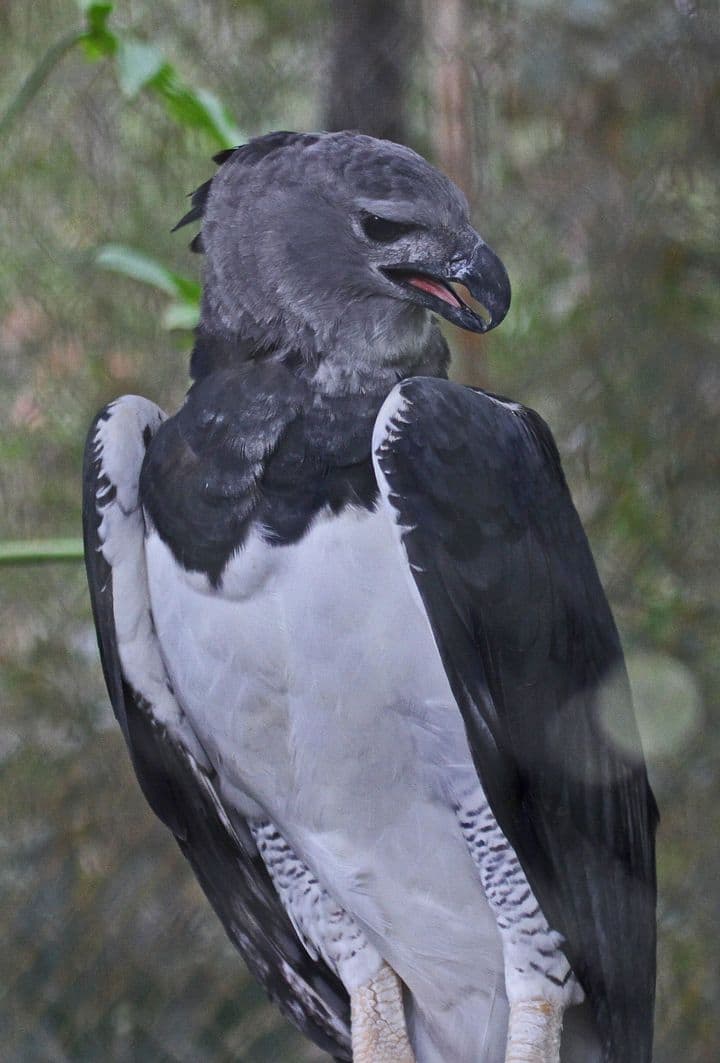 Harpy eagle
Harpy eagle (Belize Zoo): heavy hooked bill, dark gray head and stocky, broad-shouldered build.
Photo: Judy Gallagher, CC BY 2.0, via Wikimedia Commons
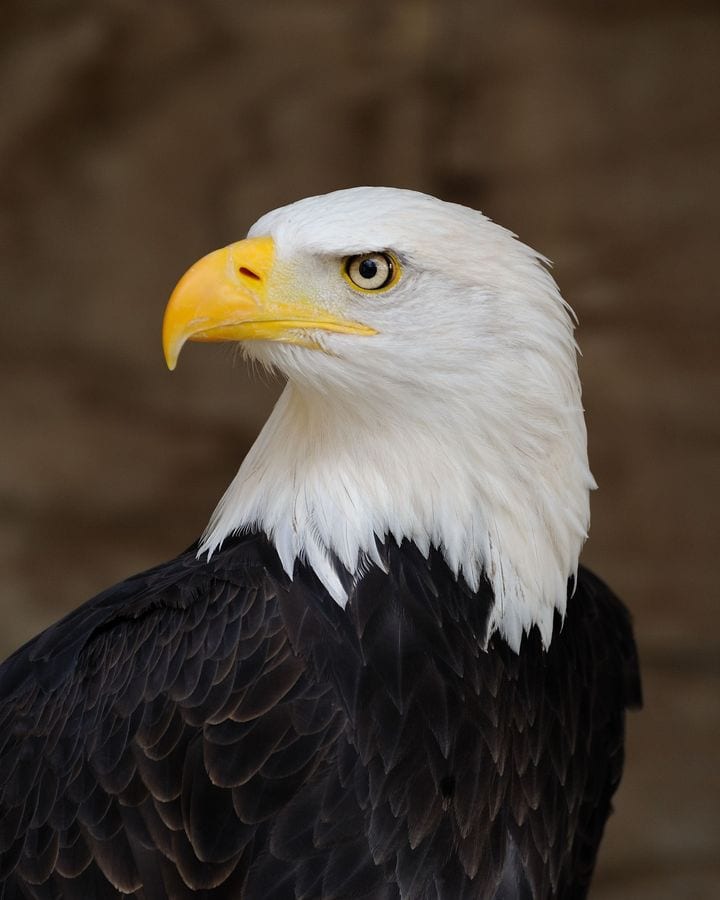 Bald eagle
Bald eagle: white head and tail, yellow bill, no crest. A fish-eating eagle of North American waters.
Photo: Saffron Blaze, CC BY-SA 3.0, via Wikimedia Commons
| Feature | Harpy eagle | Bald eagle |
|---|---|---|
| Scientific name | Harpia harpyja | Haliaeetus leucocephalus |
| Where it lives | Tropical forests, southern Mexico to northern Argentina | North America, usually near coasts, rivers and large lakes |
| Length | 89–105 cm | 71–96 cm |
| Weight | Females 6.3–9 kg; males 3.8–5.4 kg | 3–6.3 kg |
| Wingspan | Up to about 2 m | About 2 m (1.8–2.2 m) |
| Head | Gray, with split crest and facial disc | White, no crest |
| Main food | Sloths and monkeys | Mainly fish; also opportunistic and scavenges |
| Hunting style | Waits on a perch inside the forest, then a short powerful attack | Hunts from a perch, snatching fish from the water surface; steals food |
| IUCN status | Vulnerable | Least Concern |
Which Is Bigger: Harpy Eagle or Bald Eagle?
- By weight: harpy. Female harpies weigh 6.3–9 kg; bald eagles 3–6.3 kg (Cornell Lab).
- By length: usually harpy. 89–105 cm vs 71–96 cm, though the ranges overlap.
- By wingspan: about equal. Both reach about 2 m; the bald eagle’s wings are longer relative to its body.
- By talons: harpy. Its talons are much larger, matching its larger, heavier prey.
Learn more about the bald eagle, its life cycle or how it compares with the golden eagle. Bald eagle diet and range from The Peregrine Fund.
Harpy Eagle vs Golden Eagle
Short answer
The harpy eagle is heavier and longer than the golden eagle, but the golden eagle’s long wings can span as wide or wider (1.85–2.2 m). Golden eagles are open-country soarers; harpies are forest ambush hunters.
Harpy eagleA free-living adult in Carajás National Forest, Pará, Brazil. The Brazilian Amazon is the species’ stronghold.
Photo: Hector Bottai, CC BY-SA 4.0, via Wikimedia Commons
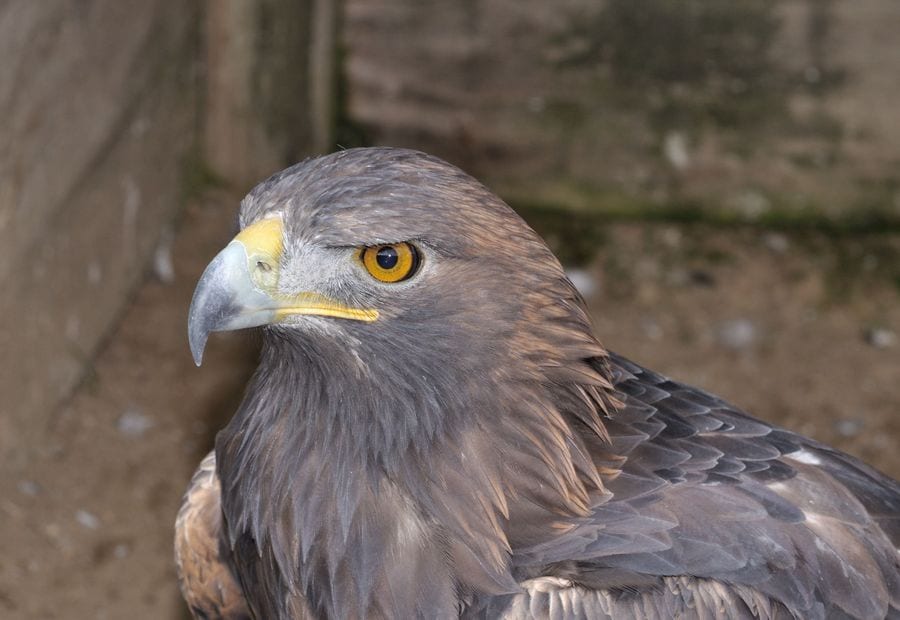 Golden eagle
Golden eagle: dark brown with a golden nape. A long-winged hunter of open country and mountains.
Photo: Quartl, CC BY-SA 3.0, via Wikimedia Commons
| Feature | Harpy eagle | Golden eagle |
|---|---|---|
| Scientific name | Harpia harpyja | Aquila chrysaetos |
| Where it lives | Neotropical rainforest | Open country, mountains and deserts across the Northern Hemisphere |
| Length | 89–105 cm | 70–84 cm |
| Weight | Females 6.3–9 kg; males 3.8–5.4 kg | 3–6.1 kg |
| Wingspan | Up to about 2 m | 1.85–2.2 m |
| Wing shape | Short and broad | Long, for soaring and fast glides |
| Main food | Sloths and monkeys | Rodents, rabbits, hares, game birds; carrion in winter |
| IUCN status | Vulnerable | Least Concern |
Which Is Bigger: Harpy Eagle or Golden Eagle?
- By weight: harpy. Golden eagles weigh 3–6.1 kg (Cornell Lab).
- By length: harpy. Golden eagles measure 70–84 cm.
- By wingspan: golden eagle or tie. 1.85–2.2 m vs the harpy’s up to about 2 m.
- By talons: harpy.
Read our golden eagle guide and golden eagle life cycle. Golden eagle prey and habitat from The Peregrine Fund.
Harpy Eagle vs Steller’s Sea Eagle
Short answer
The two are closely matched in weight and length. The Steller’s sea eagle has the wider wingspan (up to about 2.4 m), while the harpy has the bigger feet and talons. Which is “heaviest” is genuinely disputed.
Harpy eagleA wild adult harpy eagle in Brazil: pale gray head, black breast band, white underparts and slate-black wings.
Photo: Christoph Moning, CC BY 4.0, via Wikimedia Commons
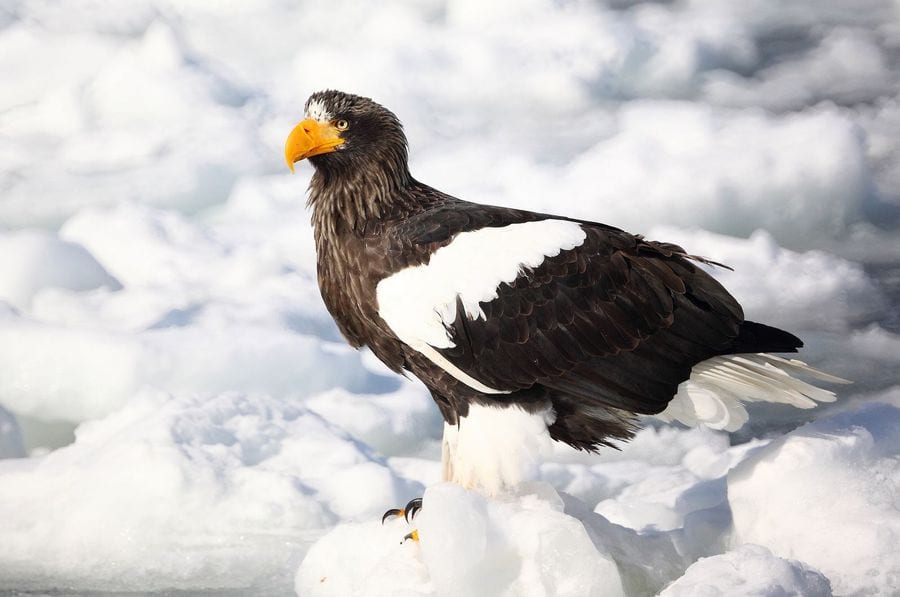 Steller’s sea eagle
Steller’s sea eagle (Hokkaido, Japan): massive yellow bill, white shoulders and tail. Its wingspan is wider than a harpy’s.
Photo: Sammy Sam, CC BY-SA 3.0, via Wikimedia Commons
| Feature | Harpy eagle | Steller’s sea eagle |
|---|---|---|
| Scientific name | Harpia harpyja | Haliaeetus pelagicus |
| Where it lives | Tropical forest, Americas | Coasts and rivers of the Russian Far East; winters to Japan and Korea |
| Length | 89–105 cm | 86.5–105 cm |
| Weight | Females 6.3–9 kg; males 3.8–5.4 kg | Females about 5.9–9.1 kg; males about 4.5–6.8 kg |
| Wingspan | Up to about 2 m | Up to about 2.4 m |
| Most striking feature | Gigantic feet and talons | Massive yellow bill |
| Main food | Sloths and monkeys | Mainly fish, especially salmon |
| IUCN status | Vulnerable | Vulnerable |
Heaviest vs Longest vs Widest Wingspan
- Heaviest: a tie on available data. Female Steller’s weigh about 13–20 lb (Zoo New England), very close to female harpies’ 14–20 lb. San Diego Zoo calls the Steller’s “the heaviest known eagle” (San Diego Zoo), yet the same zoo’s harpy page calls the harpy “the heaviest and most powerful of birds” (San Diego Zoo). That contradiction shows how close the two are.
- Longest: a tie: 86.5–105 cm (Steller’s) vs 89–105 cm (harpy).
- Widest wingspan: Steller’s sea eagle. Up to about 8 ft (2.4 m) vs about 2 m.
- Biggest talons: harpy. The Steller’s is built around a massive bill for tearing fish, mainly salmon (Cincinnati Zoo).
Harpy Eagle vs Crowned Eagle
Short answer
The harpy eagle is far heavier than the African crowned eagle (up to about 9 kg vs 2.5–4.7 kg), with a wider wingspan. Both are crested forest eagles that hunt monkeys, but they live on different continents.
Harpy eagleHarpy eagle identification points: each number on the photo matches the legend.
Photo: Jonathan Wilkins, CC BY-SA 3.0, via Wikimedia Commons
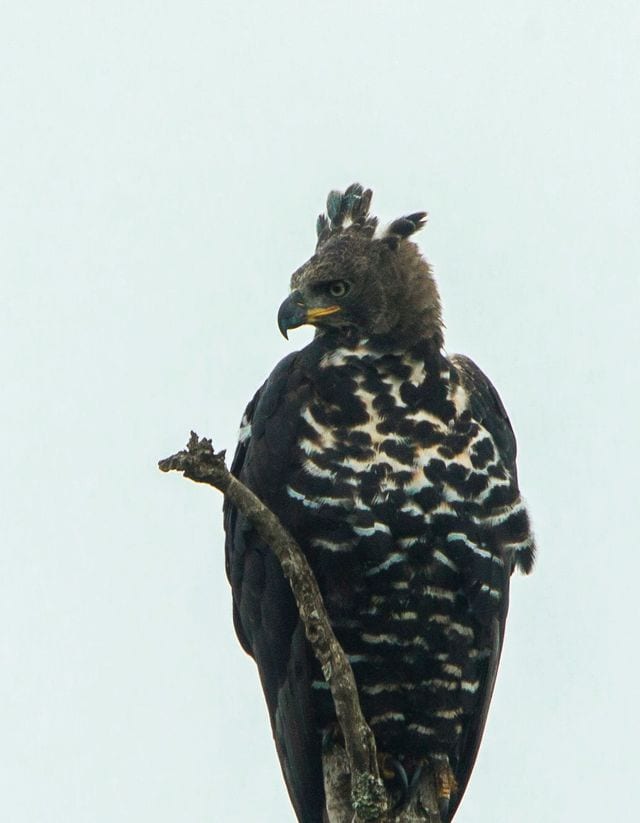 Crowned eagle
African crowned eagle (Mt Kenya): a crested forest eagle that hunts monkeys, but much lighter than a harpy.
Photo: Francesco Veronesi, CC BY-SA 2.0, via Wikimedia Commons
| Feature | Harpy eagle | Crowned eagle |
|---|---|---|
| Scientific name | Harpia harpyja | Stephanoaetus coronatus |
| Where it lives | Central and South America | Sub-Saharan Africa: forests, wooded gorges and savanna woodland |
| Length | 89–105 cm | 80–99 cm |
| Weight | Females 6.3–9 kg; males 3.8–5.4 kg | 2.5–4.7 kg |
| Wingspan | Up to about 2 m | 1.51–1.81 m |
| Main food | Sloths and monkeys | Monkeys, small antelopes and other mammals |
| Shared traits | Crest, powerful legs, forest ambush hunter | Crest, powerful legs, forest ambush hunter |
| IUCN status | Vulnerable | Near Threatened |
Crowned eagle measurements, habitat and prey from The Peregrine Fund. Despite its lighter build, The Peregrine Fund says the crowned eagle can kill an antelope up to six times its own mass, although it usually takes smaller prey such as monkeys, duikers and hyraxes.
Is the Harpy Eagle the Largest Eagle?
Short answer
Sometimes, depending on what you measure. The harpy eagle is one of the heaviest eagles and is usually credited with the biggest talons, but it does not have the widest wingspan, and its length overlaps with the Steller’s sea eagle and Philippine eagle.
Scientists who study the species call harpies “Earth’s largest eagles” (Miranda et al. 2021), while San Diego Zoo awards the “heaviest known eagle” title to the Steller’s sea eagle. Both can be defended, because “largest” can mean several things:
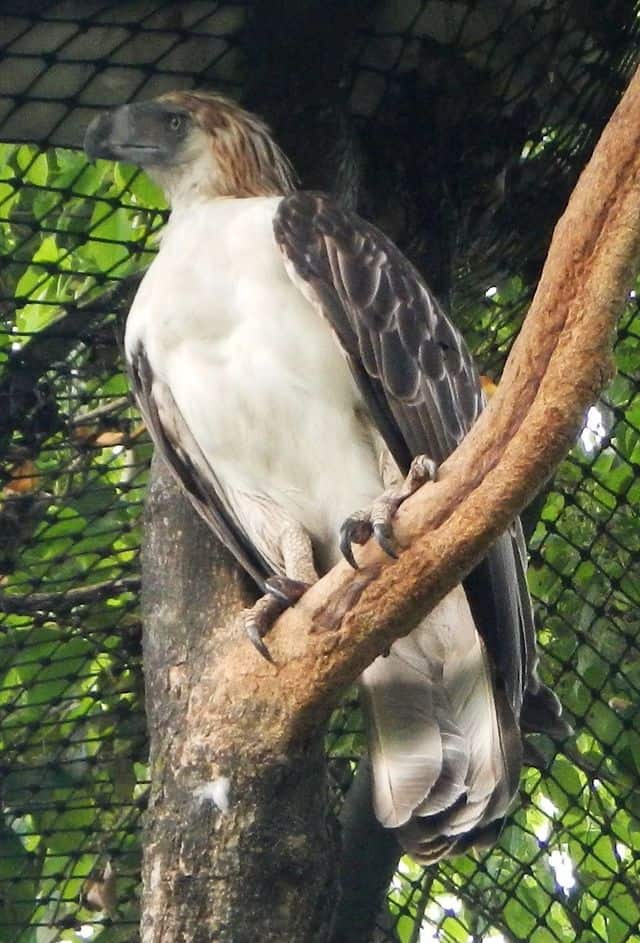
Philippine eagle: a shaggy-crested forest giant that rivals the harpy in length.
Photo: Ramon FVelasquez, CC BY-SA 3.0, via Wikimedia Commons
- Heaviest: highest body mass. Harpy and Steller’s are essentially tied.
- Longest: bill to tail. Harpy, Steller’s and Philippine eagles overlap.
- Widest wingspan: Steller’s sea eagle beats the harpy.
- Largest talons: the harpy is the usual answer.
- Overall size: a judgment call combining all of the above.
| Measure | Harpy eagle | Strongest contenders | Verdict |
|---|---|---|---|
| Heaviest | Females 6.3–9 kg | Steller’s sea eagle (females ~5.9–9.1 kg); Philippine eagle (4.5–8.1 kg) | Harpy and Steller’s overlap: a tie on current data |
| Longest | 89–105 cm | Steller’s (86.5–105 cm), Philippine (76–102 cm) | Overlapping ranges: no clear winner |
| Widest wingspan | Up to ~2 m | Steller’s (up to ~2.4 m); golden and bald eagles can match or exceed 2 m | Not the harpy |
| Largest talons | 7.6–10 cm rear talon, up to ~13 cm cited | Few standardized comparisons exist | Harpy is the usual answer |
| Overall bulk and power | Very heavy, compact, huge legs | Steller’s and Philippine eagles | Harpy is among the top three |
Philippine eagle figures (76–102 cm, 4.5–8.1 kg, wingspan about 1.9 m) from The Peregrine Fund.
Harpy Eagle Size Comparison Charts
The charts below put the harpy eagle (highlighted) beside the bald, golden, Steller’s sea, Philippine and crowned eagles, using the same sources as the tables above. Darker segments show the published range; lighter segments run from zero to the lower end of the range, or show a figure published only as a maximum.
Sources: San Diego Zoo (harpy, Steller’s), The Peregrine Fund (Philippine, crowned), Cornell Lab All About Birds (bald, golden). Ranges overlap heavily, so there is no clear “longest eagle”.
Sources: San Diego Zoo (harpy), Zoo New England (Steller’s, converted from pounds), The Peregrine Fund (Philippine, crowned), Cornell Lab (bald, golden; both sexes combined).
Sources: The Peregrine Fund and San Diego Zoo (harpy, “up to 2 m”), Zoo New England (Steller’s, “up to 8 ft”), Cornell Lab (golden), The Peregrine Fund (bald, Philippine, crowned). Lighter bars show figures published only as a maximum or typical value.
Harpy eagle (Belize Zoo): heavy hooked bill, dark gray head and stocky, broad-shouldered build.
Photo: Judy Gallagher, CC BY 2.0, via Wikimedia Commons
Bald eagle: white head and tail, yellow bill, no crest. A fish-eating eagle of North American waters.
Photo: Saffron Blaze, CC BY-SA 3.0, via Wikimedia Commons
Golden eagle: dark brown with a golden nape. A long-winged hunter of open country and mountains.
Photo: Quartl, CC BY-SA 3.0, via Wikimedia Commons
Steller’s sea eagle (Hokkaido, Japan): massive yellow bill, white shoulders and tail. Its wingspan is wider than a harpy’s.
Photo: Sammy Sam, CC BY-SA 3.0, via Wikimedia Commons
African crowned eagle (Mt Kenya): a crested forest eagle that hunts monkeys, but much lighter than a harpy.
Photo: Francesco Veronesi, CC BY-SA 2.0, via Wikimedia Commons
Philippine eagle: a shaggy-crested forest giant that rivals the harpy in length.
Photo: Ramon FVelasquez, CC BY-SA 3.0, via Wikimedia Commons
Harpy Eagle Adaptations
Short answer
Harpy eagles are adapted for ambushing heavy prey inside the rainforest. Key adaptations include short, broad wings and a long tail for maneuvering, huge legs and talons for grip, an owl-like facial disc for hearing, and the ability to go days between meals.
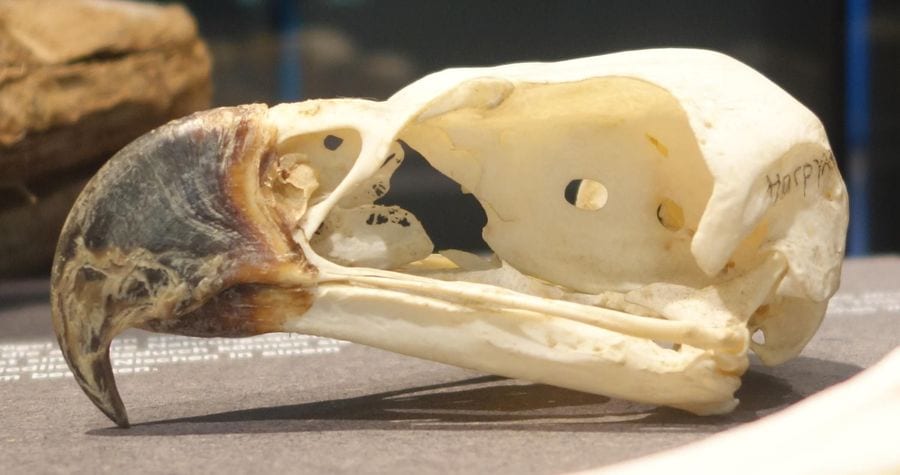
Harpy eagle skull at the Museum für Naturkunde, Berlin: a deep, strongly hooked bill for tearing large prey.
Photo: Etemenanki3, CC BY-SA 4.0, via Wikimedia Commons
Short, broad wings
Maneuverability
Give lift and quick acceleration among trees, and let the harpy fly almost straight up to attack from below. Long soaring wings would snag in the forest.
Long tail
Steering
Acts “like a rudder on a boat” to steer through dense vegetation (The Peregrine Fund).
Massive legs and talons
Grip
Legs as thick as a child’s wrist and rear talons of about 3–4 inches let it hold sloths and monkeys that fight back.
Facial disc
Hearing
A ring of feathers that can be raised to help direct sound to the ears, useful in the dim forest interior.
Raisable crest
Signaling
Raised when the bird is alert or threatened; some researchers suggest it also helps with hearing.
Energy saving
Patience
Can feed on one kill for several days, tolerate slightly old meat, and go a week or more without food (The Peregrine Fund).
Why Do Harpy Eagles Have Broad Wings?
Broad wings create lots of lift at low speed, which a heavy bird needs to take off from a branch with prey and to accelerate in short bursts. Rounded wingtips help with tight turns. The trade-off is that harpies are poor at long-distance soaring, so they travel slowly from tree to tree instead.
Harpy Eagle Sounds and Communication
Short answer
Harpy eagles are usually quiet. When they do call, it is typically a thin, drawn-out wail, plus softer croaks, whistles, clicks and mews. Most calling happens around the nest and between pair members.
San Diego Zoo calls the harpy “the strong, silent type”, describing calls as a wail (“wheee, wheee-ooooo”), croaks, whistles, clicks and mews (San Diego Zoo). Animal Diversity Web describes perched birds giving a repeated “uahaaaau” call that is believed to be territorial, and pairs chirping to each other while building the nest (ADW).
The call is much weaker than you might expect from such a powerful bird. Do not trust films or videos that dub a harpy with a loud, screaming “eagle” sound. That cry is often borrowed from other raptors.
Macaulay Library
Cornell Lab archive
Curated wild recordings of harpy eagle calls, many from nests, with location and date.
Listen to recordingsxeno-canto
Community sound library
Field recordings shared by birders across the harpy’s range; check each recording’s license before reuse.
Listen to recordingsRecorded a raptor call yourself? Try our bird sound identifier or the broader animal sound identifier.
Harpy Eagle in Culture and History
Where Does the Name “Harpy Eagle” Come From?
The name comes from the harpies of Greek mythology: predatory flying creatures with hooked beaks and claws (San Diego Zoo). Linnaeus named the bird Vultur harpyja in 1758, and the species name harpyja survives in today’s Harpia harpyja.
Ancient Depictions
Harpy eagles appear in pre-Columbian art. Tozzer and Allen’s 1910 study of animal figures in the Maya codices, published by Harvard’s Peabody Museum, identified harpy eagle depictions among the birds drawn by Maya scribes (overview).
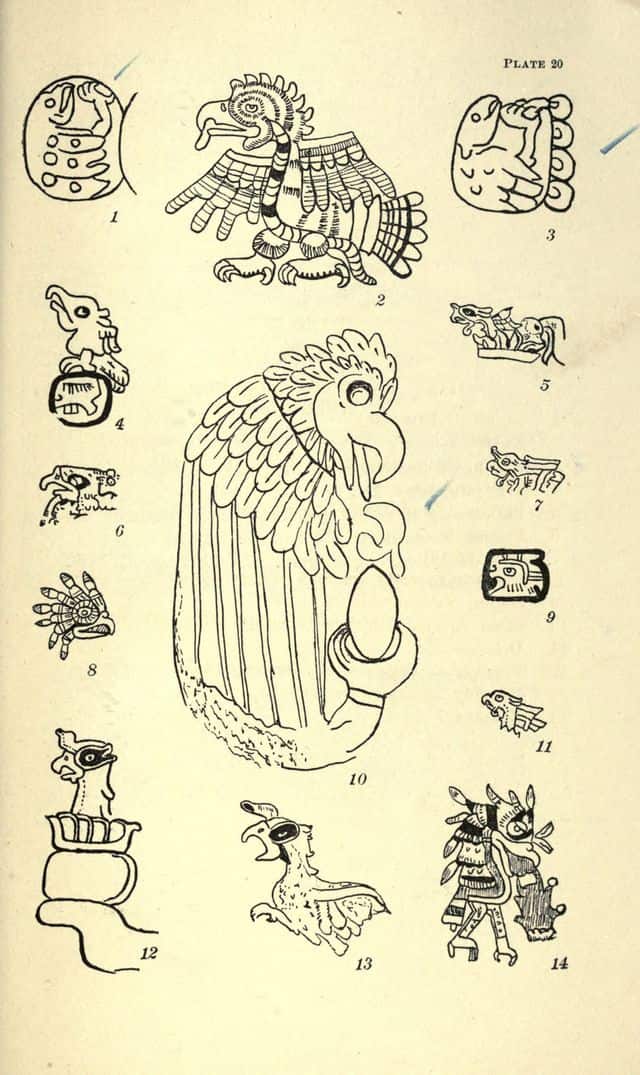
Plate 20 of Tozzer & Allen’s 1910 study “Animal figures in the Maya codices”, which identified harpy eagle depictions among the bird figures.
Photo: Tozzer & Allen (1910), public domain, via Wikimedia Commons
Indigenous Peoples and the Harpy Eagle
Across the Amazon, harpy eagle feathers have traditionally been used in headdresses and arrow fletching. BirdLife notes that this use, along with keeping birds as “mascots”, now contributes to poaching pressure in parts of the range (BirdLife International). Beliefs and stories differ between peoples, and we do not generalize them here. Some Indigenous communities in Ecuador and Peru have also taken part in harpy eagle monitoring projects (overview).
Symbolism Today
- National bird of Panama, declared on 10 April 2002 (The Peregrine Fund), and shown on Panama’s coat of arms (overview).
- Conservation ambassador: an education bird named Luigi helped teach Panamanian schoolchildren that harpy eagles deserve protection.
- Umbrella species: protecting harpy eagles means protecting the huge forests, prey animals and trees they depend on.
Harpy Eagle Identification Checklist
Short answer
An adult harpy eagle is a very large forest eagle with a pale gray head and split crest, a black chest band, white underparts, dark upperparts, broad rounded wings, a banded tail and enormous yellow feet with black talons.
AdultA free-living adult in Carajás National Forest, Pará, Brazil. The Brazilian Amazon is the species’ stronghold.
Photo: Hector Bottai, CC BY-SA 4.0, via Wikimedia Commons
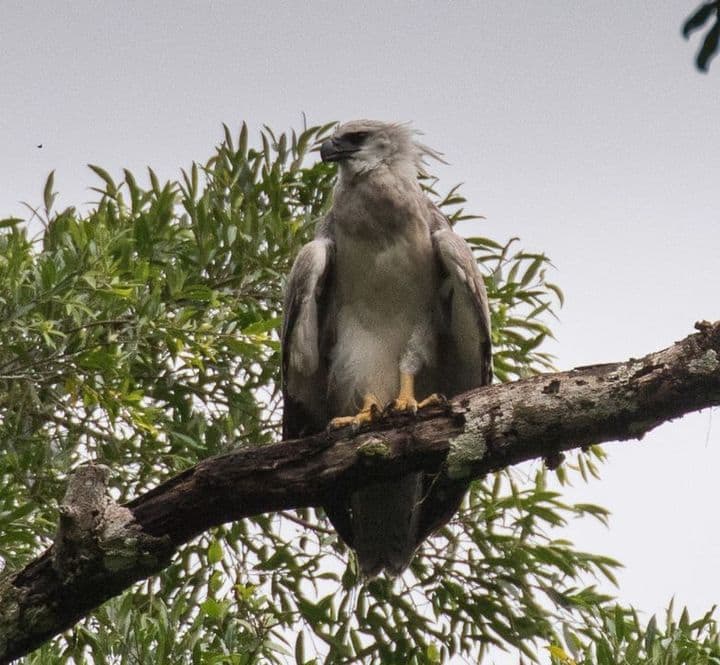 Immature
An immature harpy eagle in Darién, Panama: paler and plainer than an adult, without the solid black breast band.
Photo: Francesco Veronesi, CC BY-SA 2.0, via Wikimedia Commons
Checklist
0 / 10 checked
Not sure? A crested eagle is slimmer, with thinner legs and a single-pointed crest, and juveniles of the two are easy to confuse. Upload your photo to our bird identifier by picture for a second opinion.
15 Harpy Eagle Facts
- 1The harpy eagle is the only species in the genus Harpia.
- 2Females can weigh up to twice as much as males.
- 3Its rear talons are about 3–4 inches long, comparable to a grizzly bear’s claws (The Peregrine Fund).
- 4Its legs can be as thick as a small child’s wrist (San Diego Zoo).
- 5At five nests in the Brazilian Amazon, sloths made up 78% of prey items (Aguiar-Silva et al. 2014).
- 6More than 100 prey species have been recorded across its range (Miranda 2018).
- 7It has an owl-like facial disc that can help funnel sound to its ears.
- 8Its wings are short for its weight, an adaptation for flying among trees.
- 9It can perch and watch for prey for many hours at a time.
- 10One kill can feed it for days, and it can go a week or more without eating.
- 11A pair can build a nest from more than 300 branches, big enough for two adults to fit inside (The Peregrine Fund).
- 12Pairs lay one or two eggs but usually raise just one chick, about every two to three years.
- 13Young birds are mostly white and take around four to six years to reach full adult plumage.
- 14It is the national bird of Panama.
- 15It was uplisted to Vulnerable on the IUCN Red List in 2021 (BirdLife International).
Harpy Eagle FAQs
Is the harpy eagle the largest eagle?
+
It is one of the largest. Female harpies are among the heaviest eagles alive (6.3–9 kg) and are usually credited with the biggest talons. But the Steller’s sea eagle matches it in weight and has a wider wingspan, and the Philippine eagle overlaps in length. Which is “largest” depends on the measure you use.
Are harpy eagles friendly to humans?
+
No. They are wild predators, not pets. Harpy eagles are not known to hunt people and generally avoid humans, but they can defend nests and their talons can cause serious injuries. Watch them only from a distance and never approach a nest.
Are harpy eagles found in India?
+
No. Wild harpy eagles live only in Central and South America, from southern Mexico to northern Argentina. A crested eagle photographed in India is a different species, such as a crested serpent eagle or a hawk-eagle.
How much does a harpy eagle weigh?
+
Females weigh about 6.3–9 kg (14–20 lb) and males about 3.8–5.4 kg (8.5–12 lb), according to San Diego Zoo. A female can be up to twice as heavy as her mate.
What is the wingspan of a harpy eagle?
+
Up to about 2 m (6.5 ft). That is relatively short for such a heavy eagle: short, broad wings help it maneuver among trees instead of soaring.
What do harpy eagles eat?
+
Mainly tree-dwelling mammals, especially sloths and monkeys, plus porcupines, opossums, kinkajous, coatis, agoutis, armadillos, birds such as macaws, and reptiles such as iguanas. Over 100 prey species have been recorded.
How long do harpy eagles live?
+
They are estimated to live about 25–35 years. There is little reliable data on wild birds, so no guaranteed maximum lifespan can be given.
Where do harpy eagles live?
+
In lowland tropical rainforests from southern Mexico through Central America to northern Argentina. They are most common in the Brazilian Amazon and need large forests with giant nest trees.
How big is a harpy eagle?
+
About 89–105 cm (35–41 in) from bill to tail, roughly 1 m long, with a wingspan of up to about 2 m. Females are bigger than males.
How big are harpy eagle talons?
+
The rear talons are about 7.6–10 cm (3–4 in) long, according to The Peregrine Fund, and some sources cite up to about 13 cm for large females. That is roughly two-fifths to half the length of an adult’s hand.
Can a harpy eagle carry a human?
+
No. Prey carried to nests in an Amazon study weighed an estimated 0.3–6.5 kg, and heavier kills are usually partly eaten before being moved. A person is many times heavier than any prey a harpy eagle is known to lift.
Can a harpy eagle carry a monkey?
+
Yes. Harpy eagles regularly catch and carry monkeys such as capuchins, howlers, titis and sakis to perches and nests. Very heavy prey may be partly eaten before it is carried.
Do harpy eagles eat sloths?
+
Yes. Sloths are their most important prey in many places. At five nests in the Brazilian Amazon, sloths made up 78% of prey items and 85% of prey biomass.
Why are harpy eagles so powerful?
+
They combine a heavy body, extremely thick legs, huge talons and short, broad wings that allow sudden attacks among trees. This lets them seize and hold heavy, struggling prey such as sloths and monkeys.
Are harpy eagles endangered?
+
They are classified as Vulnerable (not Endangered) on the IUCN Red List since 2021, with a decreasing population. They are already extinct in El Salvador and very scarce in parts of Central America and Brazil’s Atlantic Forest.
What is the scientific name of the harpy eagle?
+
Harpia harpyja. It was first described by Linnaeus in 1758 as Vultur harpyja and is the only species in the genus Harpia.
Final Summary
- The harpy eagle (Harpia harpyja) is a large, powerful eagle of Neotropical rainforests, from southern Mexico to northern Argentina, and most common in the Brazilian Amazon.
- It measures about 89–105 cm long with a wingspan of up to about 2 m. Females weigh 6.3–9 kg and males 3.8–5.4 kg.
- Its rear talons are about 7.6–10 cm (some sources cite up to 13 cm), and it feeds mainly on sloths and monkeys caught by ambush in the canopy.
- Whether it is the “largest eagle” depends on the measure: it ties the Steller’s sea eagle for weight and likely has the biggest talons, but not the widest wingspan.
- It breeds slowly (one chick every 2–3 years) and is Vulnerable (IUCN 2021), threatened by deforestation and shooting.
Sources
Measurements and life-history facts come from zoo and raptor-conservation organizations (The Peregrine Fund, San Diego Zoo Wildlife Alliance), BirdLife International and the IUCN Red List, and peer-reviewed field studies of harpy eagle diet and habitat. Photos and the range map are from Wikimedia Commons under the licenses credited in each caption.
- The Peregrine Fund — Harpy Eagle (species account, conservation program, nesting and diet)
- San Diego Zoo Wildlife Alliance — Harpy Eagle (size, life span, nesting, voice)
- BirdLife International DataZone — Harpy Eagle species factsheet (2021 Red List assessment)
- IUCN Red List — Harpia harpyja, Vulnerable (BirdLife International 2021)
- CITES Appendices (Harpia harpyja is listed in Appendix I)
- Miranda EBP, et al. (2021). Tropical deforestation induces thresholds of reproductive viability and habitat suitability in Earth’s largest eagles. Scientific Reports 11:13048
- Aguiar-Silva FH, Sanaiotti TM, Luz BB (2014). Food habits of the Harpy Eagle, a top predator from the Amazonian rainforest canopy. Journal of Raptor Research 48(1):24–35
- Miranda EBP (2018). Prey composition of Harpy Eagles (Harpia harpyja) in Raleighvallen, Suriname. Tropical Conservation Science 11
- Lerner HRL, et al. (2009). It’s not too late for the Harpy Eagle (Harpia harpyja): high levels of genetic diversity and differentiation can fuel conservation programs. PLoS ONE 4(10):e7336
- Animal Diversity Web (University of Michigan) — Harpia harpyja (2011 account; status section outdated)
- Harpy eagle — encyclopedia overview (taxonomy history, compiled measurements, culture)
- The Peregrine Fund — Crested Eagle
- The Peregrine Fund — Crowned Hawk-eagle (African crowned eagle)
- The Peregrine Fund — Philippine Eagle
- The Peregrine Fund — Bald Eagle
- The Peregrine Fund — Golden Eagle
- Cornell Lab of Ornithology, All About Birds — Bald Eagle identification and measurements
- Cornell Lab of Ornithology, All About Birds — Golden Eagle identification and measurements
- San Diego Zoo Wildlife Alliance — Steller’s Sea-eagle
- Zoo New England (Franklin Park Zoo) — Steller’s Sea Eagle
- Cincinnati Zoo & Botanical Garden — Steller’s Sea Eagle
- Gordon CC, et al. (2014). 2012 Anthropometric Survey of U.S. Army Personnel (ANSUR II): Methods and Summary Statistics — hand length
- ISO/IEC 7810:2019 — Identification cards: physical characteristics (ID-1 card 85.60 mm wide)
- Macaulay Library (Cornell Lab) — Harpy Eagle audio recordings
- xeno-canto — Harpy Eagle recordings
- eBird — Harpy Eagle species page and sightings map
Related Articles
What Animals Live in the Amazon Rainforest?
Meet the jaguars, sloths, monkeys and macaws that share the harpy eagle’s rainforest home, layer by layer.
Read article
Do Female Falcons Eat Male Falcons?
Why female raptors are often bigger than males, and how mating behavior differs from cannibalism myths.
Read article
Why Do Falconers Wear Gloves?
How thick gloves protect handlers from raptor talons and give the bird a safe, steady perch.
Read articleAnimal Vision Simulator: See Like an Eagle
Compare eagle, hawk and falcon eyesight with human vision and see how raptors spot prey from far away.
Read article
Why Do Falcons Wear Hoods?
The science behind falconry hoods and how covering a raptor’s eyes keeps it calm.
Read article
Why Are Falcons So Expensive?
Species, training, rarity and legal permits: the factors behind the price of a bird of prey.
Read articleIdentify a bird of prey & explore more guides
Upload a photo or a call recording to get likely species suggestions, compare other eagles, or explore the rainforest where harpy eagles live.