Native Biome: Forests, dense shrublands, wetlands, and coastal island vegetation with thick cover.
Quokka
Setonix brachyurus
“Quokka” from Nyungar language of southwestern Australia; Setonix brachyurus means short-tailed (brachyurus) macropod of the genus Setonix.
Linnaean Taxonomic Tree
~2.5–5 kg (larger adult males)
Female: ~1.5–3.5 kg (typical adult females)Short hopping bursts through dense cover (not a high-speed open-country hopper)
Burst Acceleration~10 years
Captivity: ~10–15 years when known in careCompare Look-Alikes
vs Red Kangaroo
🐣Growth & Lifespan
Birth to old age slider
🔍 Distinctive Diagnostic Markings & Anatomy
Critical morphological field marks naturalists use to verify species identification in the wild.
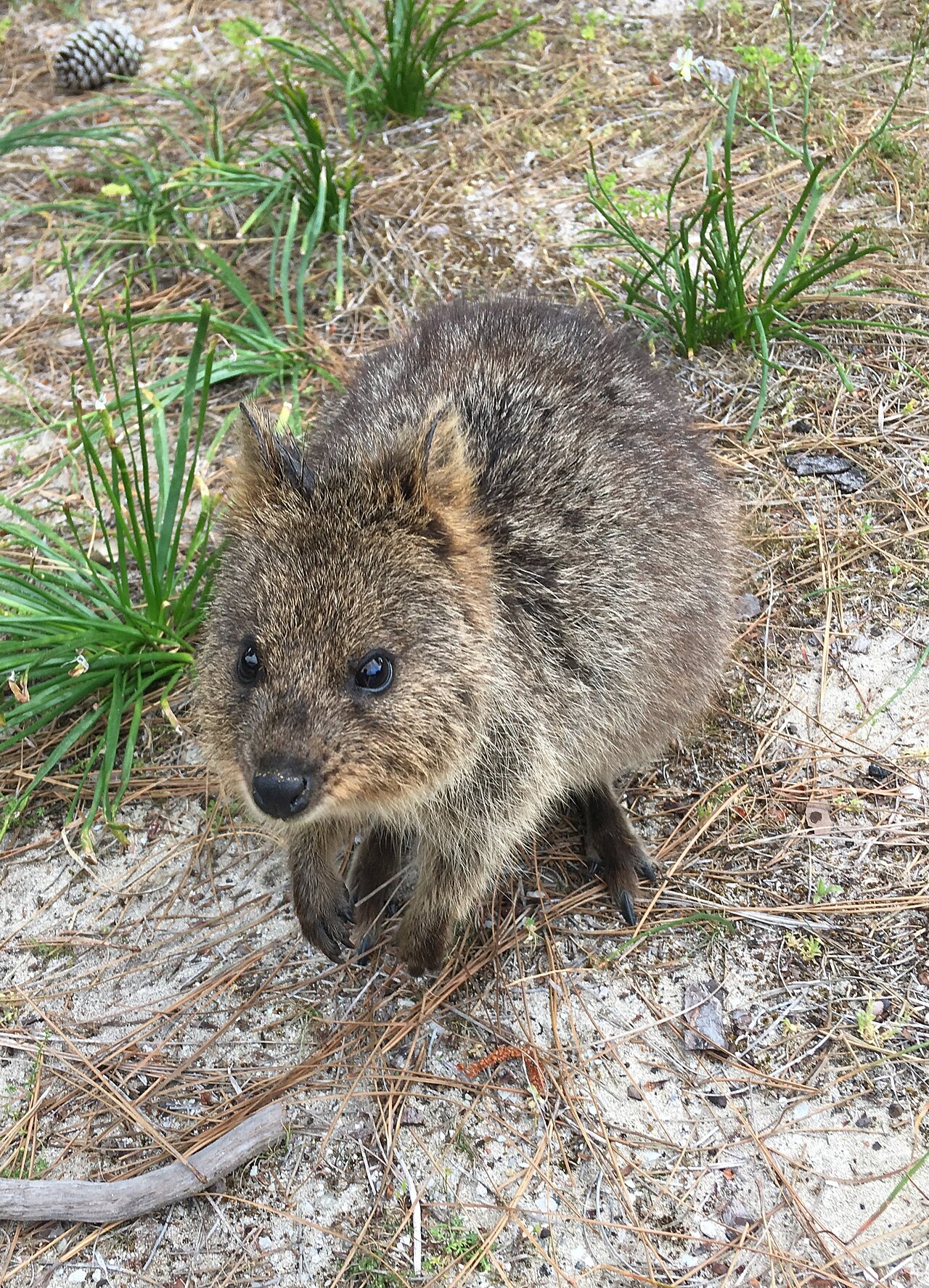
Brown to gray-brown fur; compact body; rounded face with large dark eyes; short rounded ears; short tail.
Rounded marsupial face; herbivore dentition; facial musculature creates the famous “quokka smile” appearance.
Large dark eyes adapted for mainly nocturnal activity.
Powerful hind legs for hopping; small forepaws; can climb into low shrubs.
Notably short for a macropod — a key field mark vs many wallabies.
Males average larger/heavier; both sexes share the rounded “smiling” face.
🍖 Trophic Role & Hunting Strategy
Primary HerbivoreBrowser/grazer of grasses, leaves, shrubs, and native vegetation; often forages at night.
🏕️ Social Behavior & Activity Rhythms
Strictly NocturnalOften seen alone or in loose local aggregations where food/cover concentrate; not a large “mob” species like big kangaroos
Joey crawls to pouch, nurses for months, emerges gradually, then becomes independent juvenile
Life Cycle, Growth & Lifespan Journey
| Age | Stage | Length/Height | Weight |
|---|---|---|---|
| Birth / Day 0 | Neonate | 1–2 cm | 0.0005–0.001 kg |
| Early pouch | Pouch Young | 8–15 cm | 0.1–0.35 kg |
| Emerging | Joey | 20–30 cm | 0.5–1.2 kg |
| Young-at-foot | Joey | 30–40 cm | 1–2.2 kg |
| Near maturity | Adult | 38–50 cm | 1.4–4.2 kg |
How Big Will a Quokka Get?
Calculate estimated adult weight, shoulder height, remaining growth timeline, and weekly development rate based on current age and biometrics.
Conservation Status & Population Dynamics
Strongest numbers on predator-free islands; mainland populations smaller and more fragmented
Subject to ongoing wildlife telemetry monitoring
- •Introduced foxes and cats (especially mainland)
- •Habitat loss and fragmentation
- •Fire
- •Climate and drought stress
- •Human feeding / disturbance (tourism pressure)
- Island protection (e.g. Rottnest)
- Predator control on mainland
- Habitat management and research
Field Intelligence & Diagnostic Hub for Quokka
Notably short for a macropod — a key field mark vs many wallabies.
Audio frequency analysis, territorial roar/call synthesis, and harmonic resonance measurements.
Ecosystem food web, trophic interactions, and cohabiting species in Western Australia.
⚖️ Look-Alike Species Differentiation Matrix
Instant one-click comparison tools to prevent common field misidentifications
Quokka vs. Red Kangaroo
Key DifferentiationRed kangaroos are vastly larger open-country hoppers with long muscular tails; quokkas are cat-sized, short-tailed, and tied to dense vegetation and WA islands/mainland fragments.
Quokka vs. Koala
Key DifferentiationKoalas are arboreal eucalyptus specialists with fluffy ears and almost no tail; quokkas are terrestrial hoppers with a short but visible macropod tail and rounded “smiling” face.
How to Identify Quokka from a Photograph
Standard operating procedures for photographers and field naturalists submitting sightings for verification.
- 📷Clear side profile
- 📷Head/face close-up
- 📷Full body in natural light
- 🔍Rounded “smiling” face
- 🔍Small rounded ears
- 🔍Brown/gray-brown coat
- 🔍Compact cat-sized body
- 🔍Short tail
- 🔍Macropod hopping hind legs
- ⚠️Calling the smile proof of happiness
- ⚠️Confusing with rats or bandicoots
- ⚠️Assuming feeding selfies are harmless
- ⚠️Thinking they are unrestricted pets
Frequently Asked Questions About Quokka
Verified answers compiled by zoologists, wildlife biologists, and field guides.
Related Identification Tools
Identify similar animals with focused photo tools for dogs, cats, birds, reptiles, fish, bugs, and more.