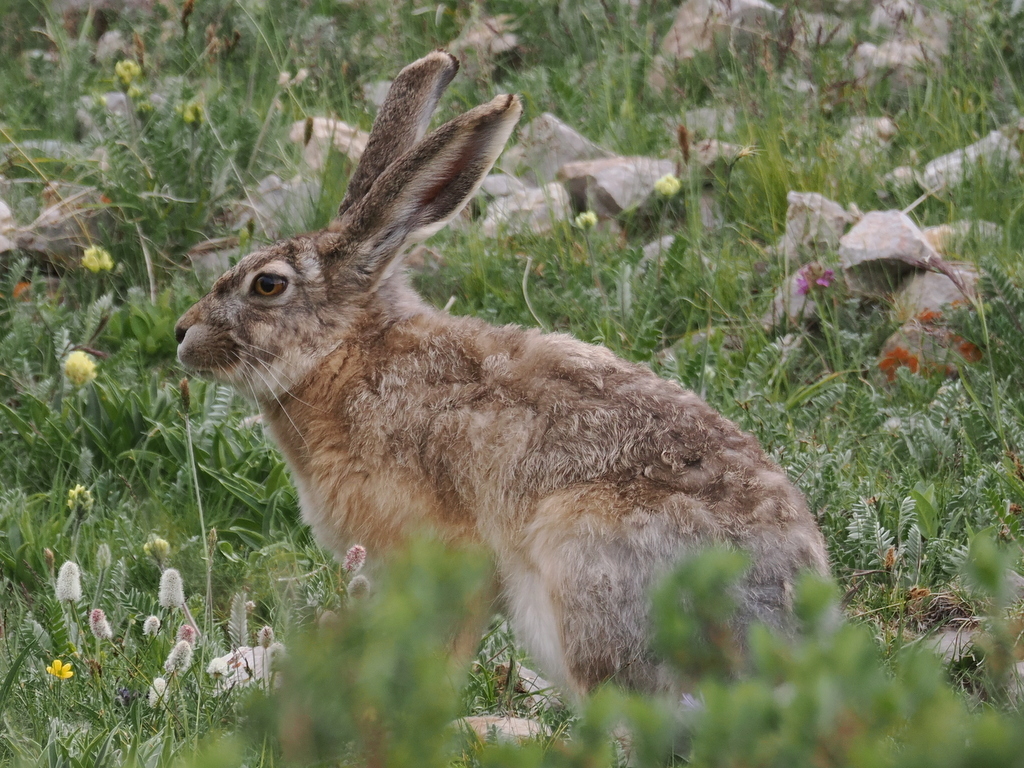
Native Biome: High-altitude cold deserts, alpine steppe, and plateau grasslands.
Woolly Hare
Lepus oiostolus
Lepus is Latin for hare; oiostolus refers to this high-plateau woolly-coated species.
Linnaean Taxonomic Tree
~2–3+ kg
Female: ~2–3+ kgFast zigzag flight across open steppe
Burst Acceleration~2–5 years typical for hares
Captivity: Short-lived relative to large mammalsCompare Look-Alikes
vs Yak
🐣Growth & Lifespan
Birth to old age slider
🔍 Distinctive Diagnostic Markings & Anatomy
Critical morphological field marks naturalists use to verify species identification in the wild.
Thick woolly fur in cold-desert tones; dense winter coat for freezing winds and snow.
Typical hare skull with continuously growing incisors.
Large lateral eyes for predator detection on open plateaus.
Long hind legs and furred feet for snow and rough ground.
Short hare scut; coat is the alpine signature.
Subtle; females may be similar or slightly larger seasonally.
🍖 Trophic Role & Hunting Strategy
Primary HerbivoreGrazer of sparse grasses and herbs; active mainly at dusk/night.
🏕️ Social Behavior & Activity Rhythms
CrepuscularTypically solitary or loose spacing; relies on crypsis and speed
Leverets grow quickly; limited denning compared with rabbits
Life Cycle, Growth & Lifespan Journey
| Age | Stage | Length/Height | Weight |
|---|---|---|---|
| Birth | Neonate | 8–15 cm | 0.1–0.28 kg |
| Juvenile | Juvenile | 22–39 cm | 0.7–1.575 kg |
| Young adult | Adult | 36–57 cm | 1.7–3.22 kg |
| Prime adult | Prime Adult | 40–60 cm | 2–3.5 kg |
How Big Will a Woolly Hare Get?
Calculate estimated adult weight, shoulder height, remaining growth timeline, and weekly development rate based on current age and biometrics.
Conservation Status & Population Dynamics
Widespread on suitable plateaus; local density varies with forage and predators
Subject to ongoing wildlife telemetry monitoring
- •Pastoral overgrazing locally
- •Climate/habitat change
- •Predation pressure natural
- Protected landscapes
- Sustainable highland grazing
Field Intelligence & Diagnostic Hub for Woolly Hare
Short hare scut; coat is the alpine signature.
Audio frequency analysis, territorial roar/call synthesis, and harmonic resonance measurements.
Ecosystem food web, trophic interactions, and cohabiting species in Himalayas & Tibetan Plateau.
⚖️ Look-Alike Species Differentiation Matrix
Instant one-click comparison tools to prevent common field misidentifications
Woolly Hare vs. Yak
Key DifferentiationYaks are huge shaggy bovines; woolly hares are small lagomorphs sharing cold highland habitats.
Woolly Hare vs. Snow Leopard
Key DifferentiationSnow leopards are apex predators that may hunt woolly hares among other prey; hares are small herbivores.
How to Identify Woolly Hare from a Photograph
Standard operating procedures for photographers and field naturalists submitting sightings for verification.
- 📷Clear side profile
- 📷Head/face close-up
- 📷Full body showing coat length
- 🔍Thick woolly coat
- 🔍High cold-desert / plateau habitat
- 🔍Long hind legs
- 🔍Cryptic steppe coloration
- ⚠️Calling them rabbits
- ⚠️Assuming they dig complex warren systems like European rabbits
- ⚠️Ignoring predator context (snow leopard prey base)
Frequently Asked Questions About Woolly Hare
Verified answers compiled by zoologists, wildlife biologists, and field guides.
Related Identification Tools
Identify similar animals with focused photo tools for dogs, cats, birds, reptiles, fish, bugs, and more.