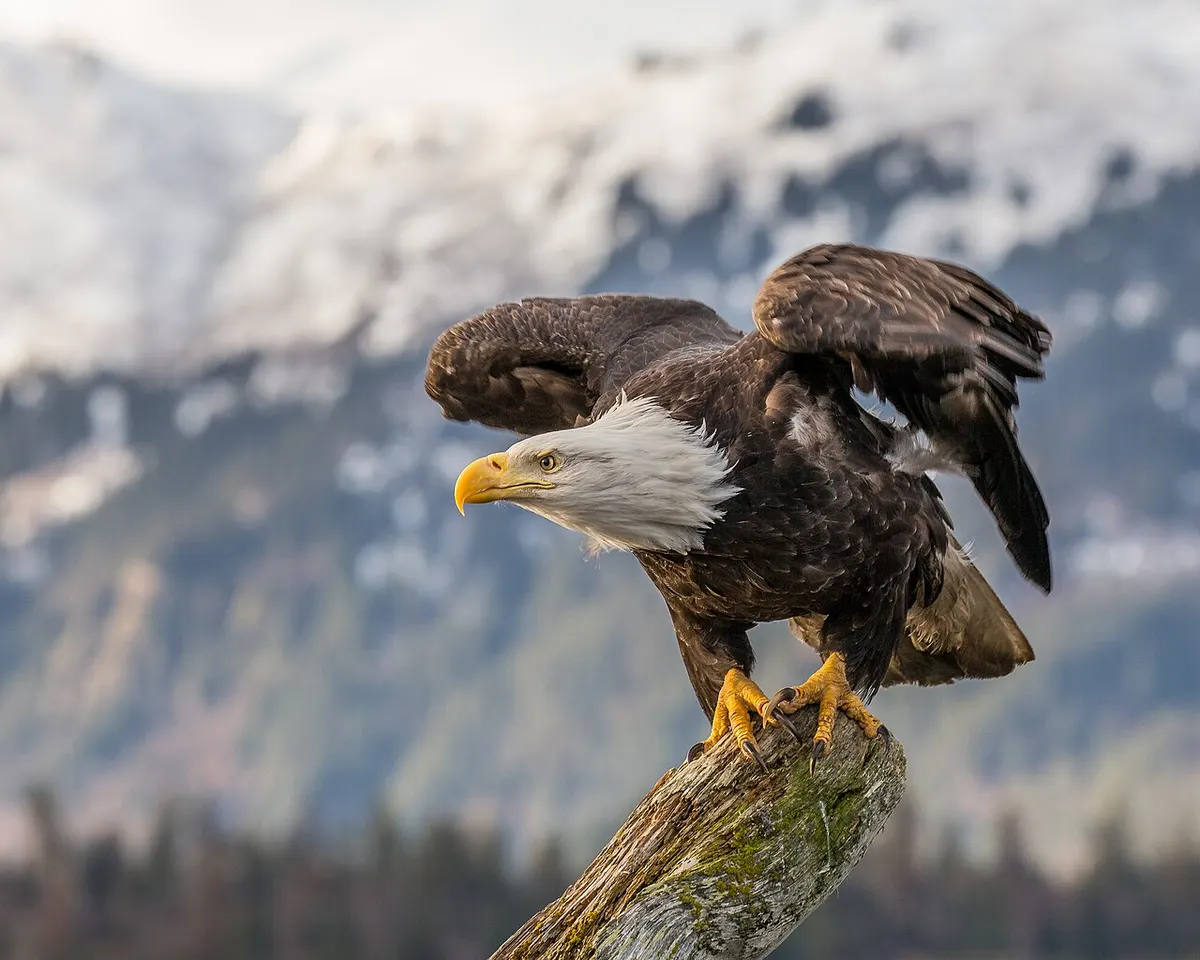
Native Biome: Lakes, rivers, coastal marshes, and forested coastlines.
Bald Eagle
Haliaeetus leucocephalus
The species name "Haliaeetus" comes from Greek "hali" (sea) and "aetos" (eagle), and "leucocephalus" means white head ("leukos" = white, "kephale" = head). The word "bald" is derived from the archaic Middle English "piebald" meaning white-patched.
Linnaean Taxonomic Tree
3.0 to 4.5 kg (6.6 to 10 lbs)
Female: 4.5 to 6.3 kg (10 to 14 lbs)160 km/h (100 mph) in high-speed predatory dive; 50–70 km/h cruising flight
Burst AccelerationGrip strength of 400 PSI exerted through razor-sharp talons
Crushing Power20 to 30 years
Captivity: Up to 50 yearsCompare Look-Alikes
vs Golden Eagle
Vision
Through their eyes
🐣Growth & Lifespan
Birth to old age slider
🔍 Distinctive Diagnostic Markings & Anatomy
Critical morphological field marks naturalists use to verify species identification in the wild.
Snowy pure white head, neck, and tail feathers contrasting sharply against deep dark-chocolate brown body and wings (in adults aged 5+ years).
Large, heavy, sharply curved bright-yellow hooked bill. Pale yellow iris with piercing binocular vision.
Round pupils with deep supraorbital ridges ("brow ridges") that shield eyes from sun glare and give an intense glare.
Bright yellow unfeathered legs with massive yellow feet equipped with 4 large curved black talons (hallux talon up to 5 cm).
Broad white fan tail used as an aerodynamic brake during water-surface swoops.
Reverse sexual dimorphism: females are roughly 25–30% larger and heavier than males.
🍖 Trophic Role & Hunting Strategy
Apex PredatorAerial pursuit and swooping strike. Soars on thermal updrafts or perches high on riverside snags, then swoops low over water to snatch fish with outstretched talons without submerging.
🏕️ Social Behavior & Activity Rhythms
DiurnalMonogamous pairs that mate for life, congregating in winter roosts near open water.
Both male and female share incubation and feeding duties for 10–12 weeks until fledging.
Life Cycle, Growth & Lifespan Journey
| Age | Stage | Length/Height | Weight |
|---|---|---|---|
| Hatch | Hatchling | 10–13 cm | 80–110 g |
| 10 Weeks | Fledgling Brancher | 180–210 cm | 3.8–5.2 kg |
| 5 Years | Breeding Adult (White Head) | 190–230 cm | 4.2–6.3 kg |
How Big Will a Bald Eagle Get?
Calculate estimated adult weight, shoulder height, remaining growth timeline, and weekly development rate based on current age and biometrics.
Conservation Status & Population Dynamics
~300,000+ mature individuals across North America
Subject to ongoing wildlife telemetry monitoring
- •Lead ammunition poisoning from eating hunter gut piles
- •Wind turbine collisions
- •Power line electrocution
- Bald and Golden Eagle Protection Act
- Migratory Bird Treaty Act
Field Intelligence & Diagnostic Hub for Bald Eagle
Broad white fan tail used as an aerodynamic brake during water-surface swoops.
Audio frequency analysis, territorial roar/call synthesis, and harmonic resonance measurements.
Ecosystem food web, trophic interactions, and cohabiting species in North America.
⚖️ Look-Alike Species Differentiation Matrix
Instant one-click comparison tools to prevent common field misidentifications
Bald Eagle vs. Golden Eagle
Key DifferentiationAdult Bald Eagles have pure white heads and unfeathered yellow legs; Golden Eagles have brown heads with a golden nape and feathered legs down to their toes.
Bald Eagle vs. Osprey
Key DifferentiationOspreys are smaller with pure white underparts and a prominent black bandit eye-stripe; Bald Eagles have dark chocolate bodies with all-white heads.
Bald Eagle vs Hawks and Falcons
An adult bald eagle is 71–96 cm long and weighs 3–6.3 kg, roughly four times as heavy as a red-tailed hawk (0.69–1.46 kg). Size is not everything, though: peregrine falcons are far faster in a dive, and crows and kingbirds routinely chase eagles away from their own nesting areas.
See how bald eagles compare with hawks and falcons in size, speed, talons and recorded encounters.
Figures:Cornell Lab of Ornithology: Bald Eagle identification
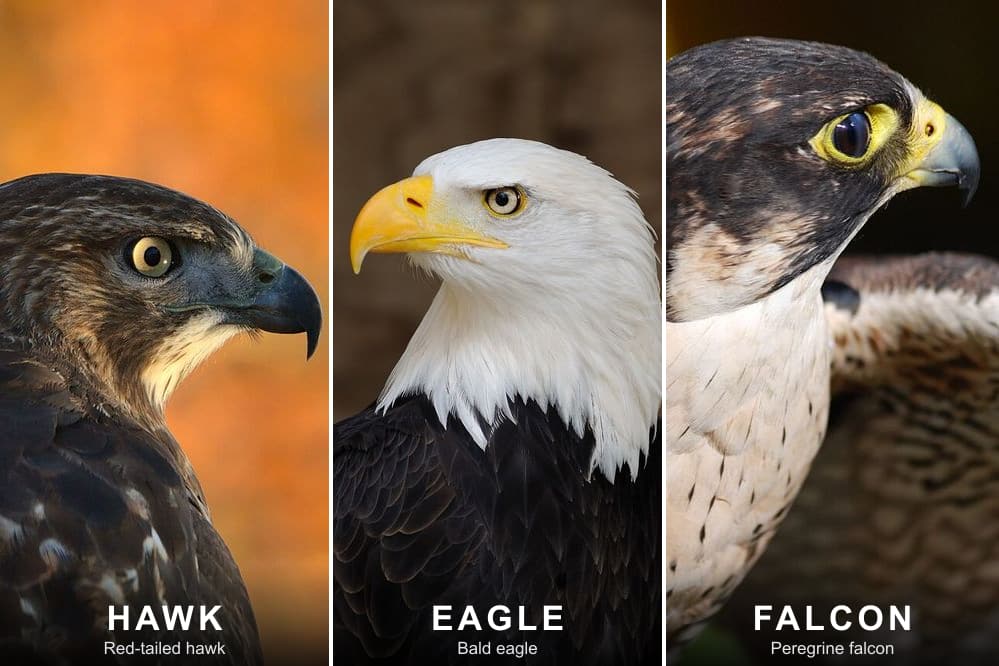
Hawk vs Eagle vs Falcon
Size, speed, strength, talons and documented encounters between the three groups of raptors, with charts and sources.
Read guide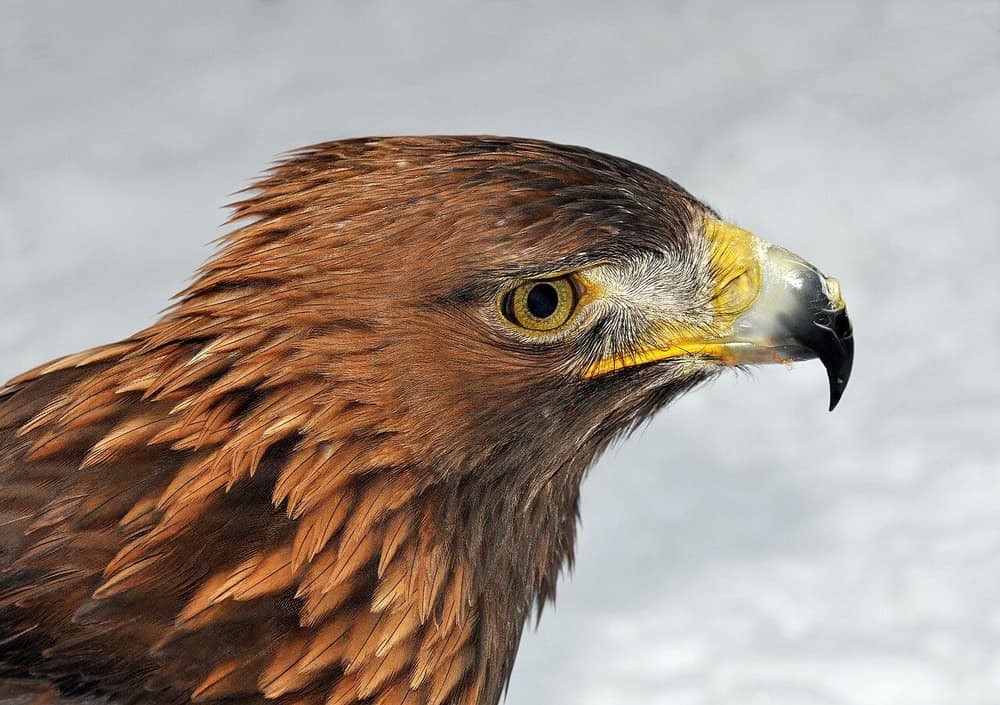
Bald Eagle vs Golden Eagle
How to tell North America’s two eagles apart by size, color, range and behavior.
Read guide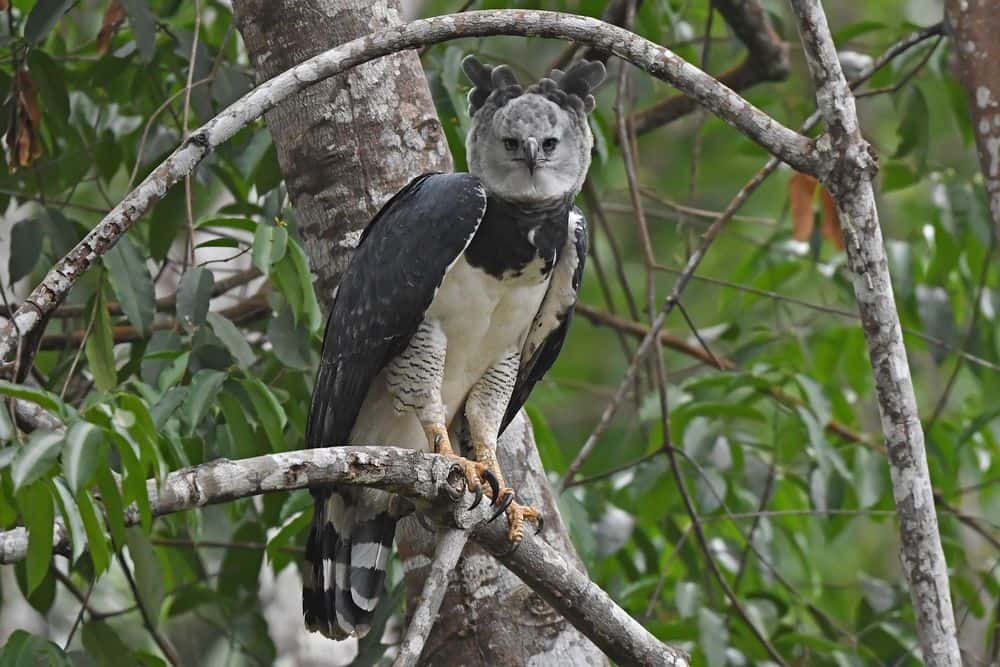
Harpy Eagle: Size, Talons, Diet & Facts
One of the heaviest eagles on Earth: how big it really is, its huge talons, and why it hunts sloths and monkeys.
Read guideHow to Identify Bald Eagle from a Photograph
Standard operating procedures for photographers and field naturalists submitting sightings for verification.
- 📷In-flight banking profile showing flat wing dihedral
- 📷Perched side portrait highlighting white head against dark background
- 📷Talons grasping fish at water surface
- 🔍Pure white head and tail on adults
- 🔍Yellow bill and legs (juveniles have dark gray bill)
- 🔍Flat wing position while soaring (unlike Turkey Vultures which hold wings in a V)
- ⚠️Confusing juvenile Bald Eagle (mottled brown and white underwing) with Golden Eagle (golden nape)
- ⚠️Confusing Osprey (white underparts with dark eye stripe) with adult Bald Eagle
Frequently Asked Questions About Bald Eagle
Verified answers compiled by zoologists, wildlife biologists, and field guides.
Related Identification Tools
Identify similar animals with focused photo tools for dogs, cats, birds, reptiles, fish, bugs, and more.



