What Is the Mariana Trench Sound?
Searches for “Mariana Trench sound” usually mean a strange metallic underwater call first heard on gliders near the Mariana Archipelago. Scientists named it the Western Pacific Biotwang. It is a whale call — not a creature from the trench floor — and NOAA researchers later tied it to Bryde’s whales.
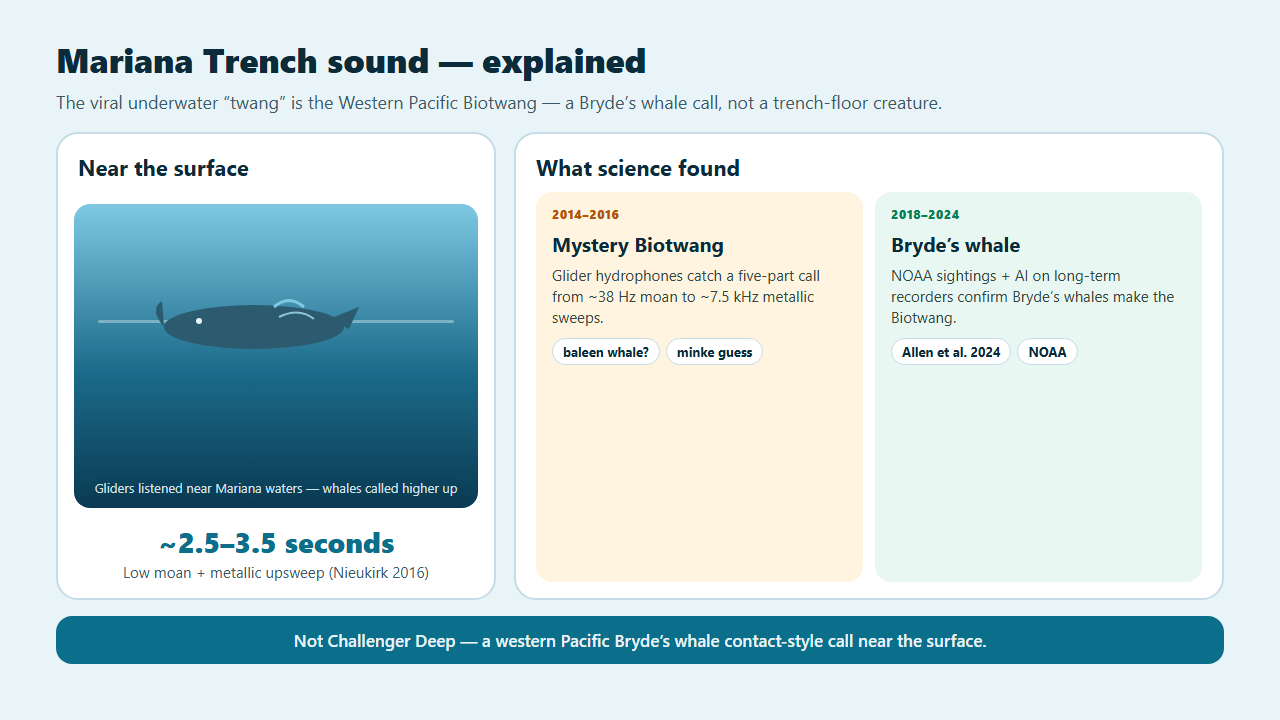
Quick answer
The sound people call the “Mariana Trench sound” is the Western Pacific Biotwang: a short, complex call lasting about 2.5–3.5 seconds, with a low moan near ~38 Hz and metallic upsweeps reaching roughly 7.5–8 kHz (Nieukirk et al., 2016).
It was recorded by autonomous ocean gliders in and around the Mariana Trench Marine National Monument region (east of Guam), not from Challenger Deep on the seafloor. Gliders dive on the order of ~1,000 m, while Bryde’s whales live in warm surface waters (Nieukirk et al.; NOAA Fisheries).
In 2018 NOAA survey work recorded Biotwangs together with Bryde’s whale sightings; a 2024 study confirmed Bryde’s whales produce the call and mapped its seasonal pattern across the central and western North Pacific (Allen et al., 2024; NOAA feature).
Listen to recordingsWhat Does the Mariana Trench Sound Sound Like?
Listeners often describe it as unnatural or “mechanical” — a low moan followed by a metallic twang. That is why researchers nicknamed it the Biotwang (biological + twang). NOAA scientists have compared the high parts to something that sounds oddly artificial for a whale (NOAA feature).
The scientific description from 2016 is precise: a short multi-part call with a low-frequency moan plus broad-frequency metallic sweeps up to about 7.5 kHz (Nieukirk et al.). NOAA’s species page also notes that Bryde’s whales make short, powerful low-frequency moans and, in the central and western North Pacific, this unique biotwang (NOAA Fisheries).
Western Pacific Biotwang (Nieukirk et al., 2016)
| Feature | What sources report |
|---|---|
| Duration | About 2.5–3.5 seconds (overall call ~2–4 s) |
| Low moan | Downsweep roughly ~44 to ~31 Hz; energy near ~38 Hz noted in summaries |
| Metallic finale | Upsweeps with energy often ~700–800 Hz, extending to ~7.5 kHz |
| Structure | Multi-part (tone → moan → upsweeps → noisy burst → metallic upsweeps) |
| First recordings | Glider surveys fall 2014 and spring 2015 east of Guam |
Was It Recorded at the Bottom of the Mariana Trench?
No. The name stuck because the gliders worked in waters that include the Mariana Trench Marine National Monument, east of Guam (Nieukirk et al.). The instrument platform was an autonomous glider diving on the order of a kilometre — not a lander sitting on Challenger Deep.
Sound travels far underwater, so a whale calling near the surface can still appear on a hydrophone that is hundreds of metres deep. The trench geography explains where scientists were listening, not where the animal lived.
Which Animal Makes the Biotwang?
Bryde’s whales (Balaenoptera edeni) produce Biotwang calls. Allen and colleagues (2024) combined visual/acoustic survey evidence with machine-learning detection across long-term Pacific recorders to show seasonal Biotwang presence consistent with a western North Pacific Bryde’s population (Allen et al.).
Bryde’s whales are mid-sized rorquals — NOAA lists about 40–55 feet and roughly 90,000 pounds — found in warm temperate and tropical seas. They often stay near the surface and use low moans as well as the Biotwang in this region (NOAA Fisheries).
How the mystery was solved
| Year | What happened |
|---|---|
| 2014–2015 | Gliders record the unknown call in the Mariana Monument region |
| 2016 | Nieukirk et al. describe the Biotwang; likely baleen whale |
| 2018 | NOAA visual + acoustic survey: Biotwangs with Bryde’s whale sightings |
| 2024 | Allen et al. publish Bryde’s ID + seasonal acoustic maps (AI-assisted) |
When and Where Do Biotwangs Show Up?
Allen et al. found consistent seasonal Biotwangs in the Mariana Archipelago and east at Wake Island, with occasional detections as far as the Northwestern Hawaiian Islands and near the equator (Howland Island) (Allen et al.).
Calling shows a smaller peak roughly February–April and a larger peak August–November, matching migration between lower and mid-latitudes. NOAA notes year-to-year swings (for example many calls in a strong El Niño year, almost none in a La Niña year) that may track shifting feeding conditions (NOAA feature).
The exact social function of the Biotwang is still being studied; a contact-call role is one hypothesis discussed publicly by researchers, not a proven fact (NOAA feature).
Audio examples
We do not embed a Biotwang sample here (rights-cleared hostable files were not available for that specific call). Listen via NOAA’s public Biotwang coverage (NOAA feature). Below is a Challenger Deep hydrophone clip of ship traffic from NOAA PMEL — ambient trench-depth noise, labeled clearly so it is not mistaken for the Biotwang.
Challenger Deep: ship traffic (not the Biotwang)
NOAA PMEL Full Ocean Depth Hydrophone, Mariana Trench / Challenger Deep, June 2020 — ship noise. This is ambient trench-depth sound, not the Western Pacific Biotwang (a near-surface Bryde’s whale call).
Listen for: low, continuous propeller / ship-pass noise, not a short metallic whale “twang.”
Recording: NOAA Pacific Marine Environmental Laboratory (PMEL) Acoustics Program · U.S. government work (public domain)
Frequently asked questions
What is the Mariana Trench sound?+
It is the Western Pacific Biotwang — a ~3.5-second multi-part whale call with a low moan and a metallic high-frequency ending, first described from glider recordings near the Mariana region in 2014–2015.
Is the Mariana Trench sound from the deepest point in the ocean?+
No. Recorders were gliders in the Mariana Monument region diving about 1,000 m. The call is made by Bryde’s whales near the surface, not by an animal at Challenger Deep.
What animal makes the Biotwang?+
Bryde’s whales. Visual/acoustic matches in 2018 and a 2024 Frontiers in Marine Science paper confirmed the species ID.
Why does it sound so strange?+
The call mixes a very low moan with broadband metallic upsweeps up to several kilohertz — unusual for many familiar whale songs, which is why early listeners thought it sounded artificial.
Can I hear it myself?+
Listen to Biotwang samples via NOAA’s public feature story. This page embeds a Challenger Deep ship-traffic hydrophone clip for trench-depth ambient contrast — not the Biotwang itself. Never chase whales at sea to “collect” sounds.
How This Guide Was Prepared
This guide was researched and written by the AnimalIDFinder editorial team using Nieukirk et al. (2016) in the Journal of the Acoustical Society of America, Allen et al. (2024) in Frontiers in Marine Science, and NOAA Fisheries Bryde’s whale and Biotwang feature pages, all linked below.
Where viral social posts exaggerate trench depth or invent sea monsters, we follow the peer-reviewed acoustic papers and NOAA summaries. Last reviewed against sources: November 2026.
Related wildlife questions
Sources
Peer-reviewed and NOAA sources used in this guide:
- Nieukirk, Fregosi, Mellinger & Klinck (2016) — A complex baleen whale call recorded in the Mariana Trench Marine National Monument, Journal of the Acoustical Society of America
- Allen et al. (2024) — Bryde’s whales produce Biotwang calls…, Frontiers in Marine Science
- NOAA Fisheries — Bryde’s whale species profile
- NOAA Fisheries — Hey, Google: Find this New Whale Sound (Biotwang feature)
Identify animals & explore guides
Curious about other animal sounds? Try the wildlife sound tools, photo identifier, or browse more wildlife question guides.