What Sound Does a Giraffe Make?
People often say giraffes have no voice. They are quiet compared with many mammals, but they do make sounds — from alarm snorts to a low humming recorded at night in zoos. Here is what researchers have actually documented.
Quick answer
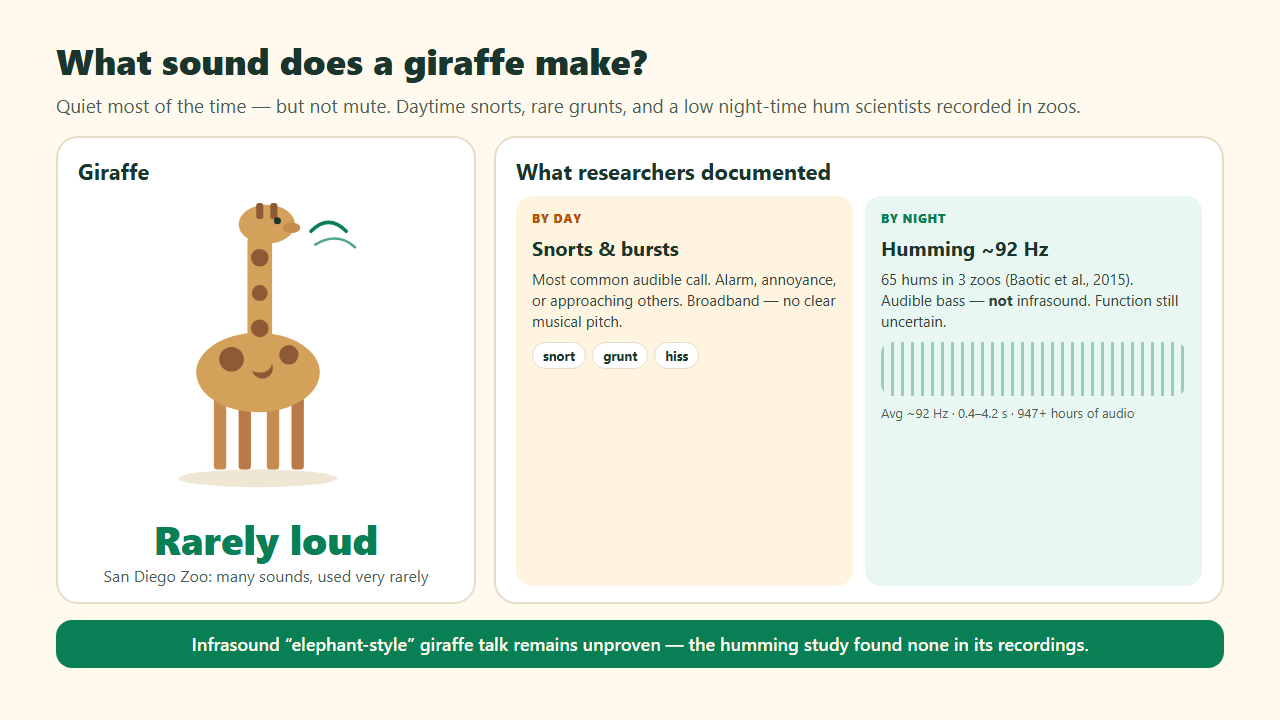
Giraffes are mostly quiet, but they do make sounds. San Diego Zoo Wildlife Alliance lists moos, roars, snorts, hisses and grunts, and notes that giraffes simply make them very rarely. An alarm snort is one of the sounds you are most likely to hear (San Diego Zoo).
At night, researchers recorded a low, sustained “humming” vocalization in three European zoos — average fundamental frequency about 92 Hz, lasting from under a second to about 4 seconds. None of the recorded calls were infrasonic (Baotic, Sicks & Stöger, 2015).
Animal Diversity Web also notes mother–calf contact sounds (such as bellowing and bleating or mewing) and alarm grunts or snorts (ADW). Vision and smell remain major ways giraffes keep track of one another (Kasozi & Montgomery, 2018).
Are Giraffes Silent?
For a long time, people assumed giraffes could not — or would not — call much, partly because a very long neck makes it hard to push a strong airstream past the larynx. Animal Diversity Web still describes them as rarely heard and “usually considered silent” (ADW).
That does not mean they have no voice. San Diego Zoo Wildlife Alliance puts it plainly: many people think giraffes have no voice, but they do make a variety of sounds — they just do so very rarely (San Diego Zoo). A 2018 review of giraffe communication likewise finds auditory signals understudied, with documented categories including snorts, hisses, hums, bursts and growls (Kasozi & Montgomery).
Giraffe sounds reported in research and zoo sources
| Sound | When it turns up | What sources say |
|---|---|---|
| Snort / burst | Alarm, annoyance, approaching others | Most commonly heard daytime call; broadband, no clear pitch |
| Grunt / hiss / moo / roar | Rare | Listed by San Diego Zoo; used infrequently |
| Humming | Night (captive recordings) | Harmonic, ~92 Hz average; 65 hums in Baotic et al. 2015 |
| Calf / mother contact | Separation, nursing contexts (reported) | ADW: bellowing, bleating/mewing, whistling |
| Infrasound “rumbles” | Often claimed, not confirmed in Baotic et al. | No infrasonic calls in 947+ hours of zoo audio |
Daytime Sounds: Snorts, Grunts and Alarm Calls
The sound you are most likely to notice by day is a snort. San Diego Zoo says giraffes snort when alarmed — for example when lions are nearby — and that a running giraffe herd can tip off other savanna animals (San Diego Zoo).
Baotic and colleagues summarise earlier work: snorts are the most commonly heard call and appear when animals are alarmed, annoyed or approaching one another. Snorts and “bursts” are broadband noises without a clear musical pitch, made by a sudden rush of air from the nostrils. In one daytime recording project cited in their paper, about 700 hours of zoo audio yielded only 72 vocalizations, mostly snorts (Baotic et al.).
The Night-Time Hum
In 2015, researchers recorded giraffes day and night at zoos in Berlin, Vienna and Copenhagen. Besides known bursts, snorts and grunts, they found a new structured call: a deep, sustained, frequency-modulated hum, heard only in nocturnal sessions (Baotic et al.).
Average pitch was about 92 Hz — low for human speech, but still audible (middle C on a piano is about 262 Hz; 92 Hz is closer to a low bass note). Keepers at the study zoos had not noticed the hum before. The authors suggest it might work as a contact call when animals cannot see each other well, but they could not identify callers or prove the function.
Night humming (Baotic, Sicks & Stöger, 2015)
| Measure | Value |
|---|---|
| Recording effort | More than 947 hours across 3 zoos |
| Hums analysed | 65 (Berlin 34, Vienna 9, Copenhagen 22) |
| Average fundamental frequency | About 92 Hz (±26 Hz) |
| Lowest frequencies measured | Down to about 35 Hz |
| Duration | About 0.4–4.2 seconds |
| Infrasonic? | No — none of the recorded vocalizations |
Do Giraffes Use Infrasound Like Elephants?
It is a popular idea that giraffes “talk” below human hearing, the way elephants use low rumbles. Some education pages still mention that possibility (San Diego Zoo; ADW).
The humming study was designed in part to look for such signals. The authors’ conclusion is cautious: none of the recorded vocalizations were infrasonic, and claims of infrasonic giraffe communication need more evidence (Baotic et al.). Until a study shows otherwise, treat infrasound as an unproven hypothesis, not a settled fact.
Mothers, Calves and Other Reported Calls
Beyond snorts and hums, field and zoo accounts describe softer contact sounds. Animal Diversity Web reports that mothers may whistle to calves, cows searching for young may bellow, and calves may answer by bleating or mewing; alarmed animals grunt or snort, and courting males may cough loudly (ADW).
Baotic et al. also mention anecdotal reports of bleats, moans, moos and loud bellows from a restrained newborn calf. These reports are useful leads, but many lack the spectrograms and sample sizes of the humming study, so treat them as reported rather than fully mapped.
Giraffes also rely heavily on sight (their height gives a long view) and on smell; vocal communication is only one channel (Kasozi & Montgomery).
Frequently asked questions
What noise does a giraffe make?+
Most often a snort when alarmed or annoyed. They can also grunt, hiss, moo or roar, but rarely. At night, captive giraffes have been recorded making a low humming sound around 92 Hz.
Are giraffes mute?+
No. They are quiet and seldom call, which is why people think they have no voice, but zoo and research sources document several call types.
Do giraffes hum?+
Yes — at least in captivity at night. A 2015 study recorded 65 harmonic humming calls across three European zoos, only during nocturnal sessions.
Can humans hear giraffe sounds?+
Yes for snorts and for the documented hum (about 92 Hz on average). True infrasound below human hearing was not found in that study’s recordings.
Why don’t we hear giraffes more often?+
They simply vocalize rarely compared with many social mammals, and they use vision and smell a lot. Daytime recording projects pick up mostly occasional snorts.
How This Guide Was Prepared
This guide was researched and written by the AnimalIDFinder editorial team using San Diego Zoo Wildlife Alliance education material, Animal Diversity Web, the 2015 BMC Research Notes humming study and a 2018 Journal of Zoology review of giraffe communication, all linked below.
Where education pages and peer-reviewed audio studies disagree (especially on infrasound), we favour the study that analysed recordings. Last reviewed against sources: November 2026.
Related wildlife questions
Sources
Zoo education and peer-reviewed sources used in this guide:
- Baotic, Sicks & Stöger (2015) — Nocturnal “humming” vocalizations: adding a piece to the puzzle of giraffe vocal communication, BMC Research Notes
- San Diego Zoo Wildlife Alliance — Giraffe
- Animal Diversity Web (University of Michigan) — Giraffa camelopardalis
- Kasozi & Montgomery (2018) — How do giraffes locate one another? A review of visual, auditory, and olfactory communication among giraffes, Journal of Zoology
Identify animals & explore guides
Heard an animal and not sure which? Try the photo identifier, read other sound guides, or browse the mammals encyclopedia.



