What Animals See Humans as Prey?
Almost no wild animal prefers humans as everyday prey. A small set of large carnivores, crocodilians and sharks do sometimes treat people as food — usually where ranges overlap with daily human activity, or when the animal is hungry or food-conditioned. Here is what the research actually shows.
Quick answer
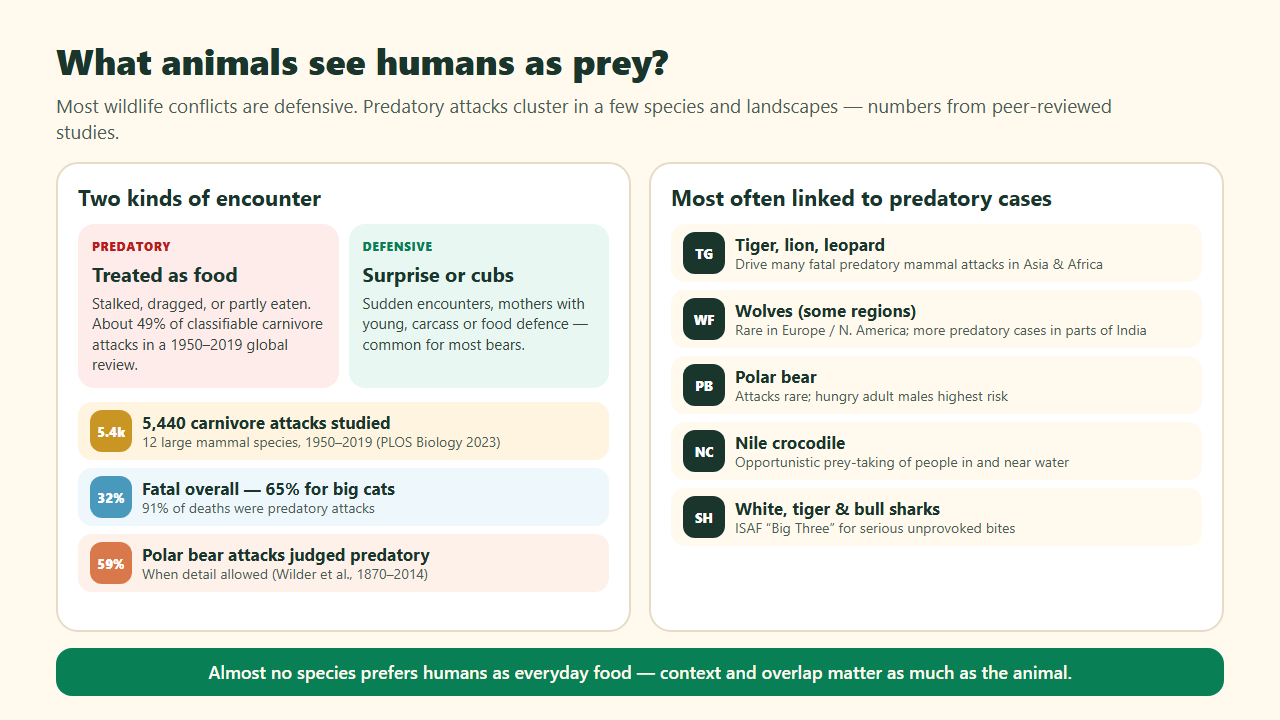
Very few species regularly hunt people. Most dangerous wildlife encounters are defensive (surprise meetings, cubs, carcasses) rather than predatory. A 2023 global review of 5,440 large carnivore attacks (1950–2019) found that about 49% of classifiable cases were predatory — and those clustered in lower-income regions, especially India and south-eastern Africa (Bombieri et al., PLOS Biology).
Animals most often linked to predatory attacks on humans in that carnivore study are tigers, lions, leopards and (in parts of India) wolves. Polar bears are unusual among bears: researchers judged the bear acted as a predator in 59% of attacks with enough detail (Wilder et al., 2017). Outside mammals, Nile crocodiles cause many opportunistic attacks on people in water, and a handful of large sharks (white, tiger, bull) account for most serious unprovoked bites.
Black bears, brown bears and most North American wolves usually do not treat humans as preferred prey. Bear attacks in the global carnivore dataset were mainly sudden encounters, cub defence or food-related conflicts, with only about 9% of ursid attacks fatal (Bombieri et al.).
Predatory Attack vs Defensive Encounter
Researchers reserve “predatory” for cases where a person appears to have been treated as food — for example dragged to cover, partly eaten soon after death, or stalked and rushed (Bombieri et al.). Many other attacks are defensive: a mother with young, a bear surprised at close range, or an animal defending a carcass or livestock kill.
In the global carnivore dataset, 32% of attacks were fatal, but fatality was much higher for felids (65%) than for bears (9%). The authors report that 91% of recorded deaths were the result of predatory attacks, and 85% of fatal attacks occurred in lower-income countries (Bombieri et al.).
Who is most often involved when attacks are predatory?
| Group | Usually predatory toward people? | Main takeaway |
|---|---|---|
| Tiger, lion, leopard (in conflict landscapes) | Often yes, where studied | Most predatory mammal attacks in the global study |
| Wolves in India | Sometimes yes | Very different pattern from Europe / N. America |
| Polar bear | Often yes when an attack occurs | Attacks are rare; hungry adult males highest risk |
| Black / brown / sloth bears | Usually no | Defence, surprise and food attractants dominate |
| Nile crocodile | Opportunistic aquatic predator | People in or near water are taken as prey |
| White, tiger and bull sharks | Bites often exploratory / opportunistic | “Big Three” for serious unprovoked bites |
Big Cats and Wolves That Prey on People
Tigers and lions drive many of the fatal predatory cases. Felids and canids were more often involved in predatory events than bears in the global review (Bombieri et al.). A separate analysis of 908 lion, leopard and tiger attacks found that outbreaks of lion attacks included more fatalities, lasted longer and covered larger areas than tiger or leopard outbreaks (Packer et al., 2019). That paper also cites earlier Tanzania data in which 65% of 815 lion attacks (1990–2004) were fatal.
Leopards and wolves can also hunt people in some landscapes. Predatory wolf attacks were rare in Europe and North America in 1950–2019 (and often involved food-conditioned animals), but numbered in the hundreds in Indian regions over the same span (Bombieri et al.).
Large carnivore attacks on humans worldwide, 1950–2019 (Bombieri et al., 2023)
| Species | Attacks in the study | Notes from the study |
|---|---|---|
| Sloth bear | 1,337 | Mostly defensive / sudden encounters (bears overall) |
| Tiger | 1,047 | Felids often predatory; high fatality share |
| Asiatic black bear | 765 | Ursid attacks rarely predatory overall |
| Brown bear | 664 | Sudden encounters, cubs, food defence common |
| Wolf | 414 | Predatory attacks rare in Europe/N. America; more in India |
| American black bear | 403 | Mainly non-predatory scenarios |
| Lion | 282 | Often predatory in parts of Africa |
| Leopard | 205 | Predatory attacks in some Asian regions |
| Coyote | 140 | — |
| Cougar | 135 | — |
| Jaguar | 25 | — |
| Polar bear | 23 | Small count; see Wilder et al. for polar-bear focus |
Do Bears See Humans as Prey?
Usually not. Across ursids in the global study, attacks were mainly involuntary sudden encounters (45%), females defending cubs (18%), or food-related conflicts (16%) (Bombieri et al.).
Polar bears are the exception. Across the five polar-bear Range States, Wilder and colleagues documented 73 wild polar-bear attacks from 1870–2014, with 20 deaths and 63 injuries. They judged the bear acted as a predator in 59% (37 of 63) of attacks with enough information, and found that nutritionally stressed adult males were the most likely to threaten people (USGS summary; Wilder et al. PDF). Attacks remain rare compared with many other conflict species, but the predatory share is high when they do happen.
Crocodiles: Opportunistic Predators in Water
Crocodilians are not in the mammal carnivore review, but they are among the animals most often described as taking people as prey in water. The IUCN Crocodile Specialist Group’s Croc Digest states that Nile crocodiles are allegedly responsible for more attacks on people than any other species, while noting large reporting gaps across Africa (IUCN CSG Croc Digest).
Country figures show how serious local conflict can be. The IUCN CSG Nile crocodile account cites 98 attacks on people in Zambia (2000–2009), of which 62.2% were fatal, and 214 attacks in South Africa from 1949–2016 (IUCN CSG Nile crocodile PDF). These are typically people swimming, bathing, fishing, doing chores or crossing water — classic opportunistic predation at the water’s edge.
Do Sharks See Humans as Prey?
Sharks rarely “hunt humans” as a preferred prey species. The International Shark Attack File still records unprovoked bites every year — 65 confirmed worldwide in 2025, in line with a recent five-year average of about 61 per year, with about eight unprovoked fatalities per year on average (ISAF yearly summary).
ISAF calls the white, tiger and bull sharks the “Big Three” for serious unprovoked incidents: they are large, overlap with people in the water, and have shearing teeth. Confirmed unprovoked totals in the ISAF species table include roughly 351 white, 142 tiger and 119 bull shark cases (fatal and non-fatal combined). ISAF also notes that many bites are not clearly directed feeding attempts on a person, but jaw power alone can still injure (ISAF species implicated).
Frequently asked questions
What animals actively hunt humans as prey?+
No large predator relies on humans as its main diet. Predatory attacks are best documented for tigers, lions, leopards and some wolves in parts of Asia and Africa, for polar bears when food-stressed, and for Nile crocodiles taking people in water. A few large shark species cause most serious unprovoked bites, which are still rare worldwide.
Do bears hunt humans?+
Black, brown and sloth bears usually attack in defence or surprise, not as hunters of people. Polar bears are different: when attacks occur, researchers often classify them as predatory, especially by nutritionally stressed adult males.
Are wolves a danger to people in North America?+
In Europe and North America, wolf attacks on people have been very rare in recent decades. Most of the predatory wolf cases in the 1950–2019 global review were from Indian regions, not the Holarctic.
Which shark is most dangerous to humans?+
ISAF highlights white, tiger and bull sharks as the “Big Three” for serious unprovoked bites. White sharks lead the confirmed unprovoked totals, followed by tiger and bull sharks.
Why do more fatal attacks happen in lower-income countries?+
The global carnivore study links this to more predatory species living where people farm, fish and collect resources daily, plus slower rescue and hospital access. In higher-income countries, more victims were attacked during recreation.
How This Guide Was Prepared
This guide was researched and written by the AnimalIDFinder editorial team using peer-reviewed carnivore-attack studies, USGS / Wildlife Society Bulletin polar-bear research, IUCN Crocodile Specialist Group publications and the Florida Museum International Shark Attack File, all linked below.
We distinguish predatory from defensive attacks wherever the sources do. Last reviewed against sources: November 2026.
Related wildlife questions
Sources
Peer-reviewed and wildlife-agency sources used in this guide:
- Bombieri et al. (2023) — A worldwide perspective on large carnivore attacks on humans, PLOS Biology
- Packer et al. (2019) — Species-specific spatiotemporal patterns of leopard, lion and tiger attacks on humans, Journal of Applied Ecology
- USGS — Polar bear attacks on humans: implications of a changing climate (Wilder et al., 2017 summary)
- Wilder et al. (2017) — Polar bear attacks on humans: implications of a changing climate, Wildlife Society Bulletin (PDF)
- IUCN Crocodile Specialist Group — Croc Digest: bibliography of human–crocodile interactions (5th ed., PDF)
- IUCN Crocodile Specialist Group — Nile crocodile (Crocodylus niloticus) species account (PDF)
- Florida Museum of Natural History — International Shark Attack File: species implicated
- Florida Museum of Natural History — International Shark Attack File: yearly worldwide summary
Identify animals & explore guides
Curious which animal you saw, or want more wildlife explainers? Try the photo identifier, browse venom and poison guides, or return to the guides hub.



