Northern Saw-whet Owl: ID and Sound
The Northern Saw-whet Owl is a robin-sized forest owl with a big round head, yellow eyes and a monotonous whistled song. It is common across northern woods yet hard to see — you are more likely to hear its too-too-too call on winter and spring nights.
Quick answer
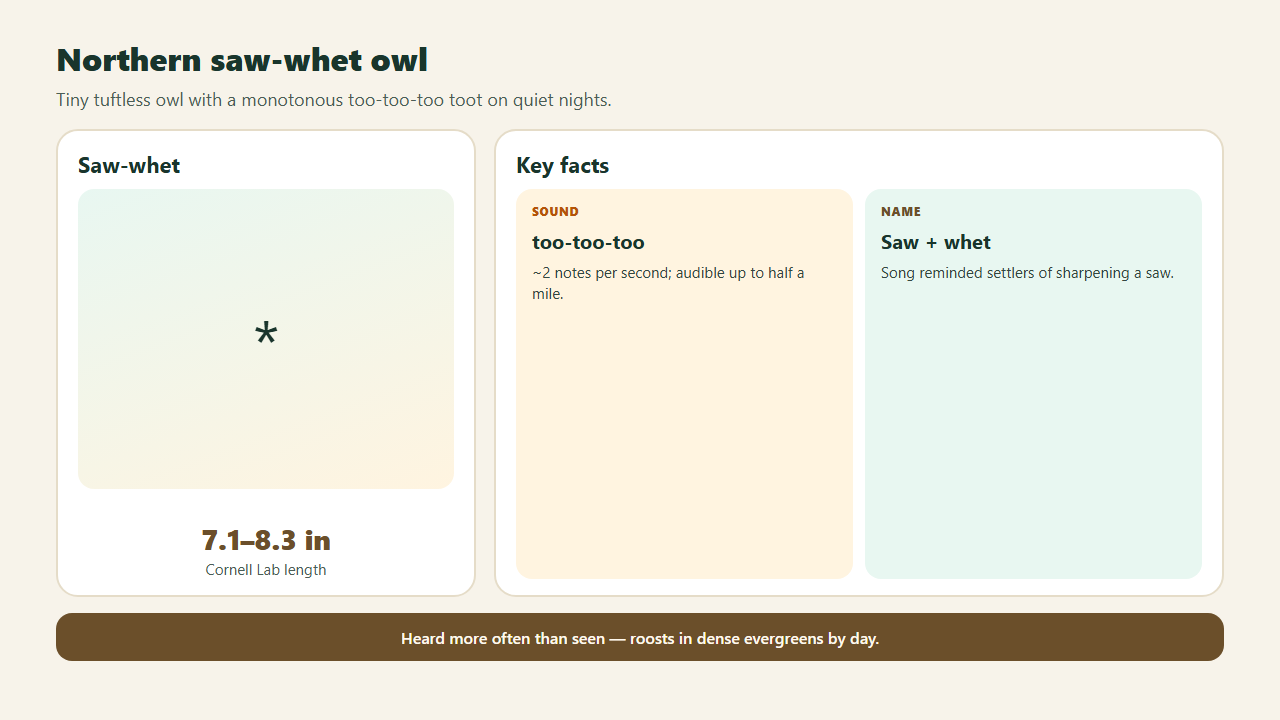
Northern Saw-whet Owls (Aegolius acadicus) are very small, round-headed owls without ear tufts. Cornell lists length 7.1–8.3 in (18–21 cm), wingspan 16.5–18.9 in (42–48 cm) and weight 2.3–5.3 oz (65–151 g) (Cornell ID).
The advertising song is an insistent series of whistled too-too-too notes on roughly the same pitch, about 2 notes per second; males can be heard up to half a mile away (Cornell Sounds).
Audubon notes the bird was named because the song reminded settlers of a whetstone sharpening a saw (Audubon).
How to Identify a Northern Saw-whet Owl
Look for a compact owl with a big round head and no ear tufts, mottled brown and white with fine white streaks on the head and a white “V” between the eyes; eyes are yellow (Cornell ID).
Juveniles look different: cinnamon belly, unspotted brown back, still with the white facial V (Cornell ID). Compared with screech-owls, saw-whets lack ear tufts and are smaller overall.
Northern Saw-whet Owl measurements (Cornell Lab)
| Trait | Value |
|---|---|
| Length | 7.1–8.3 in (18–21 cm) |
| Wingspan | 16.5–18.9 in (42–48 cm) |
| Weight | 2.3–5.3 oz (65–151 g) |
| Relative size | Robin-sized; smaller than Eastern Screech-Owl |
| Head | Large, round; no ear tufts |
| Eyes | Yellow |
What Does a Northern Saw-whet Owl Sound Like?
The classic song is a sharp, high, monotonous too-too-too whistle repeated for long stretches. Cornell times it at about two notes per second; advertising males may be audible up to half a mile (Cornell Sounds).
Audubon links the common name to that tooting song sounding like a saw being whetted (Audubon). Other calls include whines, squeaks and high barks; birds may snap their bills if approached closely (Cornell Sounds).
Sounds (Cornell Lab)
| Type | Description |
|---|---|
| Song | too-too-too whistles, ~2 notes/sec, same pitch |
| Other calls | Whines, guttural sounds, tssst, squeaks, high barks |
| Bill | Bill-snapping when closely approached |
Where and When to Hear Them
Cornell describes them as forest birds breeding across northern North America, wintering in dense forests farther south; the high-pitched call is a common evening sound in evergreen mountain forests from January through May (Cornell overview).
They are highly nocturnal and seldom seen, which is why the species often spikes in search interest when people hear an unfamiliar nighttime toot.
Audio examples
No embedded saw-whet sample yet — we do not reuse a generic owl hoot for this species. Listen to the advertising too-too-too on Cornell Lab Sounds.
Frequently asked questions
What does a northern saw-whet owl sound like?+
A repeated whistled too-too-too on one pitch, about two notes per second — often for a long time on quiet nights.
How big is a northern saw-whet owl?+
About 7–8 inches long with a 16.5–19 inch wingspan — roughly robin-sized.
Why is it called a saw-whet?+
Settlers thought the tooting song resembled a saw being sharpened on a whetstone.
Does it have ear tufts?+
No. The head is round and lacks the “horns” of screech-owls and great horned owls.
How This Guide Was Prepared
Researched from Cornell Lab All About Birds (overview, ID and sounds pages) and the Audubon Field Guide entry for Northern Saw-whet Owl.
Last reviewed against sources: November 2026.
Related wildlife questions
Sources
Cornell Lab and Audubon sources used in this guide:
Identify birds & explore guides
Heard a night call? Try the bird sound identifier or browse more wildlife guides.