Was a Blue Whale Bitten in Half?
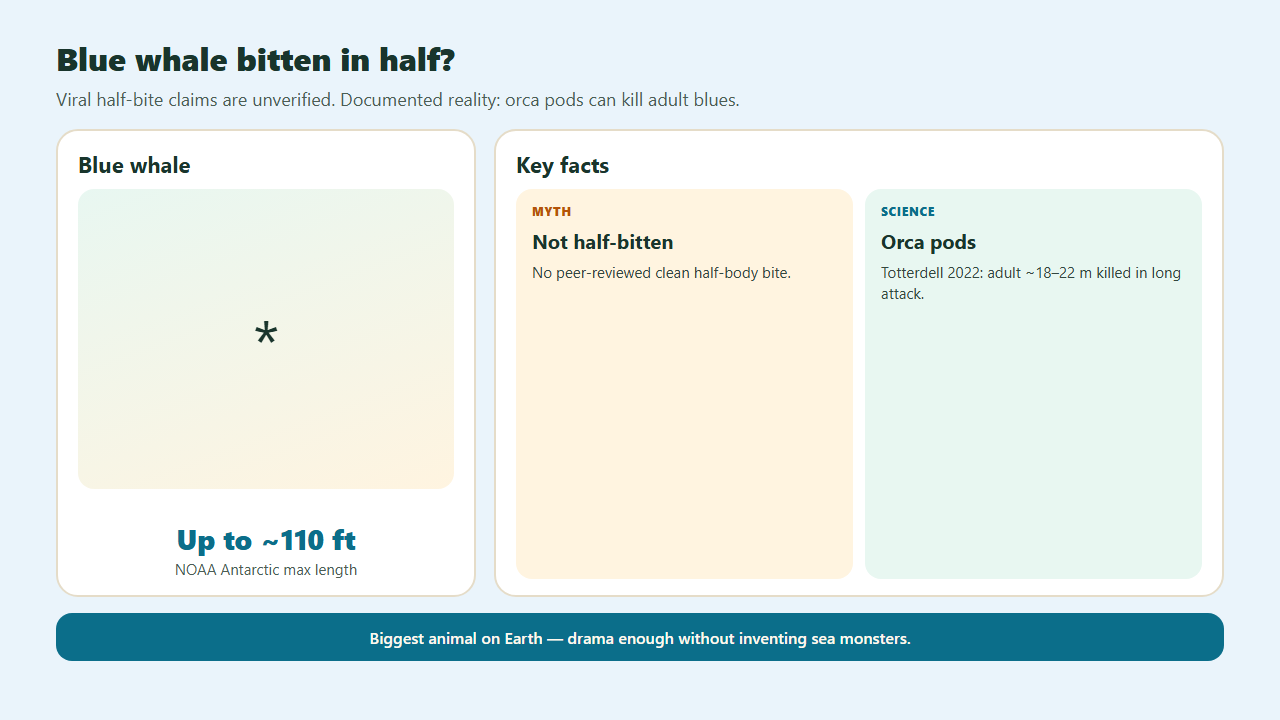
Viral posts claim a blue whale was “bitten in half.” That headline is not backed by marine-science records of a single clean half-bite. What is documented: blue whales are enormous, and killer whale pods have been observed killing adult blue whales through long, cooperative attacks — not one bite that severs the body.
Quick answer
There is no peer-reviewed record of a living blue whale being bitten cleanly in half by a shark, “mystery predator,” or single bite. Viral photo stories often recycle unverified carcass claims.
Blue whales are the largest animals on Earth. NOAA Fisheries lists lengths up to about 90 feet in some oceans and up to about 110 feet for Antarctic blue whales, with weights up to about 330,000 pounds (NOAA).
Killer whales (orcas) are documented predators capable of killing adult blue whales. Totterdell et al. (2022) describe three successful attacks off Western Australia, including a healthy adult estimated at 18–22 m (~59–72 ft) killed by a coordinated pod — injuries and drowning tactics, not a single half-body bite (Marine Mammal Science).
Where the “Bitten in Half” Story Comes From
Social posts and clickbait pages have circulated images of large marine carcasses with captions saying a blue whale was bitten in two. Details (year, place, species) often conflict, and the posts rarely cite a museum, stranding network or paper.
Treat those posts as unverified. They do not meet the standard we use elsewhere on this site: a named study or agency record you can open and check.
Viral claim vs published science
| Claim | What sources support |
|---|---|
| Bitten cleanly in half by one predator | No verified scientific case |
| Unknown giant sea monster | Unsupported |
| Orcas never kill adult blues | False — Totterdell et al. 2022 documents adult kill |
| Attack = prolonged pod hunt | Supported (ramming, drowning, feeding on tongue/blubber) |
How Big Is a Blue Whale?
NOAA Fisheries describes blue whales as the largest animals on Earth, with Antarctic animals reaching about 110 feet and more than 330,000 pounds, while North Atlantic and North Pacific animals can reach about 90 feet and over 100,000 pounds (NOAA).
That scale alone makes a single “clean half-body bite” from a shark biologically implausible as a routine event — even large white sharks are tiny beside an adult blue whale.
Blue whale size (NOAA Fisheries)
| Measure | NOAA figure |
|---|---|
| Length (N. Atlantic / N. Pacific examples) | Up to about 90 feet |
| Length (Antarctic) | Up to about 110 feet |
| Weight | Up to about 330,000 pounds |
| Lifespan (estimate) | Around 80–90 years |
What Actually Predates Blue Whales?
Killer whales are the predators with published, filmed evidence of killing blue whales. In March 2019 off Bremer Bay, Western Australia, researchers watched 12–14 orcas attack a blue whale estimated 18–22 m long. The whale had severe facial and dorsal wounds; orcas rammed its flank and fed on the tongue before it died after a prolonged fight (Totterdell et al.).
The same paper reports two further successful attacks on a calf (2019) and a juvenile (2021) in the same region. Science News summarizes the adult attack and notes orcas target fins, tail and jaw and may hold the head underwater (Science News).
That is predation by a pod over time, not a movie-style half-body chomp. The science is dramatic enough without inventing a mystery biter.
Frequently asked questions
Was a blue whale bitten in half?+
There is no verified scientific case of a blue whale being bitten cleanly in half. Viral posts are unreliable.
Can anything kill a blue whale?+
Yes. Coordinated killer whale pods have been documented killing adult and young blue whales off Western Australia (Totterdell et al., 2022).
Could a great white shark bite a blue whale in half?+
No credible evidence supports that. Adult blue whales dwarf even the largest sharks.
How long is a blue whale?+
NOAA lists up to about 90 feet in some oceans and up to about 110 feet for Antarctic blue whales.
How This Guide Was Prepared
Written from NOAA Fisheries blue whale facts and Totterdell et al. (2022) in Marine Mammal Science, with Science News used only as secondary coverage of that paper.
Last reviewed against sources: November 2026.
Related wildlife questions
Sources
Agency and peer-reviewed sources used in this guide:
Identify animals & explore guides
Curious about ocean giants or other wildlife myths? Browse more guides or try the photo identifier.