Is Chicken and Rice Good for Dogs? Ratio, How Long to Feed It, and When to See a Vet
Plain chicken and rice is the classic home remedy for a dog with an upset stomach — and veterinarians do sometimes recommend it. Here is when it helps, the ratio and preparation vets describe, how long to feed it, and why it should never become your dog’s everyday diet.
Quick answer
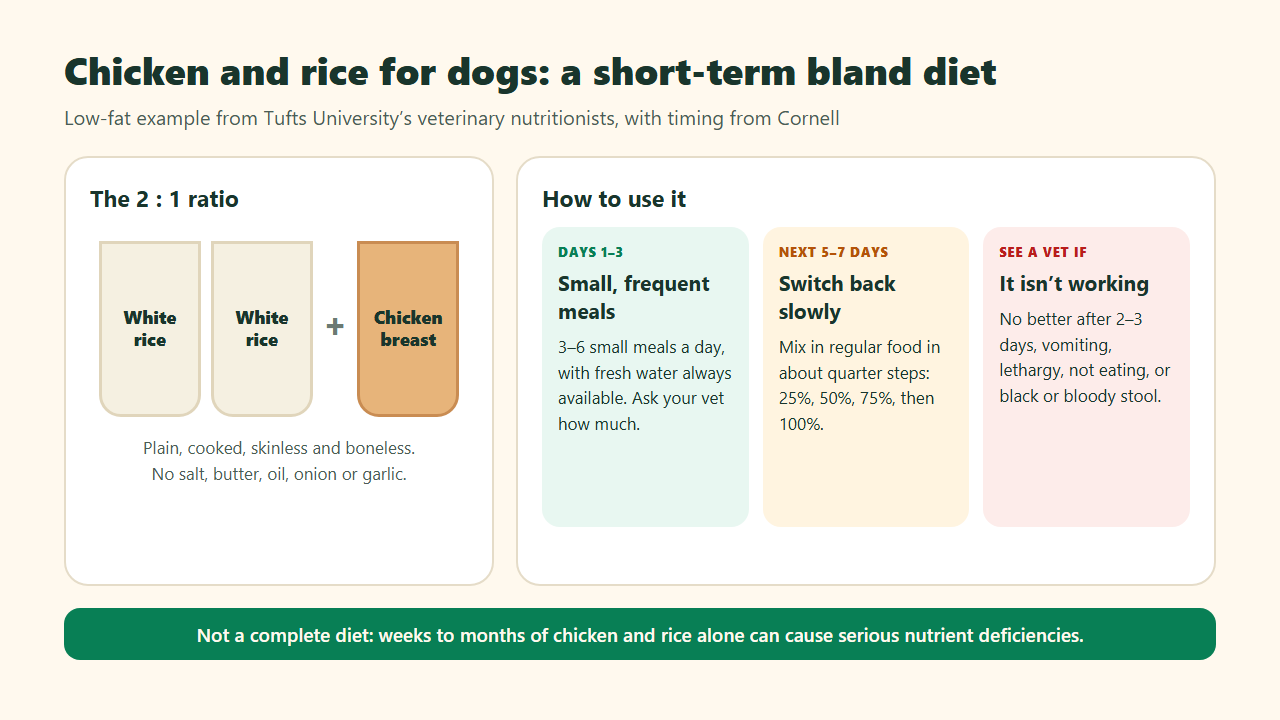
Yes — for a few days, if your veterinarian agrees. Plain cooked chicken breast and white rice is easy to digest and is a common short-term bland diet for mild diarrhoea or stomach upset (Cornell).
A low-fat example from Tufts University’s veterinary nutritionists is 2 parts cooked white rice to 1 part cooked skinless, boneless chicken or turkey breast, with no seasoning, butter or oil (Tufts). Feed small meals several times a day, then switch back to your dog’s regular food gradually.
It is not a complete diet. Tufts notes that a day or two will not cause deficiencies, but feeding it for weeks to months can cause serious harm. If your dog still has diarrhoea after 2–3 days on a bland diet, or is vomiting, lethargic or not eating, see a veterinarian.
When Is Chicken and Rice Good for Dogs?
Veterinarians use the word “bland” to mean a simple, easily digestible, usually low-fat diet that gives the gut a rest. Cornell’s veterinary college says mild diarrhoea in an otherwise bright, happy dog can often be managed at home with a bland diet such as boiled chicken or low-fat hamburger and white rice. Cooked pasta is another option.
Tufts stresses that “bland” can mean different things and that your veterinarian may instead recommend a therapeutic gastrointestinal diet — a complete, easily digestible food designed for upset stomachs (Tufts). Cornell notes that most cases of acute diarrhoea seen by vets are treated with this kind of prescription GI diet.
- Good fit: a short bout of mild diarrhoea or a single upset after eating something unusual, in an adult dog that is otherwise alert, drinking and keen to eat.
- Ask your vet first: puppies, senior dogs, dogs with diabetes, kidney, liver or pancreatic disease, or known chicken or rice allergies.
- Not a home fix: repeated vomiting, black or bloody stool, lethargy, refusal to eat, or a dog that may have swallowed something toxic or an object.
Chicken and Rice Ratio for Dogs (and How to Make It)
The most widely cited example comes from Tufts University’s board-certified veterinary nutritionists: cooked white rice and cooked chicken or turkey breast in a 2:1 ratio — for example, 2 cups (about 300 g) of rice to 1 cup (about 150 g) of chopped chicken (Tufts).
Tufts low-fat bland diet example (short-term use only)
| Ingredient | Amount in example batch | How to prepare |
|---|---|---|
| Cooked white rice | 2 cups (about 300 g) | Plain, cooked in water — no salt, butter or oil |
| Cooked chicken or turkey breast | 1 cup chopped (about 150 g) | Baked or boiled; skin and bones removed; no seasoning |
| Ratio | 2 parts rice : 1 part meat | Mix evenly before serving |
Step-by-step
- Cook the chicken breast by boiling or baking it until it is cooked through. Do not add oil, butter, salt or seasoning.
- Remove all skin and bones, then chop or shred the meat into small pieces.
- Cook plain white rice in water until soft.
- Mix two parts rice with one part chicken by volume.
- Cool before serving, and refrigerate leftovers promptly in a covered container (AVMA).
What to leave out
Skip onion, garlic and seasoned stock — onions and garlic can damage a dog’s red blood cells (ASPCA), so check the label of any stock or broth. Tufts also warns that other meats, such as ground beef, can be high in fat however they are cooked, which may worsen an upset stomach.
How Much Chicken and Rice Should I Feed My Dog?
There is no single correct amount — it depends on your dog’s size, normal intake and how unwell they are, so ask your veterinarian for a daily amount. What clinical guidance does agree on is how to feed it:
- Small, frequent meals. The Purina Institute’s clinical guidance suggests 3 to 6 small meals a day, which helps limit vomiting and diarrhoea and improves absorption.
- Start small, then build up. If your dog keeps small amounts down without vomiting or diarrhoea, increase the portion and reduce the number of meals over several days.
- Water first. Keep fresh water available at all times (Cornell). Dehydration is the most serious risk with diarrhoea and vomiting.
- No treats or rich food until the stool is back to normal.
How Long Should a Dog Eat Chicken and Rice?
Usually only a few days. Tufts notes that most pets with short bouts of vomiting or diarrhoea can go back to their regular food after a few days. Cornell advises seeing a veterinarian if a bland diet has not worked after 2–3 days, and seeking care if diarrhoea does not resolve within 48–72 hours.
Once the stool has firmed up, begin moving back to your dog’s normal complete food rather than continuing chicken and rice “just in case.”
How to Switch Back to Regular Dog Food
Changing food abruptly is itself a common cause of diarrhoea. The Purina Institute suggests a gradual return to the normal diet over 5 to 7 days once the underlying problem has resolved, and Cornell recommends spreading food changes out so the gut has time to adjust. A common approach is to replace the bland diet in roughly quarter steps, spending a day or two at each stage:
Example gradual switch back to regular food
| Stage | Bland diet | Regular food |
|---|---|---|
| Stage 1 | About 75% | About 25% |
| Stage 2 | About 50% | About 50% |
| Stage 3 | About 25% | About 75% |
| Stage 4 | 0% | 100% |
- If the stool softens again, go back one stage for a couple of days before moving on.
- If diarrhoea returns or persists, call your veterinarian rather than restarting chicken and rice indefinitely.
Can Dogs Eat Chicken and Rice Every Day?
Not as their whole diet. Tufts explains that chicken and rice alone is not complete and balanced — a day or two will not cause deficiencies, but feeding it for weeks to months “can cause serious harm.” Cornell likewise says bland diets of this kind are not safe to feed long-term because their nutritional profile is incomplete.
Dogs need more than 30 essential nutrients in the right amounts and forms. Plain chicken and rice is especially short of calcium and several vitamins, minerals and essential fatty acids, and simply adding vegetables does not fix this. A UC Davis study found that 95% of 200 published homemade recipes were deficient in at least one essential nutrient.
Small amounts of plain cooked chicken can still be a healthy topper or treat on a complete diet. If your dog needs home-cooked meals long-term, Tufts recommends a recipe created by a board-certified veterinary nutritionist. Our veterinarian warning about homemade dog food explains the risks in more detail.
When to See a Vet Instead of Feeding Chicken and Rice
Cornell advises veterinary care when:
- A bland diet has not helped after 2–3 days, or diarrhoea lasts beyond 48–72 hours.
- The stool is black or tarry, or contains fresh blood.
- Your dog is vomiting as well as having diarrhoea.
- Your dog stops eating or is lethargic.
- You suspect your dog has eaten something toxic or swallowed an object — see our list of 25 human foods that are bad for dogs.
Common Chicken and Rice Mistakes
- Feeding it for weeks because it “settles the stomach,” without a balanced recipe.
- Using fatty cuts, chicken skin, ground beef or meat cooked in oil or butter.
- Adding seasoning, onion, garlic or store-bought stock.
- Leaving bones in — cooked bones can splinter and cause injury or blockage.
- Switching straight back to regular food instead of transitioning gradually.
- Giving human medicines such as Pepto-Bismol or Imodium without veterinary advice.
- Withholding water. Fresh water should always be available.
Frequently asked questions
What is the right chicken and rice ratio for dogs?+
Tufts University’s veterinary nutritionists give a low-fat example of 2 parts cooked white rice to 1 part cooked, skinless, boneless chicken or turkey breast — for example, 2 cups of rice to 1 cup of chopped chicken. Use it short-term and only if your veterinarian agrees.
How long can a dog eat chicken and rice?+
Usually a few days. Most dogs with a short bout of stomach upset can return to their regular food after that, switching back gradually. Cornell advises seeing a veterinarian if a bland diet has not helped after 2–3 days. It should not be fed for weeks or months.
Is chicken and rice good for dogs with diarrhea?+
It can help mild diarrhoea in an otherwise healthy, alert adult dog because it is easy to digest. See a vet instead if your dog is also vomiting, lethargic, not eating, or has black or bloody stool, or if diarrhoea lasts more than 48–72 hours.
Can I use brown rice instead of white rice?+
The bland-diet examples from Tufts and Cornell use white rice, which is easy to digest. Brown rice contains more fibre, so ask your veterinarian before swapping it in for a dog with an upset stomach.
Can dogs eat chicken and rice every day?+
Not as their complete diet. Chicken and rice alone lacks calcium and several vitamins, minerals and essential fatty acids, and Tufts warns that weeks to months of it can cause serious harm. A little plain cooked chicken as a topper on a complete diet is fine for most dogs.
Can I add chicken broth or seasoning?+
No seasoning, butter or oil. Avoid store-bought broth unless you are sure it contains no onion, garlic or added salt, because onion and garlic can damage dogs’ red blood cells.
Can puppies eat chicken and rice?+
Check with your veterinarian first. Puppies have different nutritional needs from adult dogs, and some causes of puppy diarrhoea, such as parvovirus, are serious. Your vet may prefer a complete therapeutic gastrointestinal diet instead.
Should I stop feeding my dog before starting chicken and rice?+
Cornell mentions that some vets start by withholding food for 12–24 hours before introducing a bland diet, but this is not right for every dog. Ask your veterinarian first, and never withhold water.
How This Guide Was Prepared
This guide was researched and written by the AnimalIDFinder editorial team using published guidance from Tufts University’s Cummings School of Veterinary Medicine, Cornell University’s College of Veterinary Medicine, the AVMA, ASPCA Animal Poison Control and clinical nutrition references, all linked below. It has not been individually reviewed by a veterinarian and does not replace advice for your own dog.
We do not give per-weight portion sizes because the right amount depends on the individual dog; your veterinarian can advise. Last reviewed against sources: October 2026.
Related dog guides
Sources
Veterinary school and clinical nutrition references used in this guide. Always confirm diet changes with a licensed veterinarian:
- Tufts Petfoodology (Cummings School of Veterinary Medicine) — Does my pet need a “bland diet”?
- Cornell University College of Veterinary Medicine — Diarrhea in dogs
- Cornell University College of Veterinary Medicine — Re-evaluating your dog’s diet
- Purina Institute — Canine acute gastroenteritis / gastroenteropathy (therapeutic nutrition)
- ASPCA Animal Poison Control — People foods to avoid feeding your pets
- AVMA — Safe handling of pet food and pet treats
- UC Davis — Homemade dog food recipes can be risky business, study finds (2013)
Explore more dog guides
Nutrition guides are educational only. Browse related dog articles, calculators and the photo identifier, or return to the guides hub.



