Veterinarian Warning About Homemade Dog Food: Risks, Deficiencies, and Safer Choices
A meal can look fresh and wholesome without supplying every nutrient a dog needs. Here is what veterinarians actually warn about, what the research shows, why chicken and rice is a short-term fix, and how to feed home-cooked food safely.
Quick answer
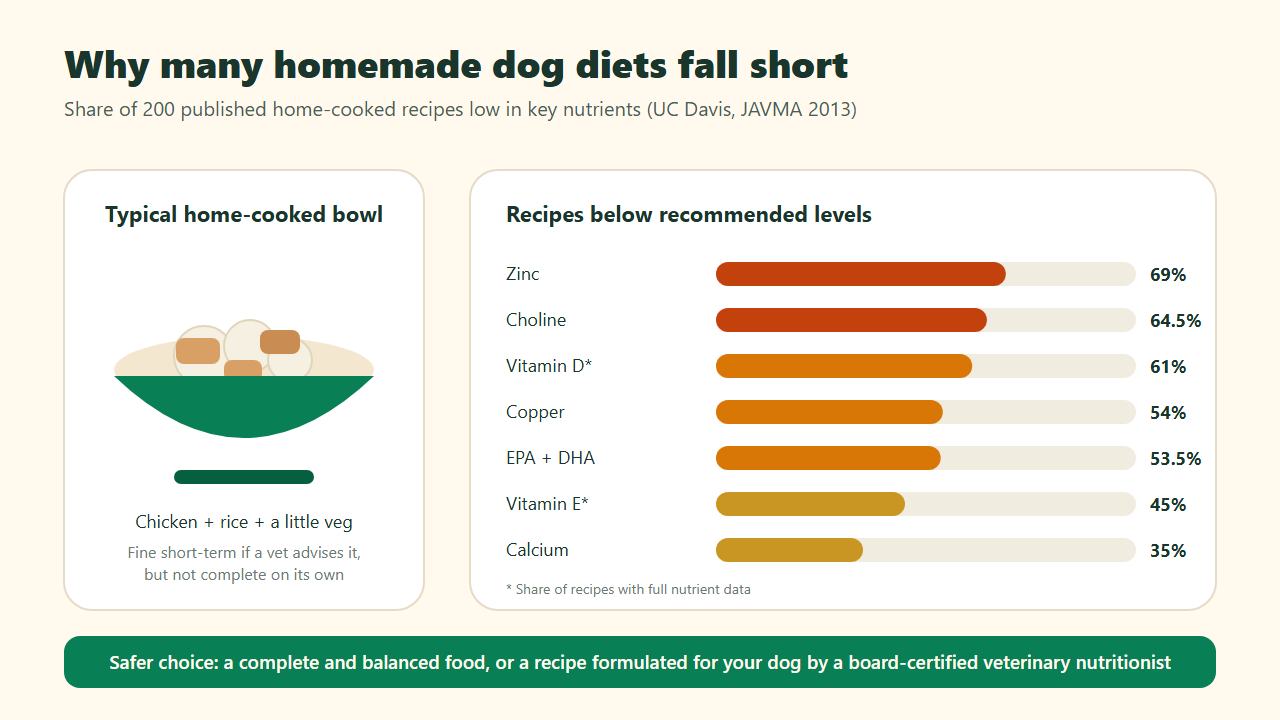
The veterinarian warning about homemade dog food is not “never cook for your dog.” It is that most home-prepared diets are not nutritionally complete. In a 2025 study of 1,726 home-prepared diets, only 6% were potentially complete for adult dogs, and a 2013 UC Davis analysis of 200 recipes found that 95% were short of at least one essential nutrient.
Common gaps include calcium, zinc, copper, choline, vitamin D, vitamin E and omega-3 fatty acids. Chicken and rice is useful as a short-term bland diet for an upset stomach, but Cornell’s veterinary college says it is not safe to feed long-term.
If you want to cook for your dog, use a recipe formulated for your dog by a board-certified veterinary nutritionist (or a nutritionist-built tool), include the exact supplements it specifies, and follow it precisely. Otherwise, a commercial food labelled complete and balanced for your dog’s life stage is the simpler safe choice.
What Do Veterinarians Warn About With Homemade Dog Food?
Home cooking for dogs has grown popular because owners want fresh ingredients, more control, or a way to tempt a picky eater. Veterinarians understand those reasons. Their warning is narrower and more practical: a diet has to supply 30-plus essential nutrients in the right amounts and ratios, and most home recipes do not.
Veterinary concerns fall into four groups:
What the research found
| Study | What was assessed | Key finding |
|---|---|---|
| Dog Aging Project, Am J Vet Res (2025) | 1,726 home-prepared diets described by owners; ingredients entered into a nutritionist-designed formulation tool | Only 6% were potentially complete for adult maintenance (AAFCO). Amounts were not reported, so the true share may be lower. |
| UC Davis, JAVMA (2013) | 200 published recipes from 34 sources (books, websites, veterinary texts) | 95% were deficient in at least one essential nutrient; 83.5% in several. Only 9 met AAFCO adult minimums. |
| UC Davis, JAVMA (2013) | Clarity of the same recipes | 92% had vague or incomplete instructions; 85% gave no calorie information or intended dog size. |
| Tufts Clinical Nutrition Service (2015, cited by Tufts) | Owners given a nutritionist-formulated recipe, about a year later | Only 13% were still feeding the original balanced recipe exactly. |
- Deficiencies — recipes that leave out nutrients dogs cannot make themselves, such as calcium, zinc, certain vitamins and essential fatty acids.
- Excesses and imbalances — too much of one nutrient (for example from a random supplement) or the wrong ratio between nutrients, such as calcium to phosphorus.
- Food safety — raw or undercooked meat, poor kitchen hygiene, and ingredients that are toxic to dogs.
- Consistency — even a well-designed recipe stops being balanced when ingredients, oils or supplements are swapped over time.
What the 2025 study actually measured
The Dog Aging Project study, published in the American Journal of Veterinary Research, reviewed 1,726 home-prepared diets that owners described in free text. Meat (90%) and vegetables (65%) were the most common ingredients, and 45% of owners mixed in some commercial food or topper. Researchers entered each ingredient list into a formulation tool designed by veterinary nutritionists; only 6% of diets had the potential to be complete under AAFCO adult maintenance standards.
The study did not laboratory-test the finished meals, and owners did not report exact amounts. As one of the researchers told Texas A&M, that means the true share of complete diets could be even lower than 6%.
Are veterinarians against homemade dog food?
No. University nutrition services — including Cornell’s — formulate home-prepared diets for dogs every day, especially for dogs with medical conditions or food intolerances. The concern is feeding an unbalanced recipe long-term, not cooking at home itself.
Why fresh ingredients do not guarantee complete nutrition
Ingredient quality and nutritional adequacy are different things. Fresh chicken, rice and carrots are wholesome foods, but together they still lack meaningful amounts of several nutrients dogs need daily. Tufts University’s nutritionists note that it is “nearly impossible” to meet every requirement from whole foods alone, without concentrated vitamin and mineral supplements matched to the recipe.
When homemade dog food may be appropriate
A home-prepared diet can be a reasonable choice when it is formulated for that specific dog — for example when no commercial diet suits a medical condition, when a dog refuses commercial foods, or when an owner strongly prefers fresh food and is willing to follow a recipe exactly. In each case, the recipe should come from a board-certified veterinary nutritionist or a tool they have built, and your regular veterinarian should know what your dog eats.
Nutritional Deficiencies in Homemade Dog Food
Three different problems hide under “unbalanced diet”: a deficiency (too little of a nutrient), an excess (too much), and an imbalance (amounts that look fine individually but are wrong relative to each other). The UC Davis recipe study found the same gaps repeating across many recipes, which is why rotating between several unbalanced recipes does not fix the problem.
Nutrients most often short in homemade recipes
| Nutrient | Why dogs need it | How often it was low (UC Davis, 200 recipes) |
|---|---|---|
| Zinc | Skin and coat health, immune function, wound healing | 69% of recipes |
| Choline | Liver fat metabolism, nerve and cell-membrane function | 64.5% of recipes |
| Copper | Red blood cell formation, connective tissue, pigment | 54% of recipes |
| EPA + DHA (omega-3) | Skin, joints, brain and eye development | 53.5% of recipes |
| Calcium | Bone and tooth strength; must be balanced with phosphorus | 35% of recipes |
| Vitamin D | Calcium absorption and bone mineralisation | 61% of recipes with full data |
| Vitamin E | Antioxidant protection of cells and fats | 45% of recipes with full data |
Calcium deficiency and the calcium-to-phosphorus ratio
Meat is rich in phosphorus but very low in calcium. Without a measured calcium source, a meat-heavy diet tips the ratio the wrong way. Cornell nutritionist Dr. Joseph Wakshlag describes calcium as “the most egregious deficiency” in home-prepared diets, one that can lead to pathologic fractures in puppies and weakened bones in adults (Cornell).
Growing puppies are the most vulnerable because their skeletons are developing quickly — and too much calcium can be harmful to them as well, particularly in large-breed puppies. That is why calcium has to be measured for the recipe, not guessed.
Vitamin and mineral deficiencies
Depending on the recipe, home-cooked diets can fall short in zinc, copper, iodine, selenium, magnesium, vitamin B12, vitamin D, vitamin E and choline. The UC Davis team warned that shortfalls in choline, vitamin D, zinc and vitamin E in particular “could result in significant health problems such as immune dysfunction, accumulation of fat in the liver and musculoskeletal abnormalities.”
Essential fatty acids and amino acids
Plenty of protein does not guarantee the right balance of essential amino acids, and a diet can contain fat yet lack essential fatty acids such as linoleic acid and the omega-3s EPA and DHA. The type of oil matters: Texas A&M’s nutritionists point out that simply switching oils can change whether a recipe is complete.
Why dogs can develop problems even when they appear healthy
Many deficiencies develop slowly. A dog can eat eagerly, keep a glossy coat and seem energetic for months while body stores are being used up. By the time signs appear — poor growth, skin problems, weakness or bone changes — the deficiency may have been present for a long time. A good appetite is not proof of a complete diet.
What can happen if deficiencies continue?
Effects depend on which nutrients are missing, by how much, and the dog’s age. Possible consequences include weak or fracture-prone bones, poor growth in puppies, skin and coat problems, reduced immune function, muscle weakness and fatty liver changes. Not every deficient diet causes every problem — but the risk rises the longer an unbalanced diet is fed.
Is Homemade Chicken and Rice Dog Food Safe Every Day?
Chicken and rice is probably the most common homemade dog meal — and the one veterinarians most often have to correct. It is safe and helpful for a few days; it is not a complete diet for weeks or months. Our guide is chicken and rice good for dogs? covers the ratio, portions and how to switch back.
Why veterinarians sometimes recommend chicken and rice temporarily
For mild diarrhoea or stomach upset, a veterinarian may suggest a short bland diet of boiled, skinless chicken or lean meat with white rice. These foods are easy to digest and give the gut a rest (Cornell). Tufts gives a common short-term example of about two parts cooked white rice to one part cooked chicken breast — but only when your veterinarian agrees it suits your dog (Tufts).
Why chicken and rice is not a complete long-term diet
Plain chicken and rice is low in calcium and lacks adequate amounts of several vitamins, minerals and essential fatty acids. Cornell states that bland diets like this “are not safe to feed long-term because they have an incomplete nutritional profile.” Tufts adds that a day or two will not cause deficiencies, but feeding it for weeks to months “can cause serious harm.”
Can dogs eat cooked chicken every day?
Plain, boneless, thoroughly cooked chicken can be part of many dogs’ daily food — for example as a small topper on a complete commercial diet, or as one ingredient in a properly formulated recipe. Chicken alone is not a complete diet. If chicken becomes a large share of daily calories, the rest of the diet has to make up what it lacks.
Can I feed my dog chicken, rice and vegetables every day?
Adding vegetables makes the bowl look more balanced, but it does not correct the main gaps. Vegetables supply some vitamins and fibre, yet not enough calcium, zinc, vitamin D, choline or omega-3s to fix a chicken-and-rice base. For daily, long-term feeding, use a recipe formulated with the specific supplements your dog needs.
Cooked vs. raw chicken for dogs
The AVMA discourages feeding raw or undercooked animal-source protein to dogs because it can carry Salmonella, Campylobacter, Listeria, E. coli and other pathogens. Dogs that look healthy can still shed these bacteria and infect people — especially young children, older adults, pregnant people and anyone with a weakened immune system. Cooking chicken thoroughly reduces that risk, but it does not make the recipe nutritionally complete.
What if my dog has been eating chicken and rice for weeks or months?
Do not panic, and do not switch foods overnight. Book a veterinary appointment, bring a written description of exactly what your dog has been eating, and ask about a gradual transition to a complete diet. If your dog needed a bland diet because of repeated digestive upsets, Cornell notes that parasites, food intolerance, pancreatitis and other conditions may be involved — so the cause is worth investigating.
Human Foods That Can Be Dangerous for Dogs
Toxic foods are a different issue from incomplete diets, but they matter whenever you cook for a dog. The foods below are drawn from ASPCA Animal Poison Control and U.S. FDA guidance. How dangerous each one is depends on the amount eaten, the size of the dog, and — for some foods — individual sensitivity. For the full list with hidden sources and warning signs, see 25 human foods that are bad for dogs.
Common human foods that can harm dogs
| Food | Main concern |
|---|---|
| Grapes and raisins | Can cause kidney damage or kidney failure |
| Xylitol (sugar-free gum, candy, baked goods, some peanut butters and toothpaste) | Low blood sugar and possible liver damage |
| Chocolate, coffee and caffeine | Methylxanthines can cause vomiting, hyperactivity, abnormal heart rhythm, tremors and seizures |
| Onions, garlic, chives and leeks | Red blood cell damage that can lead to anaemia |
| Macadamia nuts | Weakness, vomiting, tremors and overheating |
| Alcohol | Vomiting, incoordination, breathing difficulty; can be fatal |
| Raw yeast bread dough | Rises in the stomach and traps gas; risk of painful, potentially life-threatening bloat |
| Very salty foods | Thirst, vomiting, diarrhoea; tremors or seizures in severe cases |
| Fatty foods and trimmings | Stomach upset; can contribute to pancreatitis |
| Cooked bones, corn cobs, fruit pits | Choking, splintering, or intestinal blockage |
Foods that can be toxic
Grapes and raisins, xylitol, chocolate and caffeine, onions and garlic, macadamia nuts and alcohol can poison dogs. Watch for hidden sources: xylitol in sugar-free products and some peanut butters, onion or garlic powder in broths, gravies and seasoned leftovers, and raisins in baked goods.
Foods that can cause illness or physical injury
Raw yeast dough can expand in the stomach. Very fatty or salty foods can cause digestive upset and, with fat, may contribute to pancreatitis. Cooked bones can splinter, and corn cobs and fruit pits can lodge in the throat or intestines.
Safe foods still need preparation and portion control
Many plain foods — cooked lean meat, plain rice, carrots, green beans, apple slices without seeds — are fine in small amounts. Serve them unseasoned, remove seeds, cores and pits, and keep treats and toppers to a small share of daily calories so they do not unbalance the main diet.
What Is a Vet-Approved Homemade Dog Food Recipe?
“Vet-approved” is used loosely online. A recipe is only meaningfully vet-approved when it has been formulated or reviewed by a qualified veterinary nutrition professional for a defined dog and life stage, using nutrient-analysis software — not simply because it contains chicken, rice, vegetables or a supplement.
What makes a homemade recipe complete and balanced?
Formulation starts from the dog’s energy needs (based on weight, age, activity and body condition), then balances protein and essential amino acids, fat and essential fatty acids, and roughly 40 vitamins and minerals against standards such as the AAFCO nutrient profiles. Puppies, pregnant and nursing dogs, seniors and dogs with disease all have different targets.
Why generic internet recipes can be misleading
Tufts nutritionists list common red flags: recipes that let you swap meats freely (“2 cups of chicken or beef or lamb”), recipes with no vitamin and mineral supplement, and vague instructions such as “add a human multivitamin” (Tufts). The UC Davis study found that even most recipes written by veterinarians had at least one deficiency; the four written by board-certified veterinary nutritionists were all adequate.
What a professionally formulated recipe should include
A trustworthy recipe gives you:
- Exact ingredients and weights in grams (not cups or “handfuls”), including the specific cut of meat.
- How each ingredient is prepared and cooked — boiled, baked, with or without skin.
- The dog it was designed for: life stage, target weight, and any health considerations.
- The specific vitamin, mineral and fatty-acid supplements, by product and amount.
- Daily feeding amount and calories, plus storage instructions.
- Clear guidance to follow the recipe exactly and when to have it reviewed.
Why you should not substitute ingredients casually
Swapping chicken thigh for breast, sweet potato for white potato, or one oil for another changes calories and nutrients — sometimes dramatically. Leaving out the supplement because the dog “seems fine” removes the very nutrients the recipe was built around. Texas A&M’s Dr. Katie Tolbert puts it simply: “Nothing is considered a ‘filler’ that you can leave out.”
Why this guide does not include a recipe
A single published recipe cannot be complete and balanced for every dog — calorie needs, life stage and health differ too much. Rather than offer a recipe that might be fed long-term without the right supplements, we point you to sources that formulate recipes for your individual dog (see the next two sections).
Can Balance It Help You Make Balanced Homemade Dog Food?
Owners searching for homemade dog food often come across Balance It. It is worth understanding what it is — and what it is not.
What is Balance It?
Balance It is a US company founded by Dr. Sean Delaney, a board-certified veterinary nutritionist (DACVIM, Nutrition) and former clinical nutrition faculty member at UC Davis (Balance It). It offers a free online recipe builder for healthy adult dogs and puppies, and sells vitamin-mineral supplements designed to complete home-cooked recipes. For pets with medical conditions, the company requires veterinary approval before showing a complete recipe.
In the 2025 Dog Aging Project study, researchers used Balance It to check whether owners’ diets could be complete. Tufts’ nutrition team also lists it as “one good resource” for owners of healthy dogs who want to home-cook.
Does adding a vitamin and mineral supplement make any recipe complete?
No. A supplement has to match the specific recipe and the specific dog. Sprinkling a generic pet multivitamin or calcium powder onto an unbalanced meal can leave some nutrients short and push others too high. Tufts notes that a home-cooked diet may need a dedicated veterinary supplement — or several human supplements — chosen for that recipe.
How to use a formulation tool responsibly
Enter your dog’s details accurately, use the exact ingredients the tool lists, weigh portions, include the supplement in the specified amount, and do not change the recipe without re-running it. Tell your veterinarian what you are feeding, and bring the recipe to check-ups.
When to consult a board-certified veterinary nutritionist
Seek an individual consultation for puppies, pregnant or nursing dogs, and any dog with a medical condition such as kidney, liver, gut or skin disease, diabetes or food allergies. The American College of Veterinary Internal Medicine (ACVIM) certifies veterinary nutrition specialists in North America, and many offer remote consultations through your veterinarian. If your dog is pregnant, see also our guide to how long dogs are pregnant.
What Do AVMA, Cornell and AAHA Say About Homemade Dog Food?
Major veterinary organisations agree on the core message: home-prepared diets can work, but they must be professionally formulated, complete, and handled safely. None of them endorses a particular homemade recipe or commercial tool.
American Veterinary Medical Association (AVMA)
The AVMA’s guidance focuses on food safety. Its policy on raw diets discourages feeding raw or undercooked meat, poultry, fish, eggs and unpasteurised milk to dogs, and its safe-handling advice covers handwashing, cleaning bowls, and refrigerating leftovers promptly.
Cornell University College of Veterinary Medicine
Cornell’s “Re-evaluating your dog’s diet” lists over-reliance on chicken and rice among the most common feeding mistakes, and recommends either a commercial diet certified as complete and balanced for the dog’s life stage, or working with a board-certified veterinary nutritionist on a home-prepared plan.
American Animal Hospital Association (AAHA)
The 2021 AAHA Nutrition and Weight Management Guidelines state that most recipes in books and on websites — “even those written by veterinarians” — do not provide complete and balanced nutrition. AAHA recommends a consultation with a board-certified veterinary nutritionist, following the recipe exactly as written, and updating it annually because supplements change.
Where to find Cornell University dog food recipes
Cornell does not publish one-size-fits-all recipes. Its Clinical Nutrition Service formulates complete home-prepared diets for individual dogs, usually through a referral from your veterinarian with medical records. A recipe designed for one dog’s kidney disease or allergy may be wrong for a healthy dog — or a dog with a different diagnosis.
How to judge a dog nutrition source
Prioritise university veterinary hospitals, board-certified veterinary nutritionists, peer-reviewed studies and recognised veterinary organisations. Be cautious with anonymous social-media recipes, sites selling a single product as a cure-all, and any recipe that does not say who formulated it or for which dog.
Is Poor Nutrition a “Silent Killer” for Dogs? Warning Signs to Watch
“Silent killer” is an informal phrase, not a veterinary diagnosis. It is often used for conditions whose early signs are subtle. Homemade food is not itself a silent killer — but a long-term unbalanced diet can cause problems that develop quietly, which is why regular veterinary check-ups matter.
Signs that deserve a veterinary visit
Book an appointment if you notice ongoing vomiting or diarrhoea, unexplained weight loss or gain, poor growth in a puppy, a dull or flaky coat, hair loss, reduced energy, reluctance to walk, limping, or changes in appetite. These signs have many possible causes, so they cannot confirm a nutritional problem on their own — but they should be checked.
When to seek urgent care
Go to a veterinarian or emergency hospital immediately for collapse, seizures, breathing difficulty, severe weakness, repeated vomiting with a very unwell dog, a swollen hard abdomen, or any suspected poisoning.
How veterinarians assess a dog’s diet
Expect questions about exactly what, how much and how often your dog eats, plus a physical exam with body and muscle condition scoring. Blood or urine tests and imaging may be used when signs point to a specific problem. No single blood test can rule out every possible deficiency, which is why a detailed diet history is so important.
How to Feed Your Dog Safely if You Prefer Homemade Food
Cooking for your dog can work well when it is done carefully. These steps cover the essentials.
Choose a complete and balanced diet for your dog’s life stage
For commercial food, look for a nutritional adequacy statement that says the food is “complete and balanced” for your dog’s life stage, based on AAFCO nutrient profiles or AAFCO feeding trials (FDA). Foods labelled for “intermittent or supplemental feeding” are not meant to be the whole diet (WSAVA). For home cooking, get a recipe formulated for your dog.
Weigh ingredients and add supplements exactly
Use a kitchen scale in grams, cook ingredients the way the recipe says, and add the specified supplements every time. Write down the recipe and keep it with you — Tufts found that most owners drift from their recipe within a year, often without realising it.
Store and handle food safely
Wash your hands for at least 20 seconds after handling pet food, clean bowls and utensils with hot soapy water, and refrigerate leftovers promptly at 40°F (4°C) or below (AVMA). Freeze batch-cooked portions you will not use within a few days, and thaw them in the fridge.
Monitor weight and body condition
Weigh your dog regularly and ask your veterinarian to score body and muscle condition at check-ups. Adjust portions — not the recipe’s balance — if your dog gains or loses weight, and tell your vet about the change.
Review the recipe periodically
Have the recipe reviewed when your dog changes life stage, develops a health condition, or when a supplement product changes — AAHA suggests at least once a year.
The takeaway: homemade food can be a good option, but a nutritionally complete recipe matched to your individual dog matters far more than how fresh or how many ingredients go into the bowl.
Frequently asked questions
What do vets say about homemade dog food?+
Veterinarians generally say homemade dog food can be suitable when it is formulated to be complete and balanced for the individual dog, but most recipes found online or in books are not. Studies show the large majority of home-prepared diets miss at least one essential nutrient. A board-certified veterinary nutritionist can design a safe recipe.
Do vets recommend homemade dog food?+
Some veterinarians recommend home-prepared diets for selected dogs — for example dogs with medical conditions that no commercial diet suits, or dogs that refuse commercial food. They generally advise against relying on unverified recipes as a dog’s only long-term food.
Can I feed my dog chicken, rice and vegetables every day?+
Chicken, rice and suitable vegetables can be ingredients in a dog’s diet, but on their own they are not nutritionally complete. Fed daily for weeks or months without the right supplements, this combination can lead to calcium, vitamin, mineral and fatty acid deficiencies. Use a properly formulated recipe for long-term feeding.
What is a vet-approved homemade dog food recipe?+
It is a recipe formulated or reviewed by a qualified veterinary nutrition professional for a specific dog and life stage. It lists exact ingredient weights, preparation methods, named supplements and daily feeding amounts. A recipe that suits one dog may not suit another.
What is a silent killer for dogs?+
“Silent killer” is not a specific veterinary diagnosis; people use it for conditions with subtle early signs. Rather than worrying about one disease, watch for changes in appetite, weight, energy, coat or behaviour and see your veterinarian when something seems off. Regular check-ups help catch slow-developing problems early.
What nutritional deficiencies are common in homemade dog food?+
In the UC Davis study of 200 recipes, the nutrients most often too low were zinc, choline, copper, the omega-3s EPA and DHA, and calcium; vitamin D and vitamin E were also frequently short. Which nutrients are missing depends on the recipe, so a diet has to be evaluated as a whole.
Is homemade dog food healthier than commercial dog food?+
Not automatically. A properly formulated homemade diet can suit an individual dog well, and a commercial food labelled complete and balanced for the dog’s life stage is a convenient, reliable alternative. Judge a diet by its nutritional completeness and fit for your dog, not by whether it was made at home.
Can I use Balance It to make homemade dog food?+
Balance It, founded by a board-certified veterinary nutritionist, offers a free recipe builder for healthy dogs and sells supplements to complete its recipes. Follow the recipe and supplement instructions exactly, and involve your veterinarian — the company requires veterinary approval for dogs with medical conditions.
Is homemade dog food safe for puppies?+
It can be, but puppies have strict requirements for calcium, phosphorus and other nutrients, and mistakes can affect bone development — especially in large breeds. Tufts nutritionists advise against home-cooking for growing puppies unless a veterinary nutritionist formulates the diet. Talk to your veterinarian before replacing a complete puppy food.
How do I know if my dog’s homemade diet is balanced?+
You cannot tell from appearance, appetite or a list of healthy ingredients. Have the complete recipe — exact weights, cooking methods, supplements and daily amount — evaluated by a board-certified veterinary nutritionist or entered into a nutritionist-built formulation tool, and review it with your veterinarian.
How This Guide Was Prepared
This guide was researched and written by the AnimalIDFinder editorial team. It is based on peer-reviewed veterinary research and published guidance from university veterinary schools and professional veterinary organisations, all linked in the sources below. It has not been individually reviewed by a veterinarian, and it does not replace advice for your own dog.
Statistics are reported as the original authors described them, including their limitations. We will update this page when major new research or guidance is published. Last reviewed against sources: October 2026.
Related dog guides
Sources
Peer-reviewed studies and guidance from veterinary schools and organisations used in this guide. Always confirm diet decisions with a licensed veterinarian:
- O’Brien JS et al. (2025). Findings from the Dog Aging Project: home-prepared diets for companion dogs feature diverse ingredients, and few are nutritionally complete. American Journal of Veterinary Research.
- Texas A&M College of Veterinary Medicine — Most homemade dog diets are not nutritionally complete (2025)
- Stockman J, Fascetti AJ, Kass PH, Larsen JA (2013). Evaluation of recipes of home-prepared maintenance diets for dogs. Journal of the American Veterinary Medical Association 242(11).
- UC Davis — Homemade dog food recipes can be risky business, study finds
- Cornell University College of Veterinary Medicine — Re-evaluating your dog’s diet
- Cornell University College of Veterinary Medicine — Diarrhea (bland diets)
- Cornell University Hospital for Animals — Clinical Nutrition Service
- AAHA — 2021 Nutrition and Weight Management Guidelines: Home-prepared diets
- AVMA — Safe handling of pet food and pet treats
- AVMA policy — Raw or undercooked animal-source protein in dog and cat diets
- Tufts Petfoodology — Does my pet need a “bland diet”?
- Tufts Petfoodology — Should you make your own pet food at home?
- Tufts Petfoodology — Cooking up trouble: common home cooking mistakes
- U.S. FDA — “Complete and balanced” pet food
- U.S. FDA — Potentially dangerous items for your pet
- ASPCA Animal Poison Control — People foods to avoid feeding your pets
- WSAVA Global Nutrition Committee — Selecting a pet food for your pet (2021)
- Balance It — About us (founder credentials and recipe tool)
- American College of Veterinary Internal Medicine (ACVIM) — Resources for animal owners
Explore more dog guides
Nutrition guides are educational only. Browse related dog articles, calculators and the photo identifier, or return to the guides hub.