How to Choose a Complete and Balanced Dog Food
The front of a dog food bag is mostly marketing. The facts that matter are in small print on the back — and some are not on the label at all. Here is how veterinary nutritionists suggest choosing a food, step by step.
Quick answer
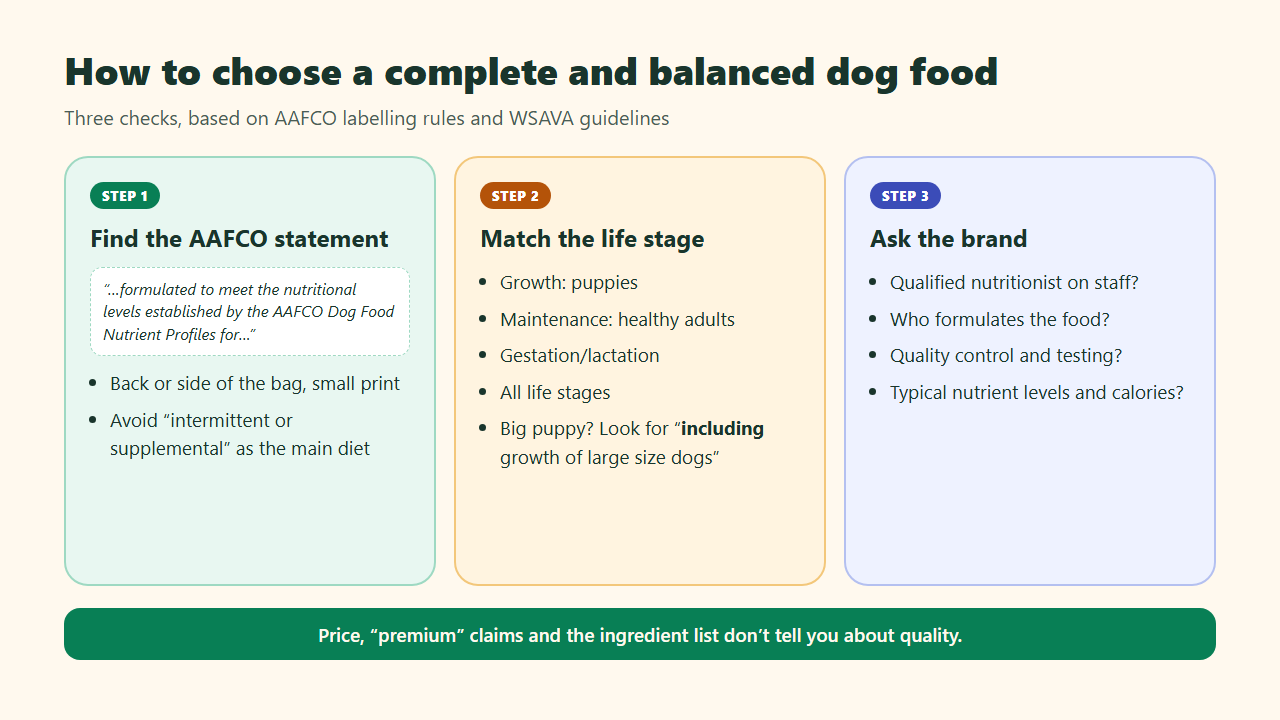
Look for the nutritional adequacy statement on the back or side of the bag. It should say the food is complete and balanced (or meets the AAFCO Dog Food Nutrient Profiles) for your dog’s life stage — growth, maintenance, gestation/lactation or all life stages (AAFCO). Foods labelled for “intermittent or supplemental feeding” are not meant to be the whole diet.
For a puppy expected to be large as an adult, choose a growth or all-life-stages food that says “including growth of large size dogs”, not “except for” (Tufts).
Then judge the company, not the ingredient list. The World Small Animal Veterinary Association suggests asking whether the brand employs a qualified nutritionist, who formulates the food, and what quality control it uses (WSAVA). Price and marketing terms like “premium” or “holistic” do not tell you about quality.
What “Complete and Balanced” Actually Means
In AAFCO’s definition, “complete” means the food contains all the nutrients a dog requires, and “balanced” means those nutrients are present in the correct ratios (AAFCO). A food that is complete and balanced for your dog’s life stage can be fed as the whole diet without added supplements.
In the US, AAFCO’s model pet food regulations are not federal law, but most states have adopted a version of them, so in practice they are the standard on American labels. European products are generally formulated against FEDIAF nutrient guidelines instead, and the WSAVA advice below applies to both (WSAVA).
Step 1: Find and Read the Nutritional Adequacy Statement
AAFCO calls the nutritional adequacy statement “perhaps the most important part of a label.” It is usually on the back or side of the package, in small print. Because the wording is standardised, there are only a few versions, which makes products easy to compare (AAFCO).
The nutritional adequacy statements you will see on dog food
| Wording on the label | What it means | Use as the main diet? |
|---|---|---|
| “…is formulated to meet the nutritional levels established by the AAFCO Dog Food Nutrient Profiles for [life stage]” | Formulated to meet AAFCO nutrient levels for that life stage | Yes, for the stated life stage |
| “Animal feeding tests using AAFCO procedures substantiate that … provides complete and balanced nutrition for [life stage]” | Passed a standardised AAFCO feeding trial for that life stage | Yes, for the stated life stage |
| “…provides complete and balanced nutrition for [life stage] and is comparable to a product which has been substantiated using AAFCO feeding tests” | A “family” product similar to one that passed a feeding trial; used less often | Yes, for the stated life stage |
| “This product is intended for intermittent or supplemental feeding only” | Does not meet complete-and-balanced standards; includes some veterinary diets | No — only as a small part of the diet, or under veterinary direction |
| “Snack” or “treat” on the front, with no adequacy statement | Treats are not required to be complete and balanced | No |
Feeding trial or formulation — does it matter?
A food can qualify by being formulated to meet AAFCO nutrient profiles, or by passing an AAFCO feeding trial. Tufts veterinary nutritionist Dr. Lisa Freeman describes feeding trials as ideal, but says a formulated food should be fine if the company also meets the other selection criteria in this guide (Tufts).
Step 2: Match the Life Stage to Your Dog
AAFCO recognises four life stages — gestation/lactation, growth, maintenance and all life stages — because dogs need different amounts and ratios of nutrients at different points in life (AAFCO). WSAVA notes that foods labelled for all life stages are formulated to meet the needs of reproduction and growth.
AAFCO life stages for dog food
| Life stage on the label | Suitable for |
|---|---|
| Growth | Puppies — check the large-size-dog wording if your puppy will be big |
| Maintenance | Healthy adult dogs only — not puppies or pregnant or nursing dogs |
| Gestation/lactation | Pregnant and nursing dogs |
| All life stages | Puppies, adults, and pregnant or nursing dogs — formulated to meet growth and reproduction needs |
What about “senior” dog food?
“Senior” is not one of AAFCO’s recognised life stages, so a senior food’s adequacy statement will usually say adult maintenance or all life stages. Ask your veterinarian whether your older dog needs a change at all — especially if they have a medical condition or weight problem.
Step 3: Extra Checks for Puppies and Large Breeds
Puppies need a diet that meets growth requirements until they are at least 1 year old, or about 18 months for giant breeds (Tufts). Foods for large-breed puppies are designed with lower calcium and are usually lower in calories than typical puppy foods.
AAFCO uses 70 lb as the large-breed cut-off, but Dr. Freeman suggests a more conservative 50 lb (about 23 kg): if your puppy is expected to weigh more than that as an adult, choose a food labelled “including growth of large size dogs.”
Step 4: Judge the Manufacturer, Not the Marketing
Tufts’ nutritionists point out that the information that matters most — the company’s nutritional expertise and quality control — is not on the label, and that the best foods are not necessarily the most expensive or the best marketed (Tufts). Their studies have even found nutritional deficiencies in foods labelled complete and balanced. The WSAVA guidelines list questions to ask a brand directly, by phone or email:
WSAVA checklist: questions to ask a dog food company
| Question | What a good answer looks like |
|---|---|
| Do you employ a qualified nutritionist? | A PhD in animal nutrition or board certification (ACVN or ECVCN), ideally full-time staff rather than a consultant |
| Who formulates your foods? | An experienced pet food formulator or board-certified nutritionist, not a breeder, trainer or owner |
| What quality control do you use? | Testing of ingredients and finished products, including nutrient analysis and safety screening |
| Is the food tested or analysed? | AAFCO feeding trials, or at least analysis of the finished product against AAFCO or FEDIAF profiles |
| Do you do research? | Studies, ideally published in peer-reviewed journals |
| Can you give me the typical level of a nutrient? | An average or typical analysis — not just the guaranteed minimums and maximums |
| Who makes the food? | “Made by” means the company manufactures it; “made for” or “distributed by” means a third party does |
If the company won’t answer
WSAVA advises that if a manufacturer cannot or will not provide this information, veterinarians and owners should be cautious about feeding that brand. The Pet Nutrition Alliance publishes a free report of manufacturers’ answers to questions based on the WSAVA criteria, which can save you some phone calls.
What the Label Can’t Tell You
- The ingredient list shows order, not quality. Ingredients are listed in descending order by weight, but amounts are not given (AAFCO). Tufts calls the ingredient list “one of the most useless aspects” of the label for judging quality, and notes it is often used for marketing.
- The guaranteed analysis gives limits, not actual levels. It lists minimum crude protein and fat and maximum fibre and moisture. Tufts calls these numbers “nearly useless” for comparing foods — ask the company for a typical analysis instead.
- Unregulated terms such as “premium” and “holistic” are designed to sell and have little practical value (WSAVA).
- Product names follow percentage rules. Under AAFCO rules, “Beef Dog Food” must be at least 95% beef (excluding added water); “Beef Dinner” or “Entrée” at least 25%; “with beef” only 3%; and “beef flavour” only needs a listed ingredient that provides the flavour.
- Ratings websites usually rank foods on opinion or on ingredient lists, which Tufts says does not ensure a good-quality food.
Step 5: Check Calories and Adjust the Amount
In the US, labels must show calorie content as kilocalories per kilogram and per familiar unit such as a cup or can (AAFCO). WSAVA notes this is only required on US labels; elsewhere the manufacturer should be able to tell you. Calories vary widely — Tufts found puppy foods ranging from about 300 to more than 500 calories per cup (Tufts).
Feeding directions are a starting point. AAFCO describes them as guidelines that may need adjusting for an individual dog, and Tufts recommends adjusting the amount to keep a trim body condition — 4 to 5 on a 9-point scale. Spaying or neutering can reduce a puppy’s calorie needs by up to 30%.
Treats count too: WSAVA advises that foods not labelled complete — including treats and supplemental foods — should make up no more than about 10% of the diet unless a veterinarian is supervising.
Grain-Free Dog Food and DCM
In 2018 the FDA began investigating reports of dilated cardiomyopathy (DCM), a heart disease, in dogs eating certain foods — many labelled “grain-free” — with peas, lentils, other legumes or potatoes among the main ingredients (FDA). In December 2022 the agency said the reports alone could not establish a causal link, described the issue as complex and possibly involving multiple factors, and said it would only publish further updates if there was meaningful new science.
Until the cause is better understood, Dr. Freeman notes that some owners choose to avoid foods with peas, lentils, chickpeas, potatoes and sweet potatoes. The FDA urges owners to work with their veterinarian before changing diets, and to contact a vet promptly if a dog shows possible signs of heart disease such as decreased energy, coughing, difficulty breathing or collapse.
What If You Want to Cook for Your Dog?
Most home-prepared recipes are not complete and balanced. If you prefer to cook, get a recipe formulated for your dog by a board-certified veterinary nutritionist and follow it exactly. See our guide: veterinarian warning about homemade dog food. For short-term bland diets, see is chicken and rice good for dogs?
Frequently asked questions
What does “complete and balanced” mean on dog food?+
It means the food contains all the nutrients a dog needs, in the correct ratios, for the life stage stated on the label. In the US this is shown by an AAFCO nutritional adequacy statement, based either on AAFCO nutrient profiles or an AAFCO feeding trial.
Where is the AAFCO statement on a dog food bag?+
It is almost always on the back or side of the package in small print, often near the guaranteed analysis and feeding directions. Look for wording such as “formulated to meet the nutritional levels established by the AAFCO Dog Food Nutrient Profiles” or “animal feeding tests using AAFCO procedures substantiate.”
Is an AAFCO feeding trial better than “formulated to meet”?+
Feeding trials test the food in dogs and are considered ideal. Tufts veterinary nutritionists say a formulated food is generally fine too, provided the manufacturer has qualified nutritionists and strong quality control.
Can I feed an “all life stages” food to an adult dog?+
Yes. All-life-stages foods meet the needs of puppies and pregnant or nursing dogs as well as adults. Check the calories per cup on the label and adjust portions to keep your dog trim.
Can a puppy eat adult dog food?+
Not as the main diet if the label says adult maintenance only. Puppies need a growth or all-life-stages food until at least 1 year old (about 18 months for giant breeds). Large-breed puppies need one labelled “including growth of large size dogs.”
Is expensive dog food better?+
Not necessarily. Tufts nutritionists note that quality and nutritional value are not tied to price, and some excellent foods are sold in grocery stores. The manufacturer’s nutritional expertise and quality control matter more than price or packaging.
Should I choose dog food by reading the ingredient list?+
It is not a reliable guide to quality. The list shows ingredients in order of weight but not amounts or quality, and it is often used for marketing. Start with the nutritional adequacy statement, then the manufacturer’s expertise and quality control.
Is grain-free dog food bad for dogs?+
The FDA investigated reports of DCM in dogs eating certain diets, many grain-free and high in peas, lentils or potatoes, but said in 2022 that the reports alone could not establish a cause. Some owners avoid foods high in peas, lentils and potatoes until more is known; ask your vet if you are unsure.
How This Guide Was Prepared
This guide was researched and written by the AnimalIDFinder editorial team using AAFCO’s consumer labelling guidance, the U.S. FDA, the World Small Animal Veterinary Association’s Global Nutrition Committee guidelines, and articles by board-certified veterinary nutritionists at Tufts University’s Cummings School of Veterinary Medicine, all linked below. It has not been individually reviewed by a veterinarian. We do not recommend or rank specific brands.
Label rules described here are US (AAFCO) rules unless stated otherwise. Last reviewed against sources: October 2026.
Related dog guides
Veterinarian Warning About Homemade Dog Food
Why most home-cooked diets miss essential nutrients, and safer ways to cook for your dog.
Read guide25 Human Foods That Are Bad for Dogs
Toxic foods, choking hazards, hidden sources, and what to do if your dog eats one.
Read guideIs Chicken and Rice Good for Dogs?
The vet-cited 2:1 ratio, how long to feed it, and how to switch back to regular food.
Read guideSources
Regulatory and veterinary nutrition references used in this guide:
- AAFCO — Reading pet food labels
- U.S. FDA — “Complete and balanced” pet food
- WSAVA Global Nutrition Committee — Guidelines on selecting pet foods (2021)
- Tufts Petfoodology — Questions you should be asking about your pet’s food
- Tufts Petfoodology — What’s the best food for your new puppy?
- Tufts Petfoodology — Confused about what to feed your large breed puppy?
- U.S. FDA — Investigation into a potential link between certain diets and canine DCM
- Pet Nutrition Alliance — Pet food manufacturer evaluation report
Explore more dog guides
Nutrition guides are educational only. Browse related dog articles, calculators and the photo identifier, or return to the guides hub.